I never trusted people who say they love heavy metal but have no opinion on where it comes from. At school in Newcastle in the late 90s, every argument in the smoking area behind the leisure centre eventually boiled down to geography: “Sabbath, mate – Birmingham. End of.” “Aye, but what about Leppard? Sheffield. That’s proper working-class.” For me, a British heavy metal travel guide was never going to be about booking trains and hotels; it was more like an excuse to trace a line between steel mills, shipyards and sticky-floored clubs, and figure out why those places still echo through the riffs.
I grew up hearing metal through thin bedroom walls. My older cousin in Gateshead had a copy of Master of Reality on cassette, and I can pinpoint it: I was about fourteen, lying on a scratchy carpet, when “Children of the Grave” kicked in and I realised music could sound like machinery and grief at the same time. Years later, standing outside an old steelworks-turned-arts-space near Consett, I remember thinking: of course it started in towns like this. Of course it did.
My slightly argumentative take, and you can fight me on this: early British metal is closer to folk music than most people like to admit. Not folk as in acoustic guitars and beards (although, fair), but folk as in music made by and for a specific class in a specific place. Sabbath, Priest, early Leppard, even Venom and Raven from my own patch of the north-east – that stuff made actual sense once I started paying attention to the streets and factories around them, not the cover art.
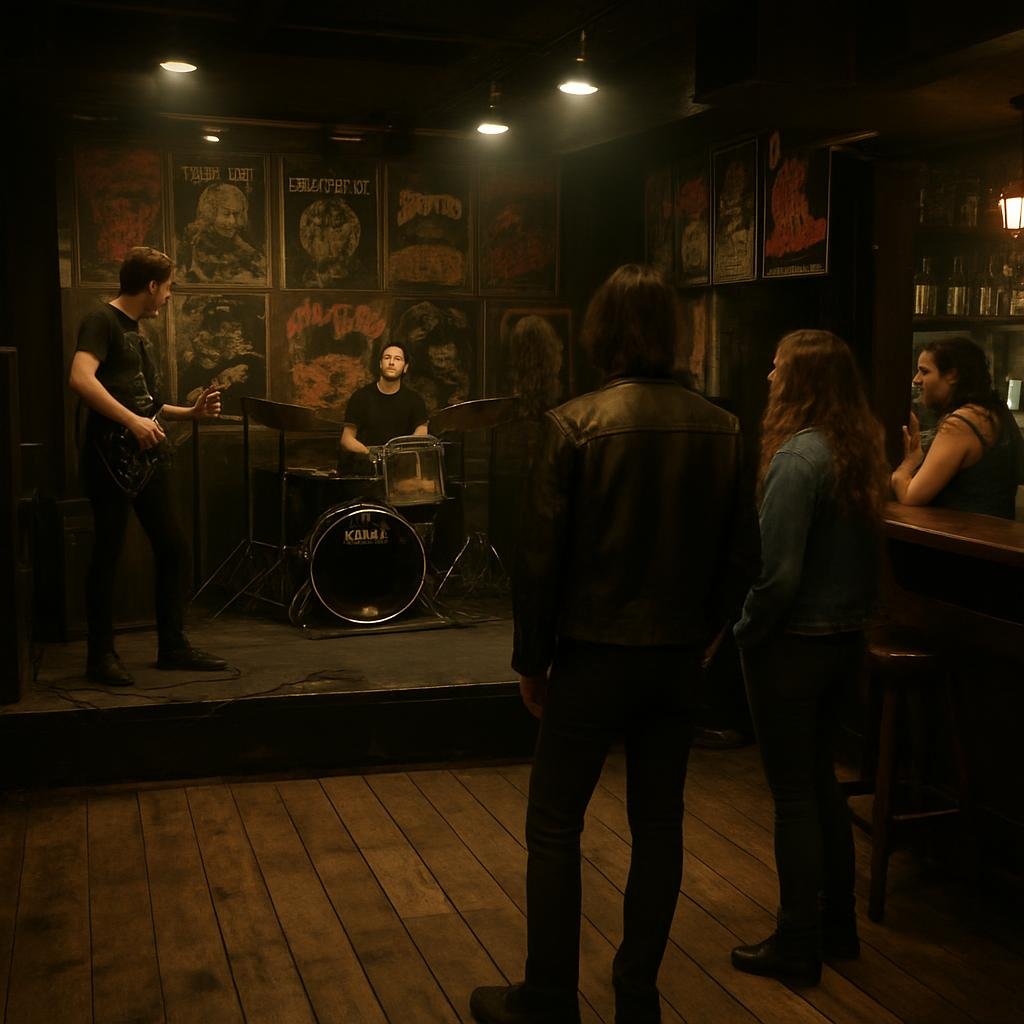
Black Sabbath were never just “from Birmingham”. They were from Aston – foundry-work, scrap-metal Aston – and you can hear it in the way “Iron Man” lumbers like factory machinery starting up. The riff in “War Pigs” sounds like it’s been hammered out on a lathe. Geezer Butler wrote lyrics about war, drugs and boredom because that’s what was going round the pubs in the late 60s. Without that industrial background, Sabbath become a cartoon. Put them back in a smoggy Midlands suburb and it all clicks.
Judas Priest, same deal. When I finally made it to Birmingham in my early twenties and walked up to the O2 Academy for a gig, the thing that struck me was how ordinary it all felt. No grand cathedral of metal. Just a busy road, cheap food, and people in hi-vis on a late shift. Listen again to “Breaking the Law” with that in mind. It’s not some American outlaw fantasy. It sounds like clocking off at the metalworks and realising your pay packet doesn’t stretch far enough, so you fantasise about kicking off instead.
The geography isn’t a backdrop; it’s the material. The “British heavy metal travel guide” is really a map of factories, council estates and seaside towns where kids needed something heavier than chart pop to drown out the sound of their parents arguing over money.
Let’s deal with Sheffield, because Def Leppard get talked about like they teleported straight into American stadiums fully formed. I first heard them on VH1 in about 2001: “Pour Some Sugar on Me”, Union Jack shorts, everything drenched in gloss. I wrote them off as dad music until a mate in Doncaster made me listen properly to High ‘n’ Dry.
That’s the album that still smells of steelworks. “Let It Go” and “Another Hit and Run” have that New Wave of British Heavy Metal bite – tighter and leaner than Sabbath, but still with the rough edges you associate with a band rehearsing in freezing factory units. If you know anything about Sheffield’s industry – cutlery, steel, forges glowing at night – you can almost hear it reflected back. Then they go to America, work with Mutt Lange, and by Hysteria they’ve become something else entirely: international, polished, built for US radio.
Here’s my arguable stance: Def Leppard are a better band if you stop at Pyromania. That’s not to say Hysteria isn’t impressive, but by then they’ve sanded off almost everything that tied them to Sheffield. On “Photograph” or “Rock! Rock! (Till You Drop)”, there’s still this sense that they’re metal kids trying to bust out of a city where the steel jobs are starting to go. By “Love Bites”, they’re basically a global pop act with distorted guitars. Great choruses, of course, but the industrial flavour’s gone.
When I finally went to Sheffield in my late twenties, the bit that got me wasn’t anything to do with Def Leppard at all. It was walking past the old Leadmill and realising that while Leppard were off conquering America, generations of local bands were still grafting in small rooms, carrying the heavy side of the city’s sound forward in different ways – more doom, more sludge, more noise. The steel’s still there, just less obviously on the surface.
Heavy metal and the seaside sounds daft until you’ve had a windy afternoon on the north-east coast with “Black Metal” by Venom in your headphones. I grew up with Whitley Bay and South Shields as family day-trip territory: arcades, chips, sand in your shoes. It took me years to connect that easy, shabby coastline with the fact that some of the ugliest, most extreme metal of the early 80s came from Tyneside.
Venom were from Newcastle, but the energy of those early records – Welcome to Hell and Black Metal – always makes me think of the shipyards downriver in Wallsend and Jarrow. My grandad built ships; the stories he told about late shifts, noise, metal plates slamming into place, and the drinking afterwards are not a million miles away from the chaos you hear in “Witching Hour”. This wasn’t genteel seaside life. It was hard physical work, six pints after, then turn up again at 6am.
Here’s a hill I’m willing to die on: Venom are more important to global metal than Iron Maiden. Not better, necessarily – I love The Number of the Beast as much as the next person – but more influential on what came after. Listen to early Bathory, early Slayer, or the first wave of Norwegian black metal, and you hear Venom’s mess, not Maiden’s precision. Venom’s 1982 single “Black Metal” didn’t chart; Maiden’s Killers was selling out sizeable venues by then. But go to any extreme metal festival and count how many bands cite Venom rather than Maiden as the root.
Part of that comes back to where they’re from. Maiden’s East London roots mattered, but by the time I saw them at the Newcastle Arena in 2003, they were basically a global heritage act. Venom, on the other hand, always felt like they were still playing the same DIY game as every band crammed into the upstairs room of Trillians rock bar. Tyneside metal, even now, has this scruffy bravado – you can hear it in bands like Venom Inc., you could hear it in Blitzkrieg, in Raven. It’s shipyard humour: louder, ruder, less bothered about technical perfection and more about the sheer racket.
If British heavy metal has a centre of gravity, it’s the stretch from Birmingham through the Black Country and into the old foundry towns. I was late to actually visiting – didn’t spend proper time there until my mid-thirties – but the sound had been in my ears since I was nicking my cousin’s CDs.
One thing the usual “British heavy metal travel guide” clichés get wrong is pretending every band’s story starts in some atmospheric rehearsal dungeon. A lot of it starts in utterly normal places: community halls, ugly pubs, estate garages. Dig into early interviews with Priest and you get tales of playing youth clubs in West Bromwich and Walsall, polishing “Victim of Changes” and “The Ripper” in rooms that also hosted knit-and-natter groups.
That’s why I roll my eyes when people talk about metal as pure escapism. Listen to the first two Priest albums – Rocka Rolla and Sad Wings of Destiny – and it sounds like they’re trying to break through a concrete ceiling. Rob Halford’s vocals on “Victim of Changes” don’t just soar; they scrape. The riffs are metallic in the most literal way, chugging and grinding like the machines their parents worked on.
What changed in the late 70s is that kids across these cities started copying that sound more self-consciously. That’s where the New Wave of British Heavy Metal hits: hundreds of small-town bands, many of them on Neat Records or Bronze, pressing singles and EPs that sounded like steel offcuts – sharp, cheap and occasionally dangerous. Saxon from Barnsley, Diamond Head from Stourbridge, Girlschool from London but constantly gigging the Midlands – all of them giving shape to a movement before anyone had the branding ready.
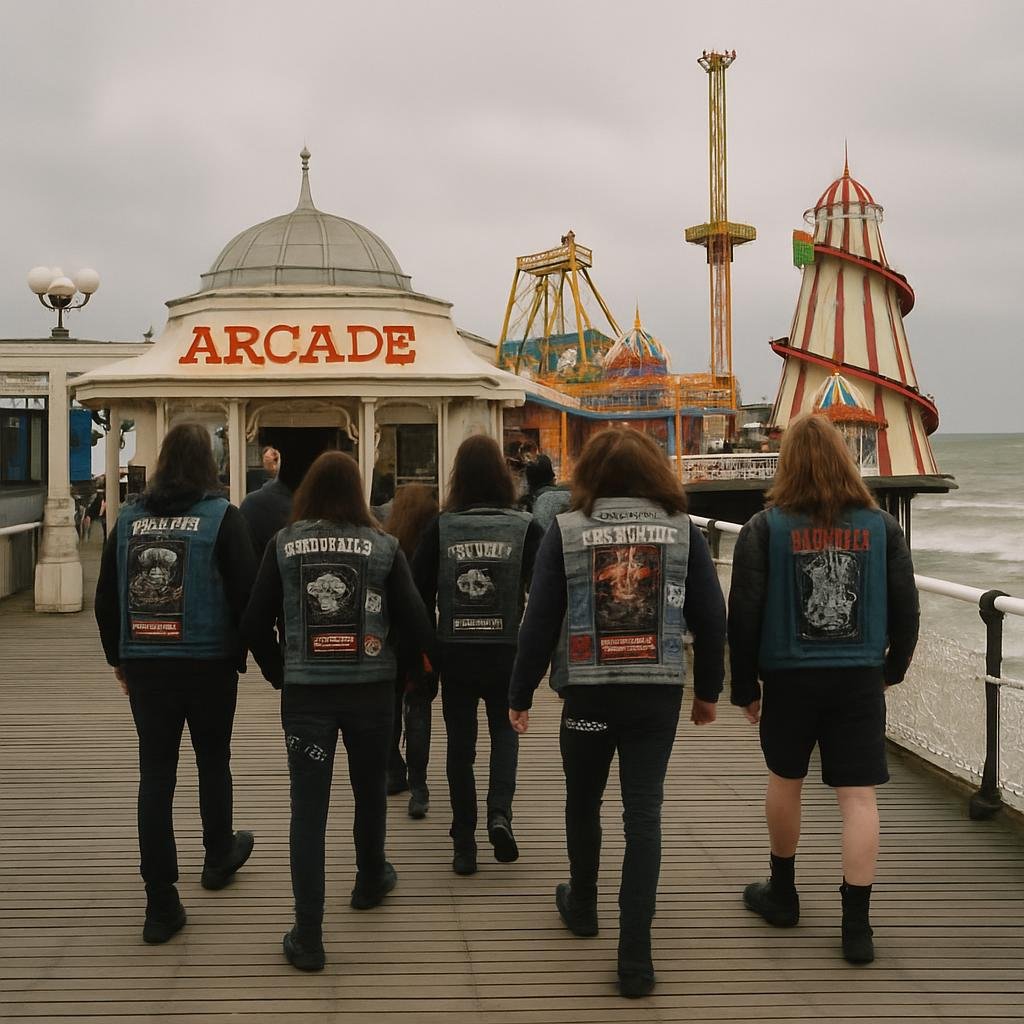
So what about those piers in the title, then? Here’s the thing nobody talks about enough: for a long stretch of the 70s and 80s, seaside venues were where a lot of heavy metal actually happened.
By the time I was going to gigs in the early 2000s, the circuits had shifted to academies, city-centre clubs and festivals. But half the stories I heard from older metalheads in pubs around Sunderland and Hartlepool involved places like Redcar’s Coatham Bowl (now demolished), Scarborough’s seafront entertainments, Blackpool’s Winter Gardens. Thin Lizzy playing Blackpool in ‘77. Motörhead rattling every glass in a seaside ballroom. Iron Maiden doing those unglamorous second-tier dates while still supporting bigger bands.
My favourite example: a bloke in a bar in Whitley Bay once told me, with absolute sincerity, that the loudest gig he ever saw wasn’t in some famous London venue; it was Judas Priest at the old Spanish City pleasure complex in the late 70s. Giant dome, dodgy acoustics, carnival lights outside, proper British seaside energy – and inside, Priest ripping into “Sinner” so hard the bingo regulars next door complained.
This is the bit of the British heavy metal travel guide that exists mostly in stories and bootlegs now. The piers and pavilions were cheap to hire outside holiday season. They had big rooms built for dance bands and end-of-the-pier shows, and promoters filled them with metal because metal fans would travel in the dead of winter for a night of noise and warm lager. Churches of leisure turned into accidental shrines to volume.
I should probably address the denim elephant in the room: Iron Maiden. Here’s my heresy, and I say this as someone who has seen them twice and owns Live After Death on vinyl: Maiden are slightly overrated as cultural spokespeople for British metal. Musically brilliant, yes. Their run from Killers through Seventh Son of a Seventh Son is absurd. But when people overseas think “British metal”, they often picture Eddie, Union Jacks and Bruce Dickinson in a redcoat outfit, and that flattens everything else into a cartoon of wartime nostalgia and galloping basslines.
Where’s the space in that image for Witchfinder General from Stourbridge, spending most of their time writing slightly daft but properly heavy doom efforts like “Burning a Sinner”? Where’s the respect for Angel Witch, who dropped one self-titled album in 1980 with songs like “Angel Witch” and “White Witch” that basically sketched the blueprint for European power metal, then promptly fell apart commercially? Or Cloven Hoof, Walsall lads in daft stage gear, quietly influencing loads of US bands who bought their 1984 debut on import?
Maiden sell out arenas. Great. But ask any serious metalhead who’s spent time crate-digging in UK second-hand shops, and they’ll tell you: the really interesting story is in the bands who released a single on some tiny Birmingham label in 1981 that went nowhere, only for someone in Sweden or Brazil to build an entire scene on that sound fifteen years later.
One thing I can’t ignore, given my background: metal scenes live and die by what you can eat and drink before and after a gig. It matters. In Newcastle, my standard pre-gig routine for anything heavy used to be: stottie sandwich or a Greggs cheese pasty, pint at The Dog & Parrot or The Bodega, then down to the City Hall or across to Trillians. I’m convinced part of why the north-east metal crowd has such stamina is that everyone’s on decent carbs before they hit the pit.
In Birmingham, the first time I went down for a Sabbath tribute night, we ended up in a Balti house off Ladypool Road at midnight, ears still ringing. Sitting there with a garlic naan the size of a 12-inch record, trying to talk about which version of “Symptom of the Universe” we preferred, I realised this was the other side of heavy metal’s heartlands: not just where the riffs come from, but where the people who love them refuel.
Same in coastal towns. I saw a sludgy doom band in Scarborough a few years back, tiny venue near the front, and you could tell half the crowd had come over from Hull or York for it. After, everyone poured into the nearest chippy. There’s something beautiful about watching a lad in a patched Kutte gently cradle a polystyrene tray of chips and gravy like it’s treasure. If you’re writing any sort of British heavy metal travel guide and you miss the food – the pasties, the dodgy kebabs, the pints in pubs that smell of decades of gigs – you’ve skipped half the culture.
I’m not saying you have to literally visit Bilston or Whitley Bay to “get” British heavy metal. Most of the venues that mattered in the 70s and 80s are gone or rebuilt anyway. But I do think the music makes more sense when you picture it properly rooted in its surroundings.
I’ve changed my mind on loads of bands as I’ve grown up and moved around the country. I used to think Motörhead were basically one joke pushed very loudly, until I heard “Overkill” walking back from a shift in a hotel kitchen in Leeds at 2am, hands still smelling of onions and bleach, and suddenly Lemmy’s whole speed-fuelled rage made sense as worker’s music. You clock off, you’re knackered, but the city’s still going, and you need something faster than your own thoughts.
So no, this isn’t a travel article. It’s more like a way to listen: each riff pinned to a dot on the map, each scream echoing off a particular kind of brick or sea wall. A British heavy metal travel guide that never asks you to book a train – just to hear the industry, the seaside rain, the chip fat, the cheap lager, and the late-shift exhaustion baked into the music.
Next time someone bangs on about metal being fantasy escapism, put on Sad Wings of Destiny, Welcome to Hell or High ‘n’ Dry, and think about the factories and piers that sat just outside those rehearsal rooms. Then tell me that’s not as real – and as British – as it gets.