
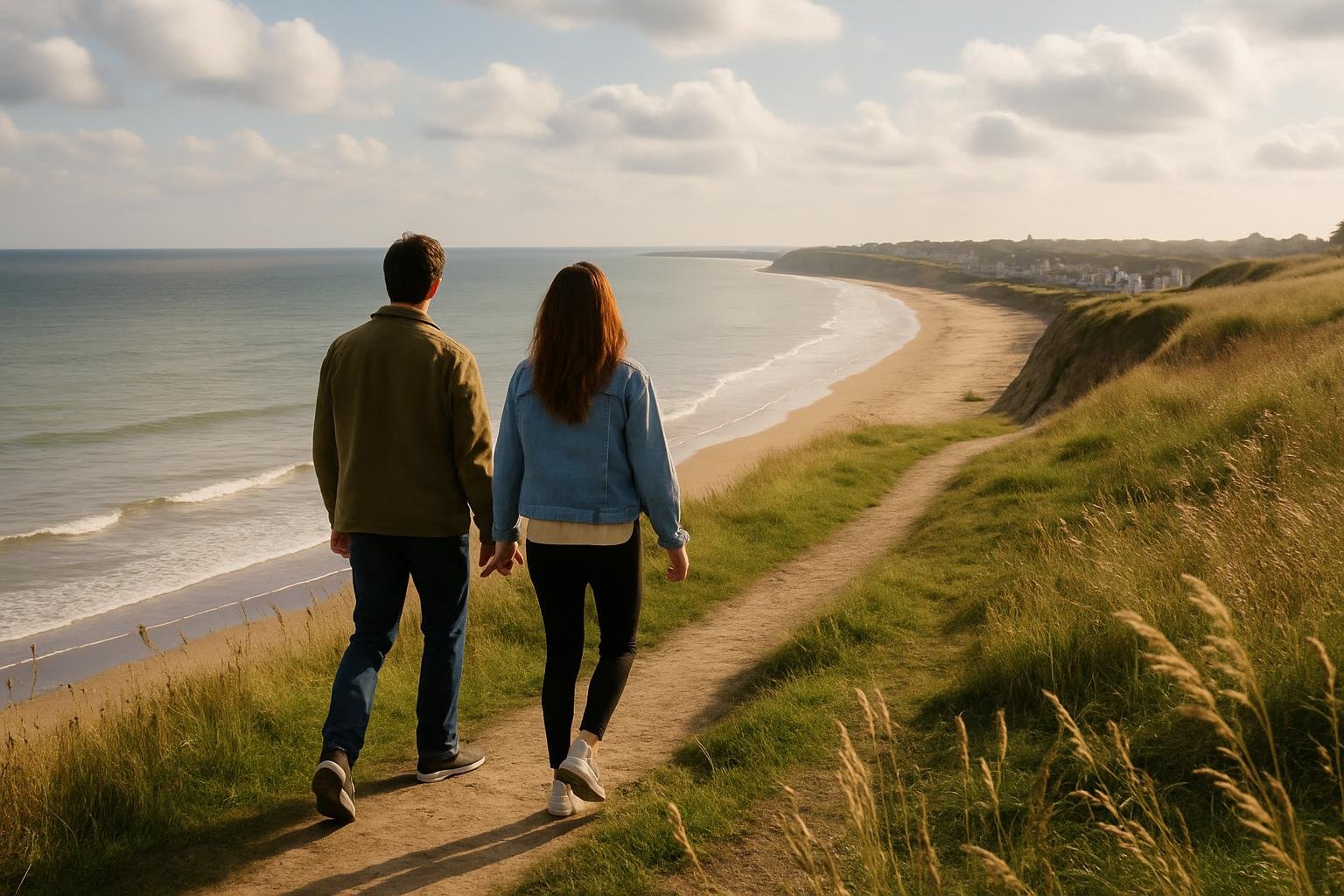
There are days when you want a full-on coastal hike, and days when you just want a bit of sea air, a clifftop view, and a café that understands the importance of proper tea. This is about the second kind: easy UK seaside walks you can do in half a day, where you can still be back in time for the six o’clock news and an argument about what to have for tea.
I’ve done all of these with varying degrees of organisation, fitness and footwear. None of them needs trekking poles, Lycra or a personality transplant into “outdoor person”. You just need a couple of decent hours, a light jacket and an appetite.
The north Norfolk coast looks flat on a map. Then you stand on Cromer Pier and realise the cliffs are quietly, steadily crumbling into the North Sea like a tray of overbaked flapjack. The beauty of the Cromer to Overstrand walk is that you get proper clifftop drama without technical faff – and crucially, a café at both ends.
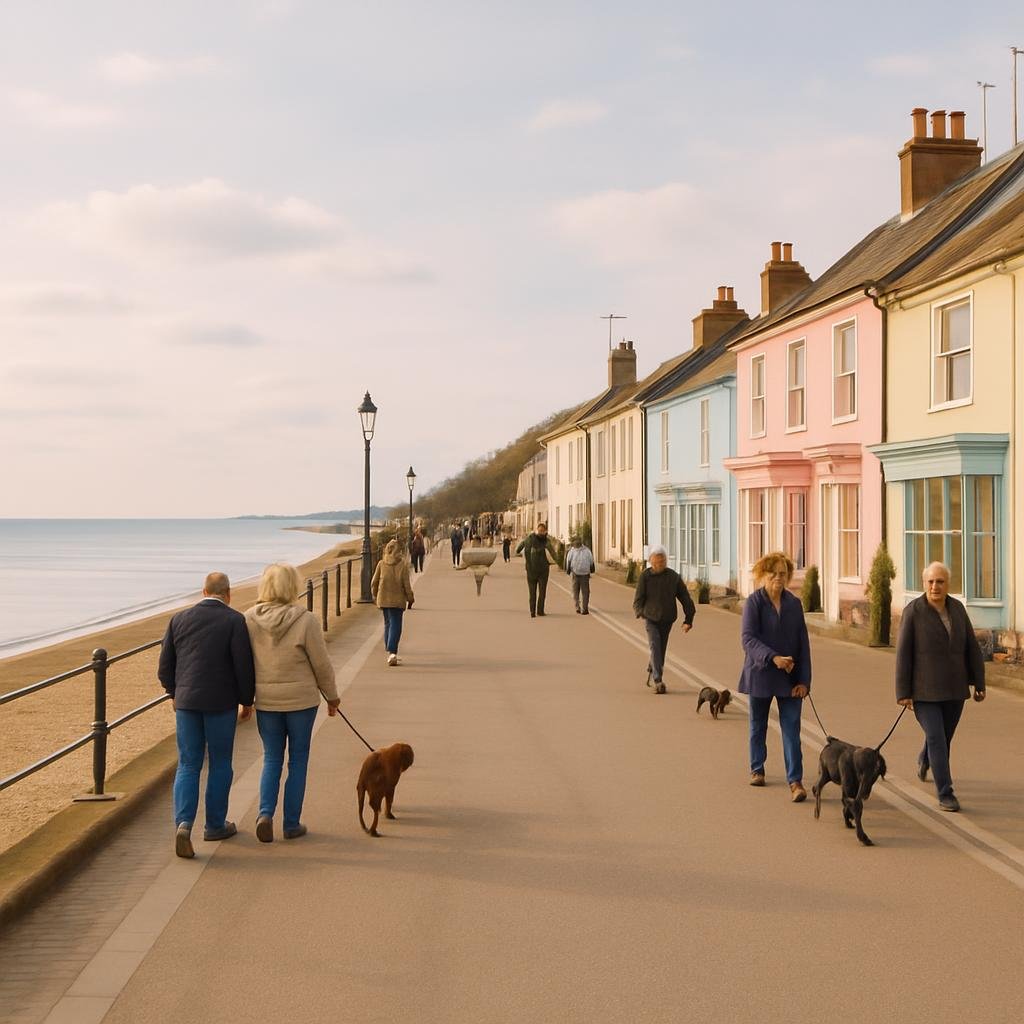
I usually start in Cromer because the parking is easier to find by accident. The pay-and-display at Runton Road (£2–£3 for a couple of hours last time I used it) sits above the town with a first good view of the pier and the red-brick huddle of hotels. From there, it’s a short wander downhill to the seafront and up again onto the clifftop path heading east.
The path itself is simple enough: a grass strip following the edge of the golf course, with the sea on your left and, if the wind’s in the wrong direction, the occasional golf ball whizzing past in a way that focuses the mind. There are a few fenced-off bits where the erosion has taken a bite, but nothing dramatic, and it’s mostly gentle undulations rather than anything that involves puffing.
About half an hour in, you start seeing the odd WW2 pillbox peering out of the cliffs. The first time I walked this route, a few years back, someone had decorated one with fairy lights and an old deckchair, which sounds ridiculous but sort of worked. Since then it’s gone back to plain concrete, though the graffiti keeps changing.
Overstrand creeps up on you – a row of seafront houses, a slipway, and then the path drops down towards the promenade. For me, this is where the café maths kicks in.
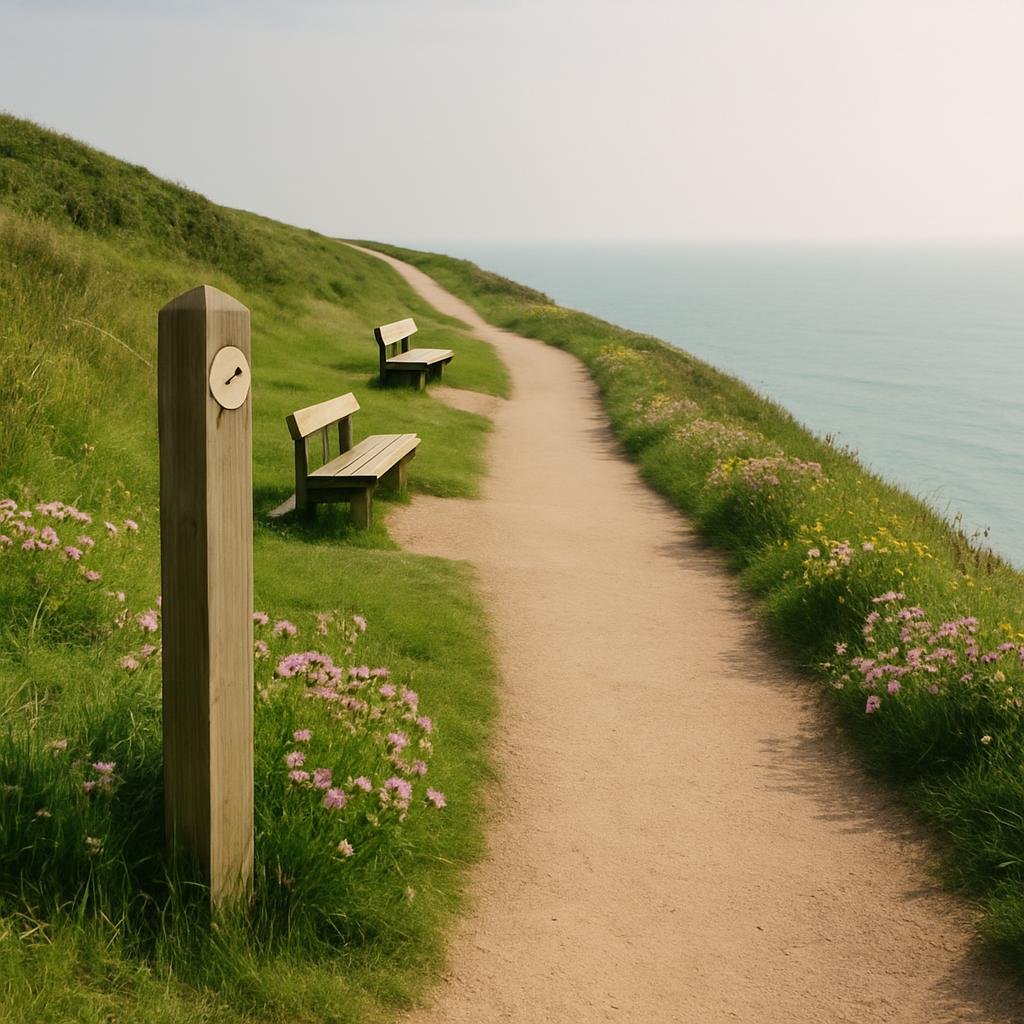
On the seafront you’ve got Sea Marge Café & Bar (confusingly signed around the back of the old Sea Marge Hotel) and the Cliff Top Café slightly uphill. I tend to default to the Cliff Top: the coffee is decent, the crab sandwiches come in doorstop slices, and there’s usually at least one muddy dog sulking under a table. The last time I was there, a chalkboard at the counter just said “We’re out of scones. We’re sad too”, which I appreciated.
You can either trudge back along the beach at low tide (check the board by the slipway for tide times) or rewind along the cliffs. I prefer the cliffs again: the view looks slightly different in reverse, and there’s something quietly satisfying about watching Cromer’s pier grow from a thin line into a proper structure as you walk.
Scarborough doesn’t really do subtle. You’ve got donkeys, ice cream, slot machines and kids high on candyfloss. But walk a little, and you get one of the easiest “big view” seaside walks in the country, wrapping round two bays with a ruined castle supervising the lot.
I start at the South Bay, near the harbourside where the smell is 50% seaweed, 50% vinegar. Parking on Foreshore Road is about £2.20 an hour; if that makes you flinch, there’s a cheaper long-stay by the Spa, but it adds a bit of a slog back at the end.
South Bay is all noise and neon. Once you’ve dodged the kids with luminous plastic buckets, keep the sea on your left and walk north along the seafront. You pass Harbour Bar, which still feels like it escaped from the 1950s – lemon sorbet, metal chairs, staff in proper uniforms. Their knickerbocker glory is overkill for a short walk, but I’ve never let that stop me.
At the far end of the South Bay, the promenade curves round beneath the cliffs. The castle is up to your right, hunched on its headland. You can cut up through the old town here (steep little lanes, some smelling faintly of fish and chips, some less pleasantly of bins) to the castle and then back down the other side. Or, if you’re set on an “easy UK seaside walks” themed day, stay on the lower level.
The path wraps round the headland in a broad sweep, the sea slapping at the rocks. In rough weather it can be dramatic – waves hitting the seawall in flourishes that make bystanders back off very politely and very quickly. There are warning signs and bollards; take them seriously unless you enjoy surprise seawater.
As the headland opens out, North Bay appears. This one’s calmer: fewer arcades, more families with windbreaks they clearly regret buying. Up at the far end is Open Air Theatre & Peasholm Park inland and, crucially for our purposes, the Watermark Café practically on the sand. They do a good line in bacon sandwiches and the sort of tea that comes in heavy white mugs. Inside can feel a bit of a crush, but there are usually seats on the terrace, even if you have to share your crumbs with opportunistic gulls.
You can loop back across town or just retrace your steps. The full there-and-back along both bays and round the headland is about 5km – leisurely in two hours, even with an ice cream stop and some half-hearted castle gawping from below.
This one is short, sweet and slightly sneaky. Llangrannog on the Ceredigion coast is where I first learned that Welsh seaside villages can be both tiny and absolutely packed, especially on a warm weekend. The beach car park fills by mid-morning. The trick, if you’re lazy like me, is to treat the walk as the main event and not get wound up about squeezing your car into a gap the size of a toaster.
The village has a pay-and-display just before you drop to the seafront – around £3–£4 for a few hours. From there it’s a downhill wander to the main beach, backed by two pubs and a couple of cafés. The Pentre Arms does solid pub food and has a terrace facing the sea, while the orange-fronted Beach Hut shifts a frankly dangerous number of cakes and ice creams. There’s also usually a distinct whiff of chips and wetsuits drying in the sun.
The walk itself starts at the far northern end of the beach. When the tide is suitably out, you can walk across the sand and pick up the coast path right at the back, but I’ve more often taken the little lane round the back of the houses and followed the coast path signs up the hill.
Here’s the thing: it’s steep for about five minutes. I once wheezed so ostentatiously at the top that a passing teenager asked me if I was “alright, mate”. That’s quite the moment in a man’s life. But then it levels, and suddenly you get that wide view of Cardigan Bay, with Ynys Lochtyn poking out to the north.
Just beyond the headland, a side-path drops down to Cilborth Beach, which is usually quieter than Llangrannog’s main strip. At low to mid-tide you can actually walk between the two beaches without using the path – there’s a sort of rocky arch and a gap that looks impassable at first, then opens out. It feels mildly smug to appear in Llangrannog that way, like you’ve solved a puzzle everyone else missed.
You can sit on Cilborth with a flask or head back to Llangrannog for coffee. I’m generally drawn back to the Beach Hut, partly for their Welsh cakes and partly because they once handled a smashed ice cream incident involving a small child with such calm efficiency that they probably deserved a medal.
Broadstairs has always felt slightly theatrical to me. The chalk cliffs, the tucked-away bays, the fact that Charles Dickens used to holiday here and complain about the weather. It’s perfect for easy UK seaside walks because you can pick your distance. My go-to is a simple clifftop loop between Viking Bay and Louisa Bay, with a bonus wander towards Kingsgate if the legs are feeling cooperative.
Start at Viking Bay – the horseshoe of sand right in front of the town. There’s usually a mix of families with windbreaks, hardy swimmers and someone being dragged along the promenade by an overexcited dog. Parking on the clifftop (Carlton Avenue and surrounding streets) is usually pay-and-display around £1.50–£2 an hour, but double-check the machines: Thanet parking rules have a personality all of their own.
The walk north from Viking Bay is simple: pick up the coastal path near The Crown pub and follow the edge of the clifftop. On your right: rows of short, slightly stubborn-looking houses. On your left: chalk cliffs and sea. You pass the lift down to Louisa Bay, which has a curious “retro seaside postcard” feel about it, and further on there’s a path down towards Stone Bay.
If you keep going for another 20–30 minutes you reach Joss Bay, popular with surfers and, occasionally, slightly baffled golfers from the course above. But even just looping between Viking Bay and Louisa Bay makes for a decent half-day leg-stretcher, especially if you drop down to the sands at one and return along the promenade at the other.
Back in the town, the café decision is annoyingly hard. Albion Street Café does a reliably good fry-up and coffee; Morelli’s on the seafront is pure old-school ice cream parlour – neon, brass railings, and sundaes in tall glasses. Before they refurbished it a while back it felt like stepping into another century; it’s shinier now but still endearingly over-the-top.
If you want a bit of low-key culture with your sea air, time your visit with the annual Broadstairs Folk Week in August. The clifftop paths get livelier – buskers, Morris dancers, the occasional group drinking cider with banjos at 11am – but the bays themselves still work for a gentle wander.
What ties these easy UK seaside walks together isn’t epic mileage. It’s the way they balance effort and reward. A couple of miles, a clifftop, a breeze that smells faintly of chips, and somewhere honest to sit afterwards with tea or beer or ice cream and slightly sandy ankles.
If you like a plan, you could treat them as anchors for short breaks – Cromer with fish and chips on the pier one weekend, Scarborough with the Two Bays stroll another, Ceredigion on a mild, grey day when you don’t fancy crowds but still want to hear waves. Or you can do what I usually do, and tack them on to whatever else has dragged you to that bit of coast in the first place: visiting friends, a work thing, a family obligation that needs a walk to clear the head afterwards.
There are longer, grander coastal routes all over the UK – you can walk the entire edge of some counties if you’ve got the time, knees and patience. But there’s something to be said for the half-day rambles: enough to feel like you went somewhere, not so much that you need three days to recover.
Just remember: wear shoes you can hose sand off, don’t trust gulls, and always factor in at least one unhurried café stop. That’s where half the pleasure lives.