
I went to Agincourt assuming I already knew the story. Like most people who grew up in England, I met it first through Shakespeare: muddy but glorious, Henry V giving his “we few, we happy few” speech while everyone cries and the French inconveniently fall over. An Agincourt battlefield visit sounded like a history fan’s box-tick. Go. Nod at the information boards. Picture Kenneth Branagh in the drizzle. Come home.
What I didn’t expect was how small it feels. Not emotionally – physically. When you stand on that field, the scale shrinks in a way that the school version never hints at. You can see, with your own eyes, how a badly organised French nobility could tangle itself to death in a strip of clay, and how a lot of the “miracle victory” story relies on ignoring the fact that ordinary men – mostly archers who’d been conscripted out of towns and villages – had been living with this sort of violence for years by the time they reached northern France in 1415.
Let’s start with the received version. You probably know the outline. In October 1415, after a grim march up from Harfleur, a hungry, sick and heavily outnumbered English army faced a glittering French force somewhere near the village of Azincourt (the French spelling) in Picardy. The French outnumbered the English, depending on which chronicler you trust, by two to four times. Then there was mud, arrows, French knights tripping over each other, heroic English yeomen, and a patriotic victory that English people still talk about six centuries later in pubs, parliament and football commentary.
Even the numbers have politics. The figures I grew up hearing – 6,000 English against 20,000 or more French – owe a lot to Tudor chroniclers who were very keen on God favouring plucky underdogs. Modern historians usually land on something like 6,000–9,000 English and Welsh troops against maybe 12,000 French, many of them mounted men-at-arms. Still a mismatch, but nowhere near the desperate “they were doomed” version that school worksheets like so much.
Walk the Agincourt field, and the maths feels different again. On my first Agincourt battlefield visit, standing by the modern road that cuts across part of the line, I realised how compressed it all is. The main space where the fighting happened is only a few hundred metres wide. Hemmed in by woods on either side in 1415 – the Bois d’Azincourt and the Bois de Tramecourt – the French had to pile in depth rather than width. You don’t need four to one odds to create chaos in a funnel like that. Two to one will do.
And then there’s the weather. The textbooks talk about “rain” in passing; the field talks about clay. Even on a polite spring afternoon you can feel the ground trying to pull your boots off. Add late October downpour, heavy armour and horses, and suddenly the French cavalry charge looks less like heroic chivalry and more like riding headlong into a bog in several stone of metal.
We like to pretend Agincourt is a story about kings and knights, partly because they left good records and partly because they had expensive funerals. But the killing – the face-to-face work – fell heavily on men we’d now file under “ordinary”, though there was nothing ordinary about their lives. English and Welsh archers, many of them peasants or small-town craftsmen, made up around four-fifths of Henry’s force. On a normal week at home, they might be brewing ale, mending shoes, driving pigs to market, or – in the case of one archer from Nottinghamshire whose service is recorded in the Issue Roll of the Exchequer – helping maintain local ditches and bridges when they weren’t required to train.
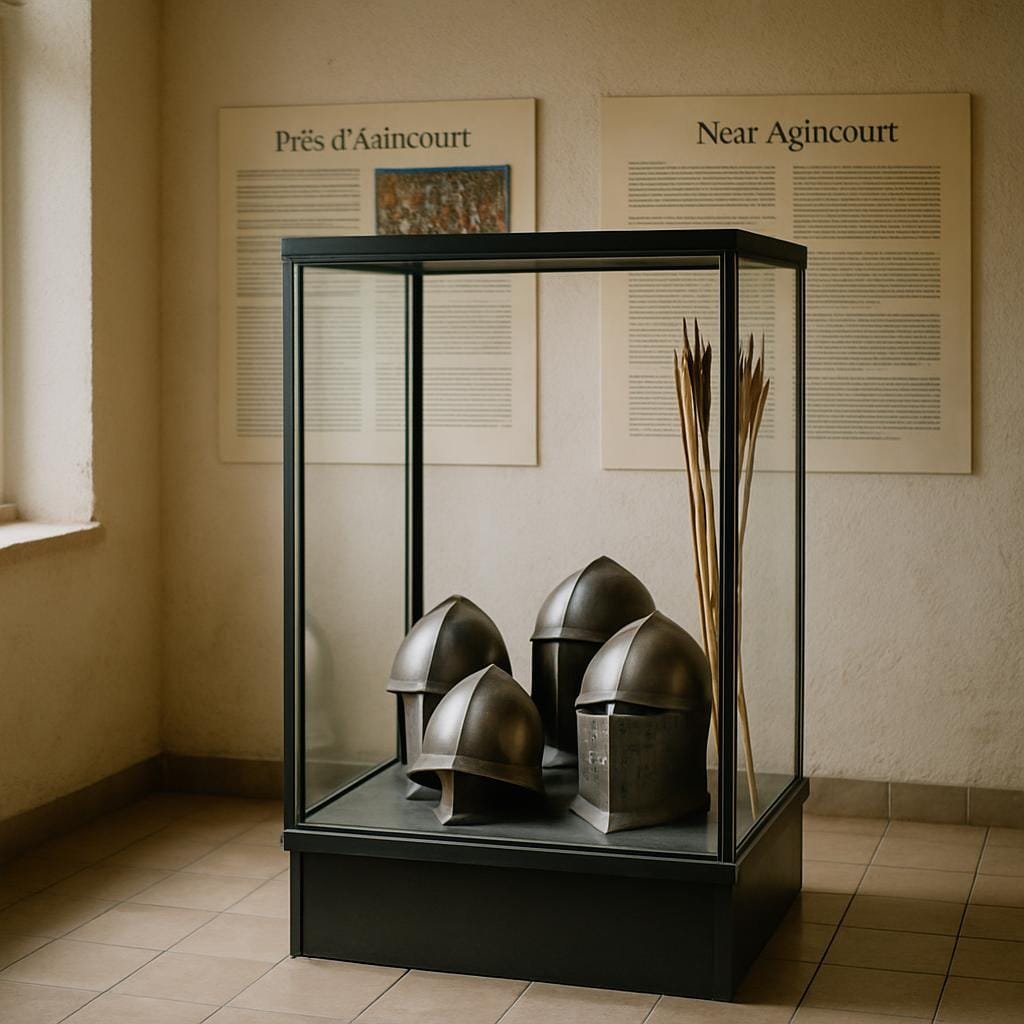
Those training requirements mattered. From the late 13th century, repeated royal orders pushed men to practise archery on Sundays and feast days, sometimes banning football or other games so they’d concentrate. Parish records and town ordinances talk about people being fined for skipping practice, or for turning up with the wrong sort of bow. It isn’t romantic; it’s admin. Behind that sudden wall of arrows at Agincourt are years of mildly grumpy Sundays where lads stood in fields instead of doing something more fun.
On the field itself, they weren’t just standing behind stakes politely shooting. One of the details that shifted my understanding came from reading Anne Curry’s work on the battle before going back for a second Agincourt battlefield visit. She points out that the archers advanced with the men-at-arms once the French line had stalled, pulling hammers, knives and mallets from their belts and finishing men on the ground. These are carpenters’ tools, farm tools, the sort of things you find in archaeological digs of medieval houses. The killing wasn’t some clean, long-range exercise in technological superiority; it was up-close work with whatever they already knew how to swing.
Imagine being a glover from Worcester, pressed into service, who’d left a wife and two children behind in a timber-framed house by the Severn. Your daily skill is shaping fingers out of leather; the same hands now go through purses and belts on a corpse-strewn field, because ransoms and loot might be the only way your family sees any money out of this campaign. These small, practical decisions sit underneath the big banners and shouted speeches.
I’ll admit it: for years I half-treated Henry V as Shakespeare’s character who happened to have been real. Then I read Christopher Allmand’s biography and realised just how professional – in the modern sense – Henry’s preparation for 1415 was. This wasn’t a gambler king who stumbled into a miracle. It was a man who spent months sorting contracts, supply chains and legal justifications, backed up by a chancellery that could drown you in parchment.
Before sailing from Southampton in August 1415, Henry had arranged thousands of indentures – written contracts with captains and noblemen agreeing the numbers and types of troops they’d bring, and how they’d be paid. Muster rolls from this period survive in The National Archives; you can see the names of ordinary archers and men-at-arms written out in sometimes scrawly Latin. A typical entry might record “John atte Watre, archer” from a particular county. He’s not a character in the official story, but he’s there on the page.
Yet the bit that stays with most people isn’t the paperwork. It’s the speech Shakespeare wrote 180 years later. The problem with that – and this is where the received version really starts to wobble – is that the focus on Henry’s charisma pushes everything else into the background: the disease that ravaged the army after Harfleur, the pillaging of French villages as they marched, the fact that the “small English force” is only small because thousands were already dead or too ill to fight.
Contemporary evidence talks about dysentery sweeping through the camp at Harfleur. Some men were shipped home sick; others stayed and got steadily weaker. If you imagine the English army as a tight, heroic brotherhood, you miss the reality that by the time they reached the Agincourt field, many of them had spent weeks with stomach cramps and dehydration, trudging through hostile territory on limited rations. There are royal orders for extra shoes and clothing; that only happens because men are literally walking out of their kit.
English memory has edited the French at Agincourt into either faceless losers or comic-book arrogance. When you actually stand at the French line on an Agincourt battlefield visit and look towards where the English were, it feels less like “ha, look at them charging” and more like a traffic jam you can’t get out of.
The French nobility arrived with the expectations of their class. Fighting on horseback, seeking personal glory, taking prisoners for ransom – all of that is embedded in decades of chivalric culture. The problem in 1415 is that you’ve got lots of powerful men with their own retinues trying to share a frontage that just isn’t wide enough.
Behind them, and under them when things went wrong, were their own foot soldiers: gens de trait (crossbowmen and archers), infantry, servants. Many of those servants were effectively camp followers whose jobs included keeping armour in repair, feeding horses, mending straps and saddles. One Burgundian source talks about armourers working through the night before battle, rebuckling straps and adjusting visors. None of them get into English schoolbook diagrams, yet they are the ones scraping dried mud out of greaves the morning after a march.
One of the grimmer details often left out of English retellings is how many French men-at-arms died effectively immobilised, crushed or suffocated in the press. Chroniclers describe “heaps” of bodies; it sounds melodramatic until you stand on that clay and try to imagine several thousand armoured men falling forwards, with more pressing from behind. An archer with a mallet and a half-decent pair of boots has the advantage, morally repulsive as the work is.
If there’s one bit of Agincourt almost entirely filtered out of our patriotic version, it’s what happened once the French first line had broken. With the battle apparently won and hundreds, possibly thousands, of French prisoners being gathered for ransom, Henry gave an order that shocked even some of his own men: he told the archers to start killing prisoners.
Chroniclers like the anonymous author of the Gesta Henrici Quinti and Jean de Wavrin record this with discomfort. The usual explanation – repeated by modern historians trying to make sense of it – is that fresh French forces were rumoured to be attacking the baggage train, and Henry feared that if the prisoners rose up, his tired army would be overwhelmed. Logically, it makes sense. Emotionally, it is slaughter.
This is where you remember that those French prisoners weren’t just halves of heraldic shields. They were husbands, fathers, landlords. Somewhere back in Normandy or Picardy, a woman who spent her days managing a household and its fields – supervising servants, organising autumn planting, making sure last year’s grain didn’t rot – was waiting to hear whether her husband had been taken for ransom or killed. The difference between the two was the difference between a financially ruinous few years and the end of the line for her children’s prospects.
For the English archers ordered to do the killing, it would have been ugly and frightening. There are accounts of some men refusing, leaving it to those less squeamish or more scared of displeasing the king. It punctures the nice clean arc from “outnumbered underdogs” to “noble victors”. The moment you really look at it, the story stops working as national myth and starts looking like what it is: a messy, panicked decision taken in fog-of-war conditions.
I didn’t get that the first time I went. My initial Agincourt battlefield visit was rushed – quick walk, a glance at the excellent Centre Azincourt 1415 displays, and a slight sense of box-ticking. It was only after reading more – Curry, Allmand, Juliet Barker – that going back made sense. Second time round, I went slower.
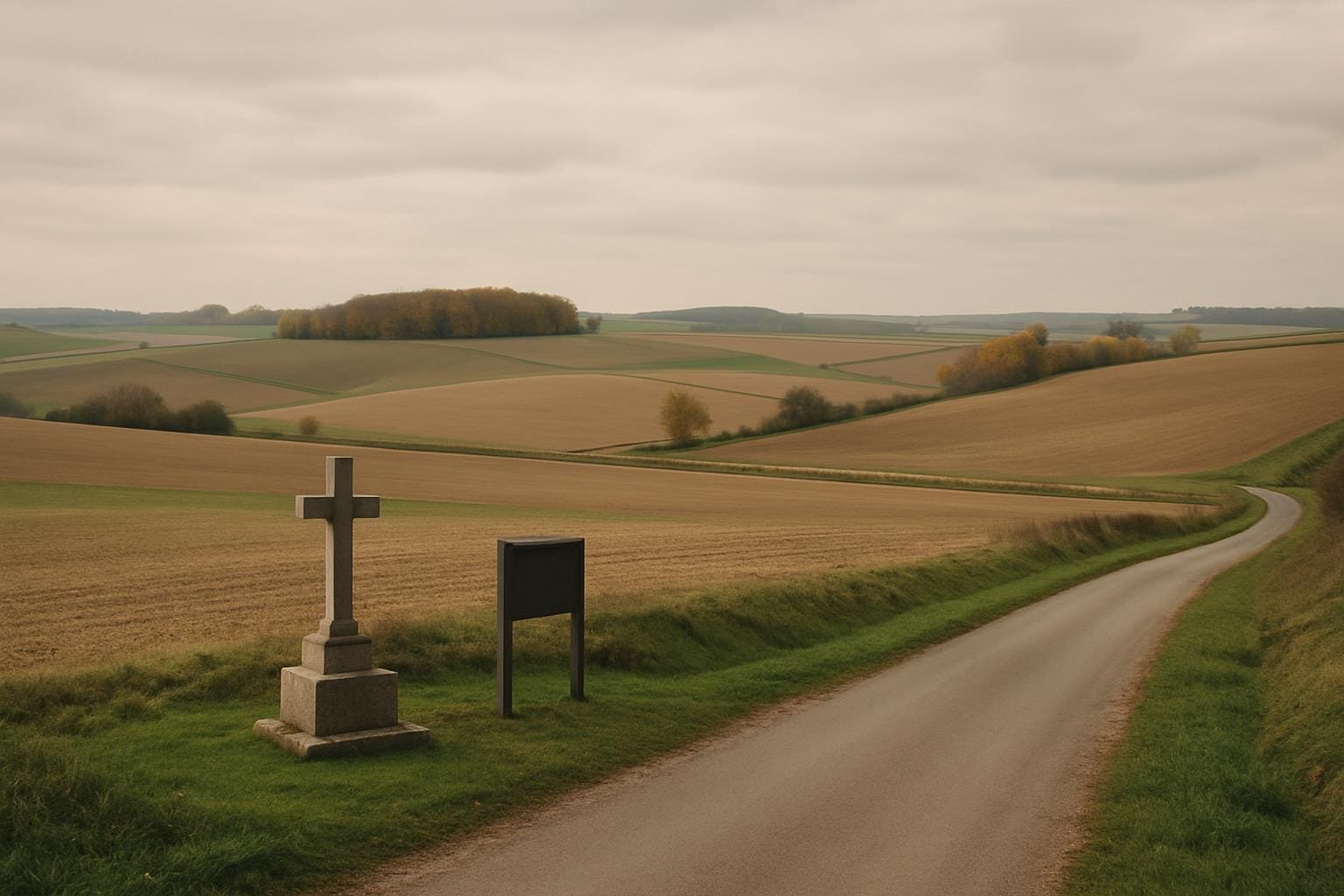
If you stand roughly where the English line was, near the modern cross and the small chapel, you can see the gentle slope down and then up again to the French side. It’s not dramatic. It’s exactly the sort of field you drive past on the A38 without noticing. Look long enough, though, and you start to see the battle as an argument with the land itself: who could use the narrowness, the mud, and the tree lines better.
Walk to the French start line and face back, and you realise something else: the English position, while good, wasn’t some impregnable fortress. If the French command had been coherent, if the weather had been different, if a few decisions had gone the other way, this story could easily be a short footnote in French histories and a brief “defeat” paragraph in ours. Standing there wipes away the sense of inevitability that textbooks like to give big battles.
There are almost no obvious physical remains from 1415 on the surface – no trenches, no craters. The field went back to farming; metal-detectorists have picked it over; nature did its usual work. Yet knowing that thousands of men spent hours killing and dying in that compact space changes how you look at any ploughed field. The next time you walk a footpath through clay after heavy rain, try picturing it full of armoured bodies, and the whole Agincourt legend snaps into brutally mundane focus.
We keep coming back to Agincourt partly because Shakespeare turned it into a set piece about leadership, and partly because it fits a certain English self-image: surrounded, plucky, winning anyway. The “small island, big punch” story has had a long life – you can hear echoes of it in how people talk about 1940, or sport, or pretty much any conversation that includes the phrase “they thought we were finished”.
The trouble is that our version of Agincourt only really works if you leave things out: the French allies at Harfleur, the executions of prisoners, the fact that most of Henry’s soldiers weren’t volunteers queueing up to fight for the flag, but men bound by contract, law, or hard economic necessity. It also helps to forget that the victory didn’t end the war. Thirty-eight years later, in 1453, the English garrison of Bordeaux surrendered and English rule in most of France collapsed. Agincourt was a spectacular chapter, not a conclusion.
Meanwhile, for the people who had to live with the consequences, Agincourt meant more taxes, more disruption, and more uncertainty. In Derbyshire, where I live, lay subsidies from the 1420s show local men taxed to support campaigns in France, even if they’d never see the place. A tanner in Chesterfield or a miller near Ashbourne might find themselves squeezed for extra shillings years after the battle, while royal agents argued that victory in France needed to be “maintained”.
And yet, there is something genuinely powerful in the way an Agincourt battlefield visit forces all that myth-making and forgetting into a single physical space. You stand there with centuries of English rhetoric in your head – from Shakespeare to Olivier to Branagh to that bloke in the pub after the Euros – and find yourself staring at quite an ordinary patch of countryside in northern France. The gap between the two is where the real history lives.
If there’s a lesson I took away, trudging back to the car past the hedges, it wasn’t about glory or destiny. It was that history happens in places that feel smaller than the stories we tell about them, and that every clean narrative – “we few, we happy few” – is built on the bodies and choices of people who never get their names into the speeches. Agincourt just happens to be one of the fields where that gap is still loud enough for England to be talking about it six hundred years on.