
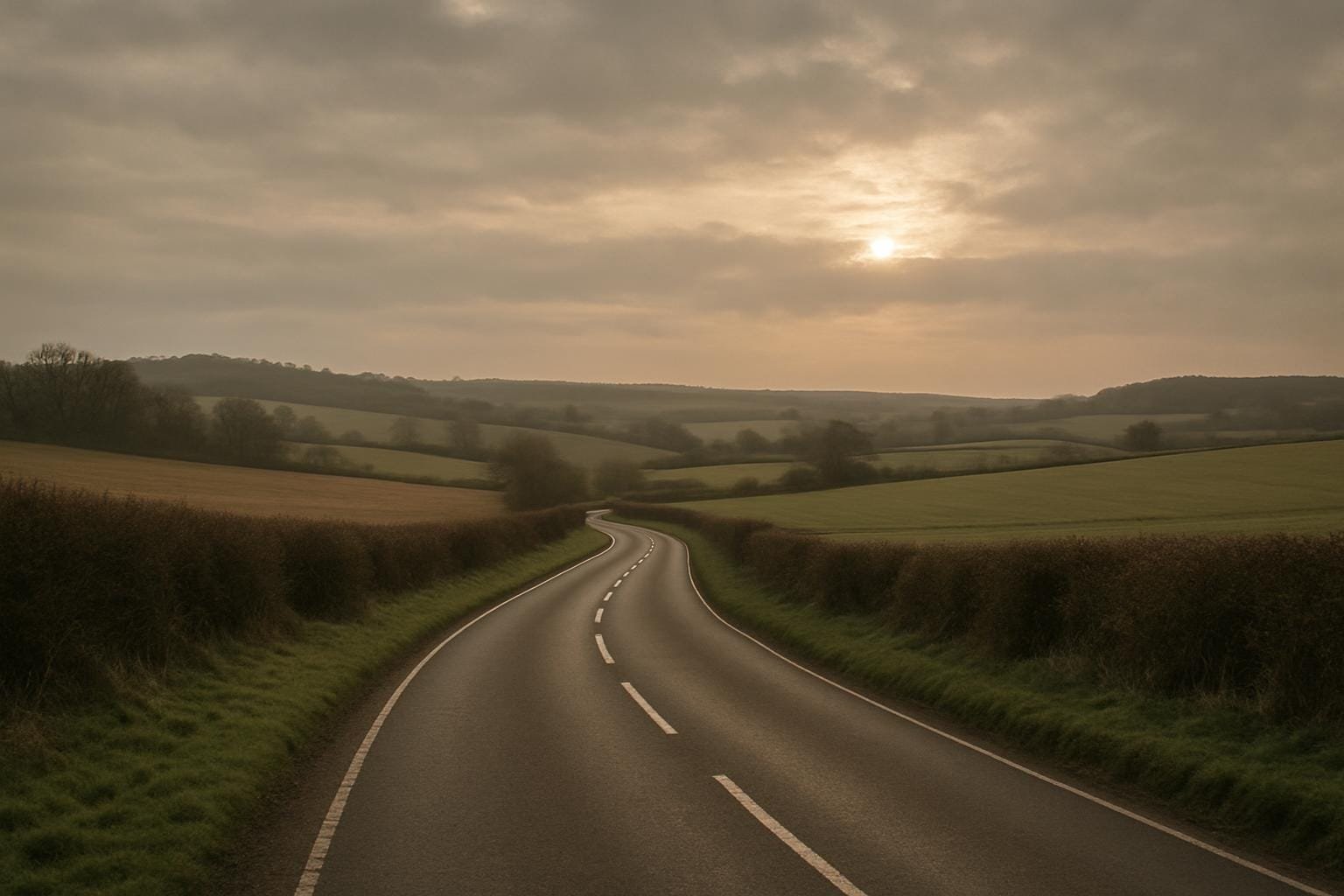
I’ve done the Radiohead England road trip without meaning to. Not a checklist with a car and a podcast, but over years of buses, trains and lifts with dodgy clutch control: Oxford to London, down to the coast, back up through service stations that feel more Kid A than kid-friendly. You start to notice how certain places cling to certain bands. The Stone Roses have the north-west motorway network. Manic Street Preachers have every half-collapsed terrace in south Wales. Radiohead, for me, live in that stretch from Oxford to the sea, under a permanent grey sky with a serviceable tea in a paper cup.
I was about fourteen when I first heard them properly. “Karma Police” on a taped copy of OK Computer that did the rounds in school like contraband. I’d grown up on my dad’s Roxy Music records and my mam’s Bowie obsession, and I was halfway through a regrettable nu-metal phase. Radiohead sounded… like a bad dream in a Travelodge. So English. So sulky. So familiar. When Thom sings about being “back to the…”, I could see the A19 in my head, sodium lights over flat fields, some lad doing 90 in a Vauxhall Cavalier. People like to talk about the band in quite grand, universal terms. I think they’re one of the most specifically English bands we’ve ever produced — and sometimes that helps them, sometimes it trips them up.
Let’s start in Oxford, because you have to. They formed at Abingdon School in the mid-80s, under the completely hopeless name On A Friday, rehearsing in the music rooms after lessons. Oxford in that period always gets painted as this bookish paradise — dreaming spires, Colin Dexter, Inspector Morse wandering about being grumpy. But musically, it had a proper chip on its shoulder. Too posh for the scruffier indie crowds, too studenty for the swagger spilling out of the north.
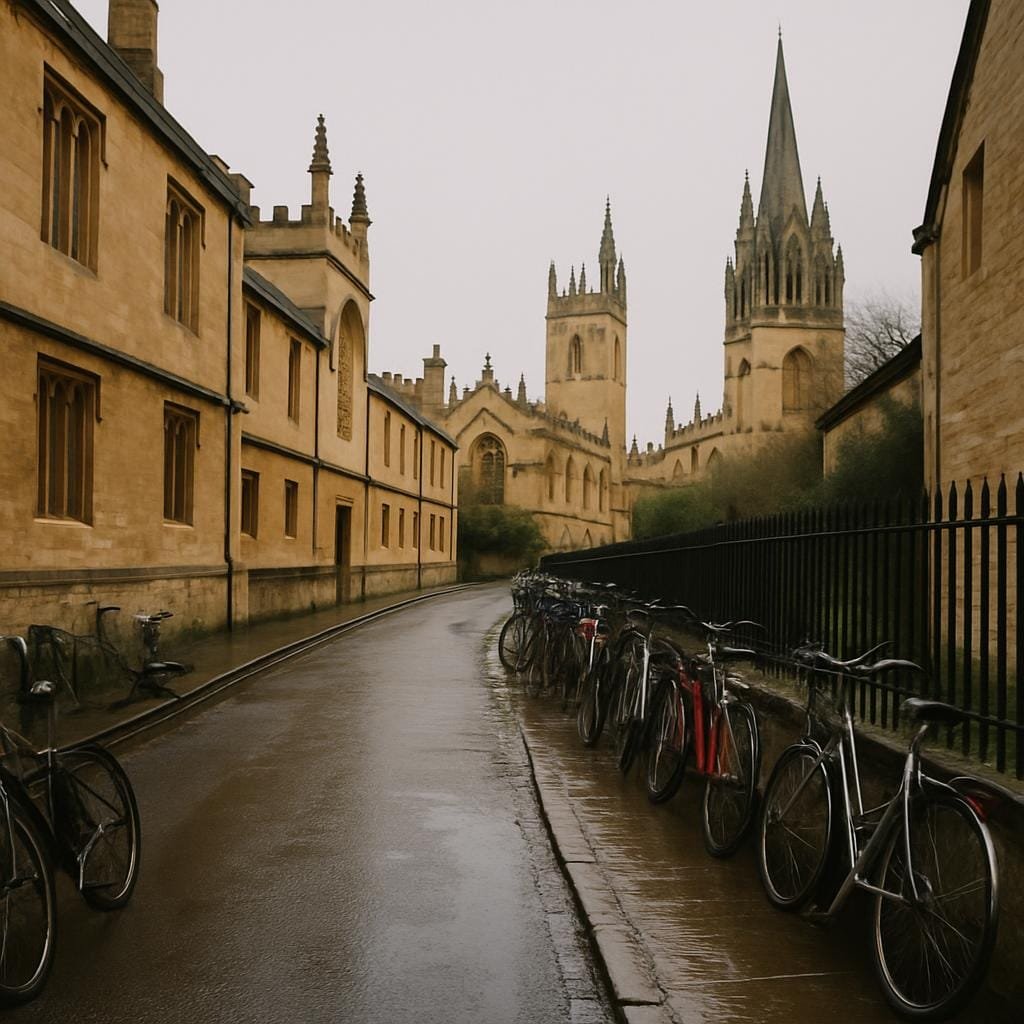
I finally went to Oxford in my early twenties on a cheap Megabus, because I wanted to see The Bullingdon and the old Zodiac where they’d cut their teeth. By then, the original Zodiac had gone and been turned into the more polished O2 Academy, as if someone had ironed out all the sticky-floor energy. I remember standing outside in the rain, thinking: this is very Radiohead. Neat, slightly miserable, historically clogged. The kind of place that would produce a band furious about being middle class, stuck between comfort and disgust.
You can really hear Oxford’s polite frustration on The Bends. “Fake Plastic Trees” isn’t LA alienation; it’s retail park dismay. It’s sitting on a bench outside a Homebase on the ring road with a paper cup of coffee going cold in your hands. People call that album their “straight rock” phase like that’s some kind of insult. I rate it above Kid A, and I’ll die on that hill. The songs are tighter, pissed off but still tuneful, and the England in it is painfully recognisable: Sunday-night dread, cheap fittings, everyone carrying secret disappointments they can only express in the car with the radio loud.
Radiohead’s England has always been linked to roads in my head. OK Computer, released in 1997, is the unofficial soundtrack of ring roads and bypasses. All those chopped-up radio voices, the aeroplane announcements, the talk of “motorways and tramlines” — it’s not science fiction, it’s the M40 on a wet Friday at 5pm.
I didn’t hear it in full until I was sixteen, when a mate of mine from college burned me a copy and wrote the tracklist on the disc in Tipp-Ex. I’d just started making the weekly train trek from Newcastle down to visit a boyfriend in Leeds. On the leg from York to Leeds, with the power lines flickering past and endless industrial sheds, “Paranoid Android” sounded like an exaggeration of something I already knew. It’s a song that jumps gears like a nervous driver: stop-start rhythms, random bursts of noise, then that eerie choir bit that could be piped into a closed-down Little Chef.
People always big up the album for predicting modern life, and yes, the eerie voice on “Fitter Happier” does feel like your phone lecturing you. But that’s the American reading of it — tech doom, surveillance, all that. From an English angle, it’s even more specific: it captures the feeling of being processed. By school, by work, by the NHS queue system, by the train ticket barriers. The England of OK Computer is full of forms and little humiliations, and you can imagine the whole thing happening between Oxford and London, broken up only by tepid service-station pasties.
Here’s my arguable bit: OK Computer isn’t their best album — it’s their most convenient one to worship. It flatters listeners into feeling clever. It’s difficult enough to impress your mates, but it still has big riffs and melodies you can hum waiting for the bus. That’s why every Radiohead England road trip playlist sticks it front and centre. Personally, when I want to feel what they really pulled off, I reach for In Rainbows and Kid A first. OK Computer is the one that got canonised because it fits the myth of late-90s Britain: New Labour optimism going curdled round the edges, corporate sheen over rotting infrastructure.
By the time Radiohead were pulling apart their sound for Kid A and Amnesiac, the band’s spiritual postcode had slid closer to London. You can feel that tension between the Oxford private-school past and the art-tech present in those records. They recorded big chunks of Kid A with laptops and modular synths in more anonymous spaces — some in Paris, some in Denmark — but the mental map is still England: CCTV, rain-slick pavements, 3am on a night bus with everyone silently hating each other.
My first time seeing them live was at South Park, Oxford, in 2001 — that huge homecoming show with Beck and Supergrass. The trains were a mess, so a mate drove us from Newcastle in a rattling Fiesta, which is where the first true Radiohead England road trip happened for me. We left at stupid o’clock, lived off garage sandwiches, and arrived half-dead. The gig itself was great, sure — that version of “The National Anthem” with a brass section was like a marching band having a panic attack — but what stayed with me was the walk back into Oxford afterwards.
Hundreds of us trudging through ordinary streets, past semi-detached houses with their curtains drawn, all having just screamed along to “Street Spirit” and “No Surprises”. It made their obsession with everyday English dread make sense. This wasn’t rock stars descending from another planet; this was five odd lads who’d soaked up the same bus stops, school corridors and chain pubs, then turned it into something slightly more disquieting.
London itself, when I finally moved there for a bit in my late twenties, had already claimed Radiohead as its own. You’d see their posters in Rough Trade East, hear “Weird Fishes” leak out of coffee shops in Hackney. I remember standing outside the Roundhouse in 2008 for one of the In Rainbows-era shows (I didn’t get in, touts were taking the piss) and thinking how different the crowd looked compared with that Oxford field. Less muddy, more art-school. That’s when their England starts stretching: from middle-class students in parkas to graphic designers in very clean trainers.
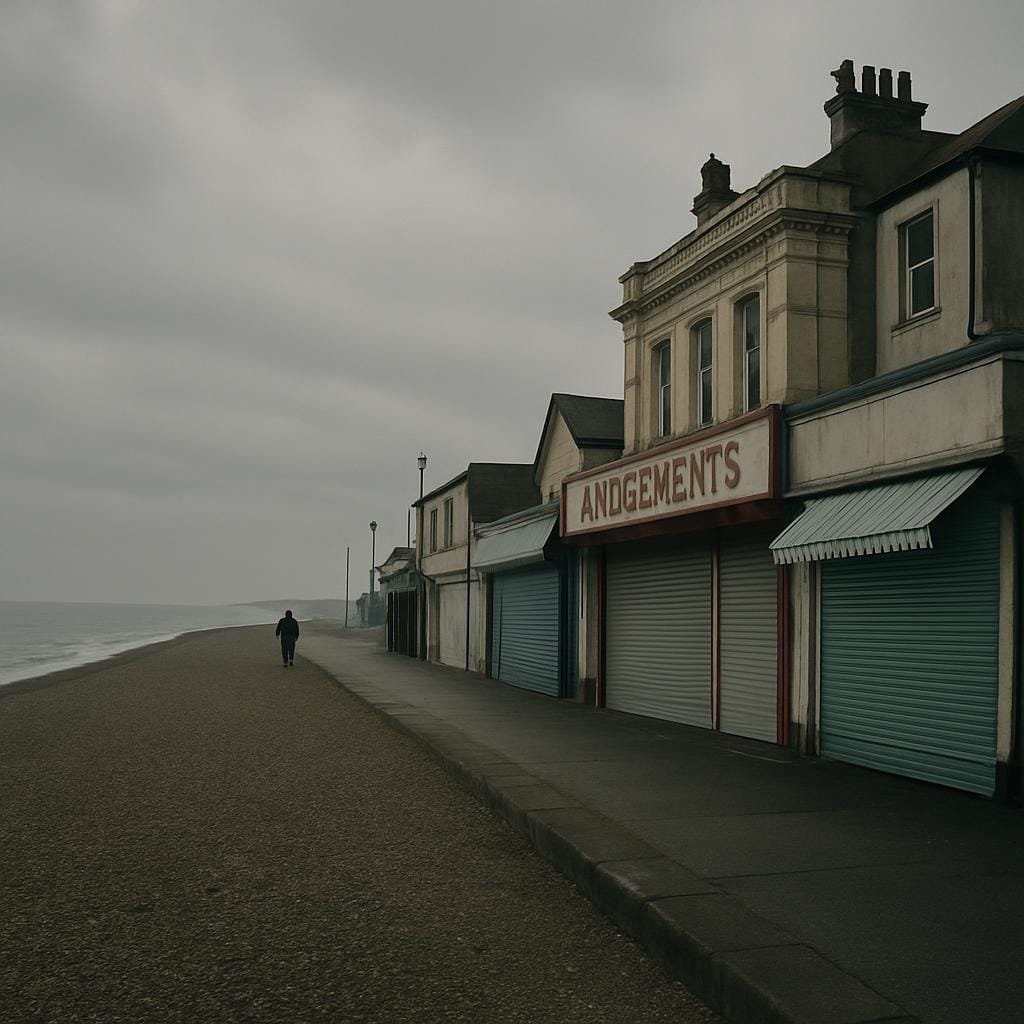
The shift from cities to coast lines up almost perfectly with my own ageing into Radiohead. I didn’t like Kid A at first — I thought it was clever-clever, all glitch and no heart. Then, around 2006, I spent a weekend in Brighton with friends, staying in a cheap B&B behind the station. I walked down to the seafront early one grey morning, headphones on, and “How to Disappear Completely” came up on shuffle, rolling over the sound of the waves and the arcade machines starting up. Suddenly it clicked. That song feels coastal: the sense that the land runs out and you’re left with too much sky.
Brighton and Hove have always had a pull for Radiohead types — art kids, people who hate Tories but secretly like posh cheese, everyone who wants to be near London but also near chip shops. It’s no surprise that by the In Rainbows era (2007), the band’s public image had drifted into something softer and slightly seaside-ish: colourful artwork, warmer guitar tones, songs that felt like sitting on a wall with a bag of chips as the wind slaps you in the face.
In Rainbows is the record that feels most like the coast to me. “Reckoner” is pure grey-water horizon stuff; “House of Cards” is drunken 2am on a pebbly beach; “Videotape” is walking home alone through residential streets with sodium-orange light flickering off wet tarmac. When they did those live-from-the-studio performances around that time — the ones you can still find on their official YouTube channel — they were looser, more human, less concerned with being important.
Here’s the thing: a lot of people adore Kid A and treat In Rainbows like a pleasant add-on. I think they’ve got it backwards. Kid A is bold in its ideas, absolutely, but it’s also quite cold. In Rainbows is where they figure out how to be strange and human at the same time, how to keep the electronics and the weird structures without losing the warmth. It’s coastal Englishness in musical form: melancholy, slightly drunk, full of small comforts. And it suits that Radiohead England road trip idea better than anything they’ll ever write about airport paranoia.
Because my life has always revolved around food and the places that serve it, I can’t separate Radiohead from what I’ve eaten on the way to and from them. Cold chips in a paper tray after the South Park gig. A service-station pasty outside Warwick, listening to “There There” on a Discman that kept skipping. A greasy spoon in Hove doing a heroic all-day breakfast while “Lotus Flower” played quietly on the café radio the week The King of Limbs came out.
People love to paint Radiohead as austere and medicinal, like you’re meant to consume them properly, in a dark room with good headphones, and think very big thoughts about late capitalism. I don’t buy that. For me, they’ve always been a band for the in-between places: lay-bys, train platforms, coastal car parks with half the lights blown. Their England isn’t the one you see on Sunday-night costume dramas; it’s the one where you’re hunched over lukewarm coffee, scrolling news, feeling simultaneously over-stimulated and bored.
And that’s why they’re comforting. Their misery isn’t exotic. It’s about stress headaches, small humiliations, background anxiety. Even when the lyrics wander off into more abstract territory — “Pyramid Song”, “Everything in Its Right Place” — the textures feel domestic. Electric hums, clanks, half-heard voices. The sonic equivalent of overhearing three different conversations in a Sainsbury’s café.
Now for the bit Radiohead fans hate: they get too much credit for things they didn’t really start, and not enough for what they did quietly very well.
Too much credit first. The pay-what-you-want release of In Rainbows in 2007 gets cited in every boring thinkpiece about the future of music. It was interesting, sure, but it didn’t save or doom anything. Bands on Warp and Domino had been messing with online distribution for years, pirate radio had been doing alternative economies since the 90s, and by 2007 half the country was already nicking everything off Limewire. The idea that Thom and co alone kicked open some door is tidy but wrong.
Not enough credit, though, for the way they stayed a genuinely good live band into middle age. A lot of their contemporaries either burn out, go full cabaret, or just fade. Radiohead tour sets from, say, 2012–2017 were fierce and surprisingly playful. When I saw them in Manchester in 2017, they swung from “My Iron Lung” to “Lotus Flower” to “Idioteque” without it feeling like a jukebox. There’s a graft there people don’t talk about enough because it doesn’t fit the tortured-genius myth.
A couple of years ago, before everything went sideways globally, I did a real Radiohead England road trip in one day: Oxford in the morning, Brighton by late afternoon, my knackered old Honda wheezing through the rain. I stuck on The Bends, OK Computer, In Rainbows in that order, like I was trying to grow up in fast forward.
Driving out of Oxford, past business parks and surprisingly beige suburbs, “High and Dry” made sense in a way it never had before. It’s not a heroic breakup song; it’s about being embarrassed, looking stupid at work or in the pub, thinking everyone is laughing at you. Very English concerns. By the time I hit the M25, the clipped voices and siren sounds of OK Computer felt less like prophecy and more like observation: this is what it’s like, stuck in metal boxes, trying not to scream.
And rolling down into Brighton as dusk came in and the first notes of “15 Step” bounced round the car, I realised that the coastline isn’t Radiohead’s escape hatch. It’s just another edge, another limit. You can see further, but the same old thoughts follow you. That’s the bitter little secret of their England: there’s no perfect place in it. Just better cups of tea, fresher fish, slightly nicer views to feel anxious in front of.
If you’re going to do your own Radiohead England road trip — physically or just in your headphones on the X12 between Newcastle and Middlesbrough — start with that in mind. Don’t treat the band like sacred art to be admired from a distance. They’re much more useful as company. For the train delays, the hangovers, the late-night walks back from the takeaway when the sea smells of chips and diesel and you can’t quite remember why you came out in the first place.
That’s Radiohead’s England for me: Oxford classrooms, London ring roads, windswept promenades, bad service-station sausage rolls, and the faint but persistent feeling that things could be better if we all just… did something. We never quite do. But at least the soundtrack’s decent.