
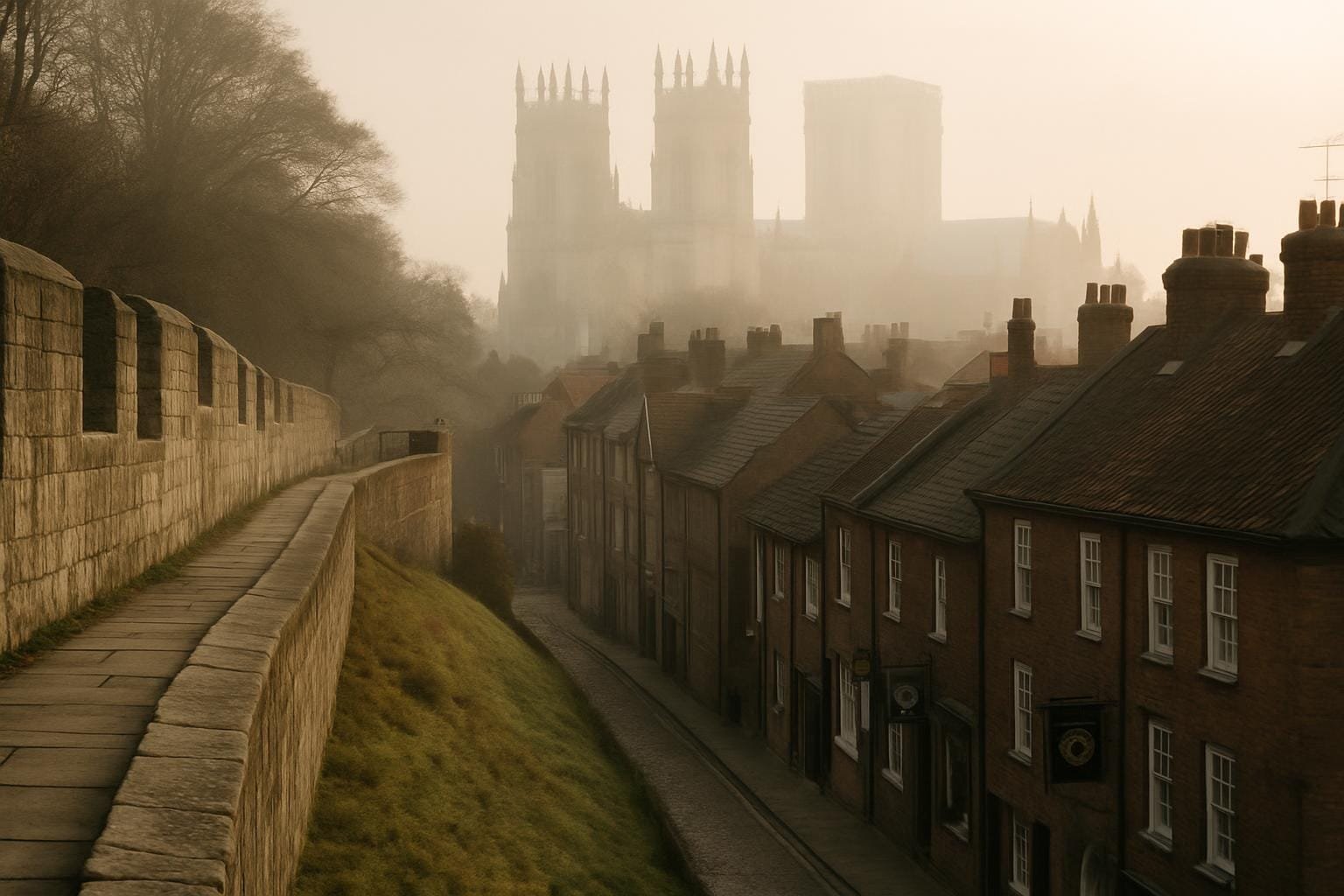
I first got hooked on Viking life in Britain standing on a very ordinary-looking street in York. I was at the JORVIK Viking Centre, doing the thing you’re meant to do there: sitting in a little time-car, gliding past animatronic people and a slightly overenthusiastic smell of fish. But the bit that stayed with me wasn’t the mannequins. It was looking down at the actual, sunken levels of tenth‑century York beneath the glass and realising: people once argued over muddy doorsteps on this exact spot. Children dropped bits of broken toy here. Someone lost a comb and swore about it. That’s Viking life in Britain – not a wave of helmeted raiders frozen in 793, but centuries of people working, marrying, bickering and dying in streets that are still busy now.
Like a lot of people, my first Vikings were the cartoon version: horned helmets, burning monasteries and lots of shouting. The school textbook story goes: 793, Lindisfarne; shock; horror; then a sort of long, dramatic slide towards the Norman Conquest. Raids, Alfred, more raids, King Cnut, then William rocks up and the Vikings vanish neatly into the background.
The trouble is, once you start walking around former Viking areas with that story in your head, it falls apart.
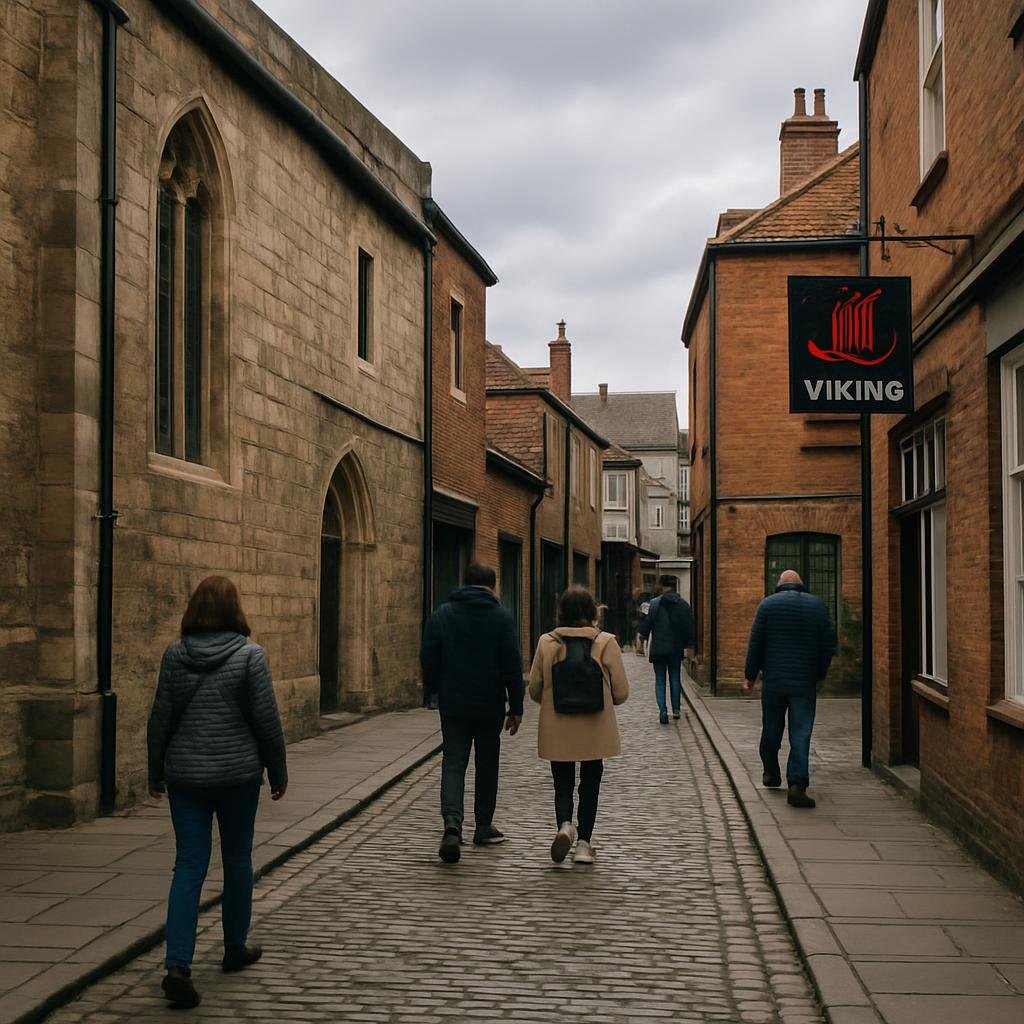
Take place names. Where I live in Derbyshire, the map is full of Old Norse if you know what you’re looking for. Any village ending in -by (Derby, Whitby, Grimsby), -thorp or -thorpe (Scunthorpe, Cleethorpes), or -toft (toft being a house plot) is carrying a memory of Scandinavian speech. That doesn’t happen from hit‑and‑run raids. That happens when people stay long enough for everyone to refer to the place in their tongue, and for it to stick for a thousand years.
Once you’ve noticed that, the “they came, they pillaged, they left” version of Viking life in Britain starts to look as thin as the plastic helmets in tourist shops.
The bit of the story that usually gets boiled down to a coloured blob on a map is the Danelaw. In class, I remember it as: King Alfred holds out in Wessex, signs some treaty, and the top half of England belongs to the Danes, the bottom to the English. Neat lines. Problem solved.
When I finally read the actual Treaty of Alfred and Guthrum years later, I realised how domestic a lot of it is. There are lines about where the boundary runs, yes, but also about how to handle murder fines and stolen slaves, and what happens if a man accuses another of harbouring his enemy. It reads like people who expect to go on sharing markets and river crossings and in‑laws, and want written rules so rows over cattle don’t turn into blood feuds.
For ordinary people inside that fuzzy band labelled “Danelaw”, Viking life in Britain meant:
The documents don’t give us the arguments over who owed milk to whom, but you can feel them between the lines. A line in a treaty about how a man who knows his enemy is living with another man must “tell him if he dares” only exists because someone had already kept quiet, and it had gone badly. That’s politics on the scale of neighbours who share a boundary ditch.
York – Jórvík – is usually presented as the great Viking city of the Danelaw. We get the kings (Halfdan, Guthrum, Erik Bloodaxe) and the dramatic bits: minted coins, church politics, rebellions. Those are true. But the most revealing things in York are small and grubby.
When archaeologists dug at Coppergate in the 1970s and 80s, they found layers and layers of rubbish preserved by the waterlogged soil: offcuts of leather, fish bones, plant seeds, parasite eggs. That means we can say quite specific things about Viking life in Britain in that city:
When you go to modern York, most people are there for the Minster or the pubs. But if you stand in the tight streets around Coppergate and imagine the smells – human waste, fish, woodsmoke – you get a feel for the daily reality. Raids didn’t fill these streets. Carts did. Women carrying buckets. Kids with worms in their guts, because the soil analysis shows those too.
The textbook version calls it a flourishing trading centre. True, but that’s an abstract way of saying “a place where hundreds of hands tanned skins, spun wool, brewed weak ale and tried not to get trampled by someone else’s pigs”.
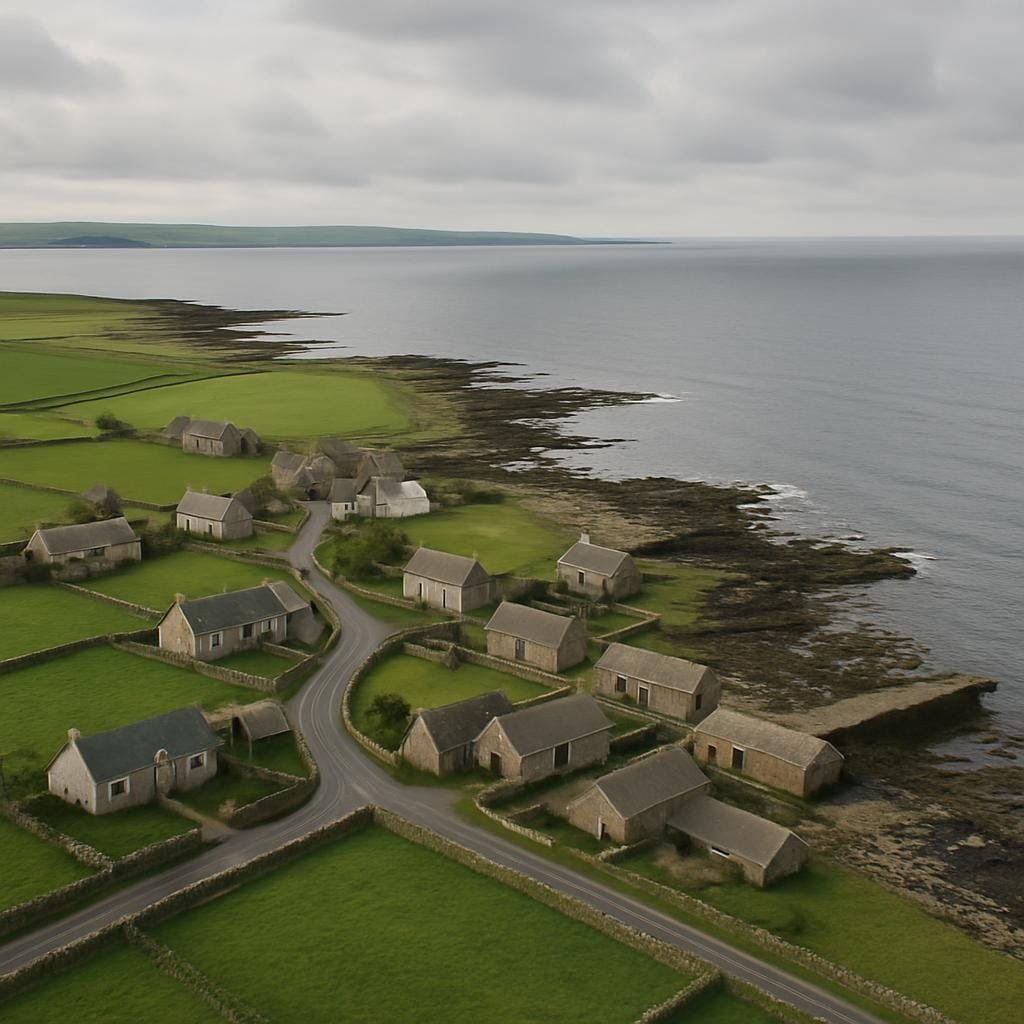
We tend to picture Vikings at sea, but most people with Scandinavian ancestry in Britain worked the land. Stand in somewhere like the Eden Valley in Cumbria, or the softer bits of North Yorkshire, and squint a bit; those enclosed pastures with a farmhouse and a couple of outbuildings work remarkably well as mental models for early medieval farms.
One of the ways we can glimpse farm life is through legal fines. Law codes from both the English and Scandinavian sides of the cultural line put careful prices on animals. Lose a cow? That’s a fine. Kill someone’s working horse? Bigger fine. You don’t bother to legislate for animals that hardly anyone owns.
So Viking life in Britain for a family on a small holding might mean something like:
I once stood by a drystone wall above Reeth in Swaledale with a friend whose family has farmed there for generations. We were trying to work out how far back the pattern of intake fields and outlying grazing might go. You can’t say those walls are “Viking” – they’re much later – but the idea of a cluster of farmsteads sharing grazing and arguing over where the sheep strayed feels very old. Old Norse vocabulary for upland grazing – fell, garth, beck – is still on every OS map in the north. Language tends to stick best where practice sticks too.
One of the tidiest myths is that Vikings arrived pagan and then, at some elegant turning point, adopted Christianity and everyone got along. The reality, judging by stone crosses in places like Kirkby Stephen or Gosforth, was much muddier.
The Gosforth Cross in Cumbria, carved in the tenth century, is a case in point. It’s an overtly Christian monument – a cross in a churchyard – yet the carvings include scenes from Norse myth: bound Loki, perhaps, and Ragnarok imagery. Stand underneath it (and you absolutely should if you’re nearby) and you’re looking at a community that saw no problem mixing stories about Christ with stories about Odin and the world‑ending wolf.
That has consequences at household level. Imagine being a child in that village. One day you’re taken to church where the priest, probably speaking poor English with a bit of Latin thrown in, talks about salvation. At home your grandmother still tells you stories about Thor’s hammer and giants in the mountains. You tie rags to a holy well “just in case”. Your diet hasn’t changed, your work hasn’t changed, but the invisible framework people talk about at funerals and in moments of fear is in flux.
This is one of those areas where the neat story (“The Vikings converted”) masks a generational muddle. You can see hints in burial practice too. In some cemeteries around York you get graves from the same period where some bodies are laid out in a Christian style, east‑west, while others seem to have grave goods in an older fashion. No council decree separated those. Families did. Probably after quite a few arguments.
The popular Viking image is extremely male. Longships, warbands, beard oil. The sources, though, keep leaving us domestic scraps that don’t fit that picture.
At Coppergate, the majority of textile tools – spindle whorls, loom weights – come from domestic plots. Someone spent hours every day spinning and weaving. On one of my visits, a curator at JORVIK said that if you tried to clothe even a small community in wool, the labour time is punishing. Wool doesn’t spin itself. Weaving a basic tunic might take weeks of spare time. That work fell overwhelmingly on women and girls.
There are other clues. In the so‑called Cuerdale Hoard from near Preston – a huge stash of silver buried around 905 – there are chopped‑up brooches and arm rings as well as coins. Some of those brooches are clearly women’s jewellery. The hoard is mostly thought of as a military or political deposit, but it quietly tells you that high‑status women’s ornaments formed part of the silver economy too. Someone, somewhere, handed over personal items when silver was required – voluntarily or not.
And then there’s law. In some Scandinavian laws, women can initiate divorce on certain grounds; later English texts hint that in the Danelaw there were customs giving widows relatively strong claims to property. It’s patchy, yes, but it suggests that Viking life in Britain for some women contained a slightly different mix of rights and expectations than in the West Saxon heartlands. How that felt in practice is hard to pull out of the scraps, but you can imagine the rumours running ahead of the reality. “Up there, a wife can leave if he beats her too much…” whispered in hall corners, mixed with disapproval and envy.
So far this might sound fairly cosy: farms, cats, cross‑carving. It wasn’t. Violence was always close. You can’t talk about Viking life in Britain and pretend the raiding went away once treaties were signed.
Certain monasteries were hit again and again. Lindisfarne, famously in 793, but also Iona and Jarrow. When you read Alcuin’s horrified letter about Lindisfarne – “the church of St Cuthbert spattered with the blood of the priests of God” – it’s tempting to file it as rhetoric. Then you stand in a small, isolated church like Escomb in County Durham, with its seventh‑century stonework, and remember that for the people who worshipped there, the idea of armed men coming from the sea to burn and kill wasn’t a story. It was a realistic fear every time rumours of ships on the coast filtered inland.
What’s less often said is that those fears went in both directions. For a Norse‑speaking farmer’s family near the old frontier line, the thought of a royal campaign from the south rolling through your area – burning, hanging rebels, taking hostages – was just as real. The Anglo‑Saxon Chronicle has a blunt line for 942: King Edmund “harried all Northumbria”. Harries is a tidy word for households broken up, barns torched, people fleeing with whatever they could carry.
The version of the Viking Age where violence only runs from “Vikings” to “English” is convenient for national stories. It doesn’t describe how fear works when you’re an actual human, trying to decide whether to leave the late hay to rot because you’ve heard there’s fighting two valleys over.
The nice chronological endpoint is 1066. Harald Hardrada defeated at Stamford Bridge; William the Conqueror wins at Hastings; cue Normans. I used to take that as the clean break: Viking Age ends, new chapter begins. Then I started noticing how much thirteenth‑century life in northern towns still carried old Norse fingerprints.
In parts of Yorkshire and Lincolnshire, medieval documents refer to town officers with Norse‑derived titles like lawman. The Bede’s World project at Jarrow (now part of Jarrow Hall) has done work showing continuity of certain farming patterns. Even local surnames – Jackson, Thompson, names in -son – echo Norse patronymic forms. The people bearing those names in, say, 1300 were not “Vikings” in any meaningful way. They were English Christians worrying about wool prices and the odd baronial feud. But traces of the earlier mixing sat quietly in their names, their field systems, their speech.
When you walk through a place like Grimsby or Whitby now, with their trawlers and chip shops, the Viking story isn’t screaming at you from every street. It’s mostly in the stuff people don’t think about. The fact that everyone calls the stream a “beck” without thinking that the word came with people in longships. The way farm names up the hill record a thwaite – a clearing in the woods – long after the original forest went into someone’s fire.
History taught in blocks – Romans, Vikings, Normans – encourages you to think in cut‑off ages. Once you start paying attention to what stayed on the ground, Viking life in Britain stretches much further forward. A medieval kid in York called Gamel or Thorkell, both very normal names in 1100, was living proof that cultural change is rarely a clean sweep.
Most of us won’t read runestones or pore over charter boundaries for fun. What we can do, quite easily, is notice where Viking Britain still nudges our lives.
If you’re in York, walk a slightly different route. Duck into Coppergate and think about the shoes. If you’re in Cumbria or North Yorkshire, read a map aloud and listen for the Norse: fell, force (waterfall), gill, thwaite. That’s Viking life in Britain carried in the mouths of people who never think of themselves as having anything to do with Vikings.
And when you hear someone trot out the line about “the Vikings came to raid our monasteries”, feel free to be slightly annoyed on behalf of the people whose lives don’t fit so neatly into a single sentence. The leatherworker in York with backache and a shop rent to pay. The farmer’s wife near Gainsborough, tying her headscarf against the wind and calculating if they can afford another cow. The child in Gosforth, listening to the priest in the morning and grandma’s stories at night, trying to make sense of two different stories of the universe.
History is less like a sequence of invasions and more like layers of rubbish and shoe leather piling up on the same patch of ground. In that sense, Viking life in Britain never entirely went away. It’s baked into the place names on our satnavs and the way we pronounce “Derby”. Once you start hearing it, you can’t quite stop.