
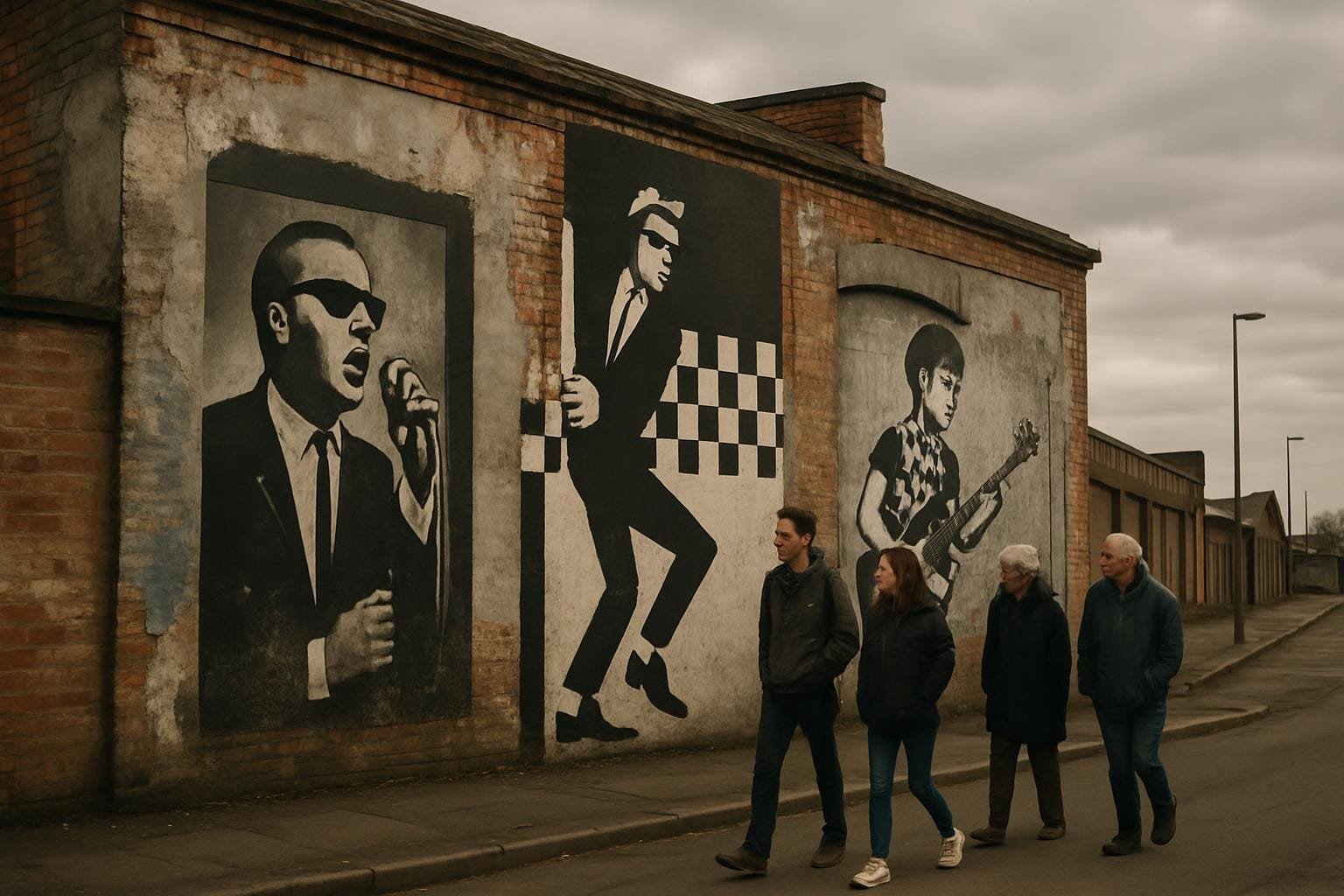
I’ve lost count of how many friends have asked me for a Two-Tone ska travel guide over the years, as if you can just follow a map and tick off a movement. You can’t. But you can trace the lines between Coventry and London, the bus routes and train lines, the youth club halls and pubs, and hear how that rattling, nervous, funny, furious noise we call the ska revival came together. I grew up in Newcastle, miles from all this, but it still shaped what I thought Britain sounded like.
I was about fourteen when I first heard The Specials. It was a taped copy of The Singles Collection that I’d picked up from a charity shop on Clayton Street sometime in the late 90s. The case was cracked, the inlay was a photocopy, and someone had written “Kev’s – DO NOT PINCH” on the spine in blue biro. Side A started with “Gangsters”, and that was it – three minutes of jumpy guitar, tight drums and that spooky, almost mocking keyboard line. It sounded like the air in the room had been changed.
I knew vaguely that they were a “Coventry band” and that they’d done “Ghost Town”, because every lazy TV clip about the 80s uses that bus shot from the video. What I didn’t get at fourteen was how much of that music is basically a Midlands and London argument pressed onto seven-inch vinyl. You can’t do a proper Two-Tone ska travel guide without talking about the way those two places keep tugging at each other across the records.
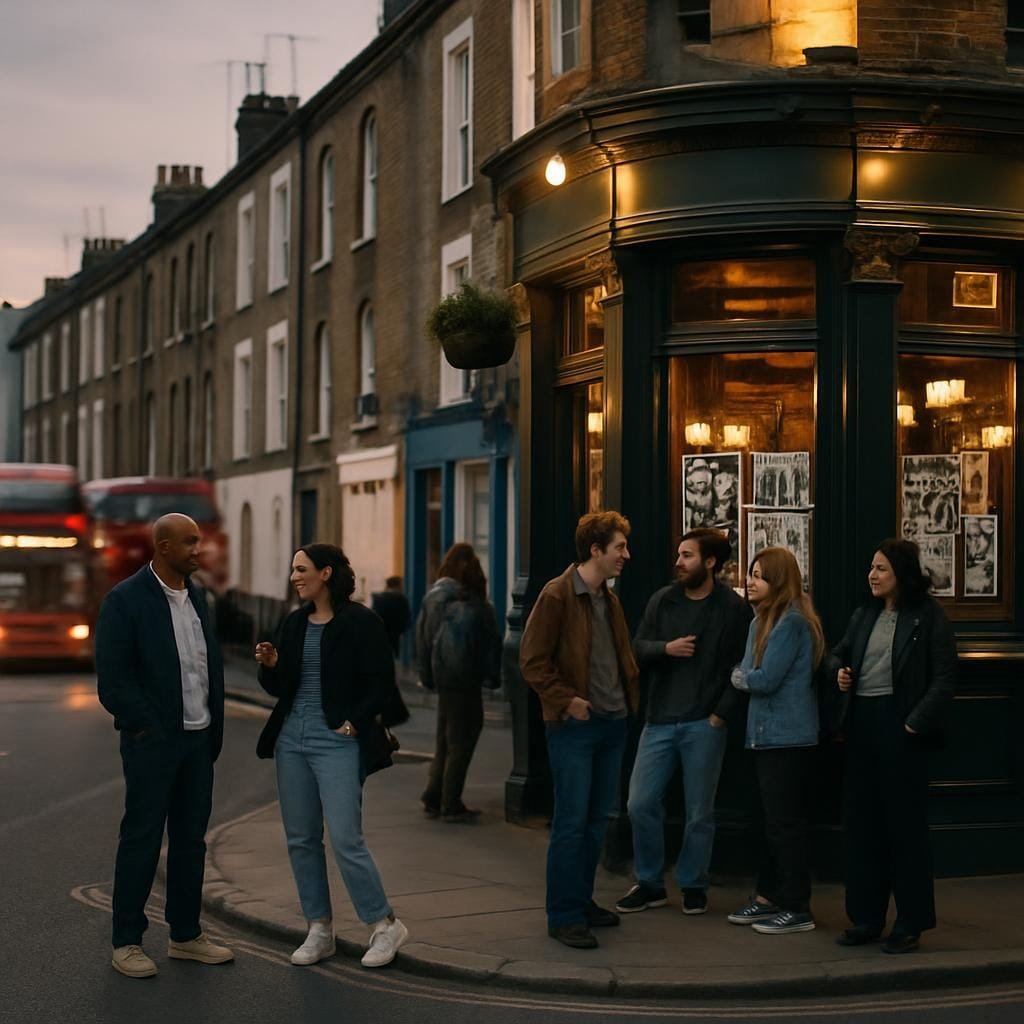
Let’s get the controversial bit out early: I think Coventry kept Two-Tone honest, and London made it a bit too pleased with itself. London gave it sharper suits, better distribution and some brilliant press shots; Coventry gave it the paranoia and the sarcasm.
Listen to the first Specials LP from 1979 back to back with Madness’s One Step Beyond… from the same year. Recorded in London, yes, but rooted in Camden and Kentish Town, that North London pub humour. “Night Boat to Cairo” is theatrical, camp and huge fun. Whereas “Concrete Jungle” from the Specials album feels like it’s recorded in a room with the curtains half-closed on a wet Sunday in the Midlands, someone’s uncle pacing about, chain-smoking and moaning about skinheads on the estate.
Coventry in the late 70s wasn’t glamorous – still isn’t. By the time I first went down there in the mid-2000s, it was ring roads, flyovers, and that cathedral shadow over everything. I remember sitting in a café near Pool Meadow bus station with a bacon sarnie and a mug of tea, thinking: of course this place produced a song like “Ghost Town”. That eerie, hollow sound on the 1981 single suddenly felt less abstract and more like a very accurate weather report.
London’s ska revival scene, especially around Camden, always felt like a night out. Coventry felt like what happens when the night out goes sideways and you have to walk home.
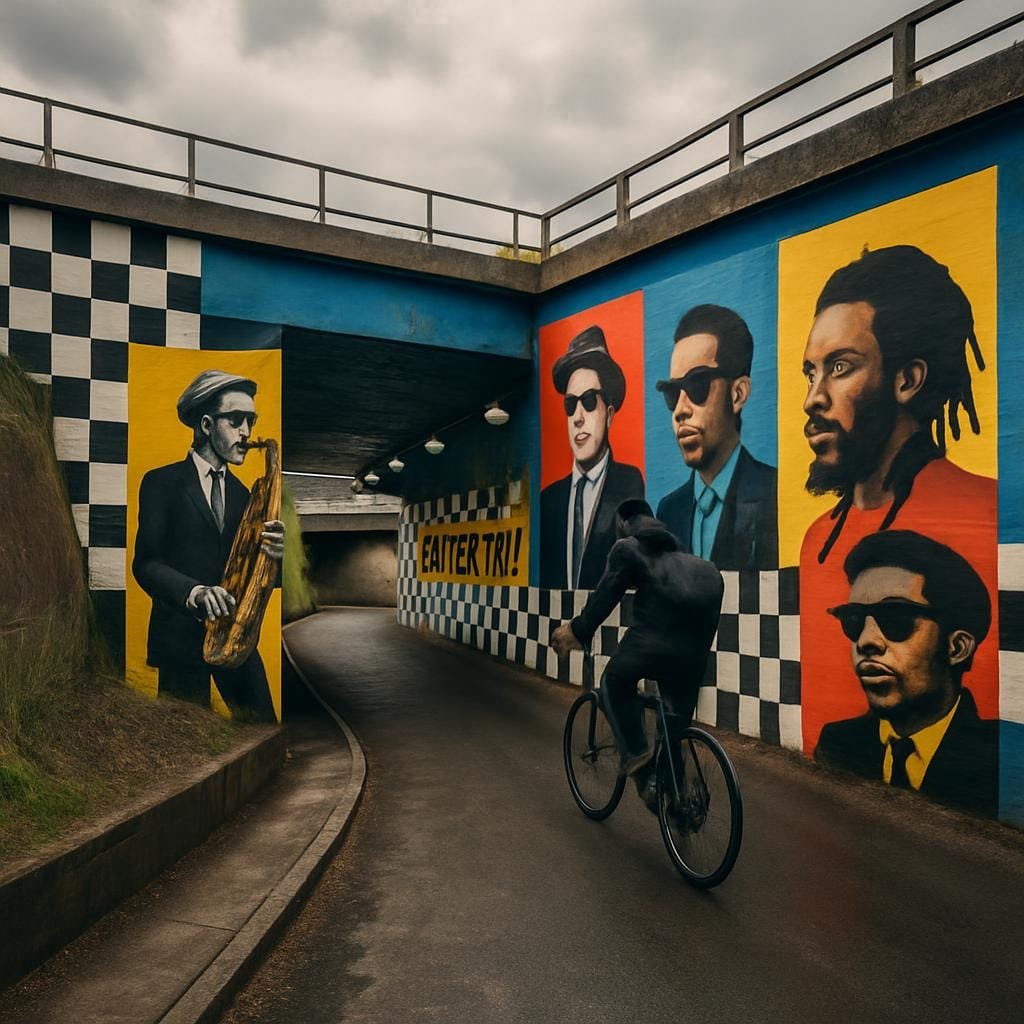
People talk about 2 Tone like it was just a style, but it was a label first. Jerry Dammers setting up 2 Tone Records in 1979, with distribution through Chrysalis, is basically the hinge between Coventry and London. The office side of things leaned London; the energy stayed in the Midlands long enough to make sure the early releases didn’t sound too tidy.
That run of singles in 1979–80 is still ridiculous:
Madness only stayed on 2 Tone for one single before heading off to Stiff Records, but even that shows you how the label functioned as a meeting point. North London lads are suddenly part of a Coventry-labelled seven-inch that’s being bought by kids in Birmingham, Leeds, Glasgow. I was a kid in Newcastle reading the small print on my older cousin’s battered copy of “The Prince” and wondering why this Camden band had the same little black-and-white checkerboard logo as The Specials.
My arguable position: the two best records with that 2 Tone logo aren’t by The Specials at all – they’re The Selecter’s “On My Radio” and The Beat’s “Mirror in the Bathroom” (on Go-Feet, but spiritually in the same club). Lynval, Terry and Jerry did the heavy lifting politically, but Pauline Black and Ranking Roger carried the pure kinetic spark.
Here’s something that still annoys me: when people do their cosy documentaries about Two-Tone, they talk about The Specials for 40 minutes, squeeze in Madness for a bit, play 30 seconds of “On My Radio”, and move on. It’s like Coventry couldn’t be allowed more than one big name at a time.
The Selecter were essentially the harder edge of the scene. The 1979 album Too Much Pressure is tighter and nastier than it gets credit for. Listen to “Street Feeling” – that constant nagging guitar, the way Pauline Black’s vocal flips from conversational to fierce in a breath. It sounds like it’s being played by people who are clocking off from factories and office jobs and turning up to rehearsal already annoyed. That’s Coventry geography as much as anything.
I saw Pauline do a solo set at the Coventry Godiva Festival around 2008, on a stage that looked like it had been dragged out of a community centre. Half the crowd were kids in Fred Perry polo shirts who clearly only knew “On My Radio”; the other half were blokes in their 40s and 50s who knew every B-side. When she launched into “Too Much Pressure”, you could feel this collective muscle memory in the air. That’s when I realised Two-Tone is as much regional pride as it is music.
London ska is where I’ve had some of my daftest nights. I saw Madness at Finsbury Park for the first “Madstock!” return in 1992 on a knackered coach from Newcastle – I was too young but lied about my age to the driver. The crowd bounce during “One Step Beyond” registered as a minor earthquake in parts of North London, which is the most Madness story possible.
The thing with Madness, The Bodysnatchers, Bad Manners and the rest of that London-heavy circuit is that they fed off pub culture. Chants, football terraces, end-of-the-pier jokes. I’m not knocking it – “Lip Up Fatty” at full tilt is unstoppable – but it sometimes let the harsher stuff slide off. By the time I caught Bad Manners at the Electric Ballroom in the early 2000s, it felt more like a stag do with brass than anything else.
Compare that to The Beat (Birmingham, I know, but let’s treat them as the midpoint between Coventry and London). “Stand Down Margaret” in 1980 was a direct, barbed song about Thatcher; Madness’s politics were more oblique, wrapped in character studies like “Embarrassment” and “Grey Day”. London ska could be very sharp when it wanted to, but it also really liked a knees-up. Coventry ska sounded like it was written after the pub fight, not during the singalong.
Because I’m a food person at heart, I notice what people eat around gigs. London ska shows in the 2000s – lots of plastic pints and late-night kebabs on Camden High Street, the odd overpriced “gourmet burger” once that craze kicked in. Fun, but slightly interchangeable.
My first proper night out in Coventry was for a Specials-related thing at the University in 2009, just after the reunion shows were announced. Before the gig I ended up in a café near Far Gosford Street, eating a massive plate of chips, beans and cheese for about three quid. The place was full of people in Fred Perrys and Harringtons, some clearly on their way to the same gig, others just finishing work. It felt very ordinary and very specific. The music later that night had the same energy: not glamorous, but full and necessary, like carbs before a shift.
This is basically my long-winded way of saying that the Midlands stamp on Two-Tone makes it feel hungrier than the London spin. The rhythms are the same Jamaican ska and rocksteady patterns, fed through British punk, but Coventry puts more beans on toast into it. You can laugh, but you can hear that difference in a song like “Nite Klub”, with its sneer at the cheap drinks and “all right slags” – that’s written by someone who’s worked behind an actual bar in an actual Midlands club, not just ponced about in a West End boozer.
Most people I know who got into Two-Tone didn’t do it by carefully checking release dates; they fell over a compilation somewhere. Mine was that taped copy of The Specials; a friend in Sunderland had an old copy of the Dance Craze live album (from the 1981 film) he’d picked up in a second-hand shop in Shields. Another had the The 2 Tone Story box set, which was like holding a history lesson in your hands – every disc with those tiny liner notes explaining who produced what, where it was recorded.
Those compilations are their own kind of Two-Tone ska travel guide, shoving you back and forth between Coventry, London, Birmingham, and beyond. One minute you’re in Coventry with “Rat Race”, the next you’ve jumped to Camden for “The Prince”, then down to Birmingham for The Beat’s “Best Friend”. You start to realise it’s not about cities in isolation but bus routes, shared vans, people sleeping on each other’s floors.
There’s this brilliant detail in a lot of Two-Tone-era interviews about bands sharing rehearsal spaces and borrowing each other’s gear. Jerry Dammers talking about rehearsing above a shop in Coventry, or Madness recalling early gigs at the Dublin Castle where they were basically playing to mates and whoever happened to be in the bar. That cross-pollination is why you can’t keep neat lines between Coventry ska and London ska, even though I’ve just spent a thousand words trying to do exactly that.
I saw The Specials twice: once around 2011, in that first proper wave of reunion gigs, and once about seven or eight years later. The first time, at a venue in Leeds, it felt like a release. Middle-aged men in old tour shirts next to teenagers who only knew “Ghost Town” from YouTube, everyone bouncing to “Too Much Too Young” like it was still 1980. Terry Hall looked faintly amused by the whole thing, which suited the songs.
The second time, somewhere in the late 2010s, something had gone. The band were tighter, more professional, better lit. The politics in songs like “Concrete Jungle” felt museum-piece, even though the lyrics made more sense than ever post-austerity. I came out thinking that maybe Two-Tone belongs slightly out of time – heard on buses, in chip shops, on scratched CD compilations – rather than on a big, well-behaved stage with £6 pints.
That said, Terry Hall’s work on the 2019 album Encore, especially on “Embarrassed By You”, showed that the Coventry/London argument in his head never really stopped. The song has that same tired fury at small-minded racism and petty thuggery that powered “Why?” back in 1981. Hearing that in my thirties, after having spent years eating chips in Coventry cafés and queuing for drinks in Camden, felt circular in the best way.
Let’s be plain about this:
Put on The Beat’s “Doors of Your Heart” from 1981 and tell me that isn’t as sophisticated, lyrically and musically, as anything their more lionised peers did. Ranking Roger switching between patter and melody, that restless bass line – for me, that song captures urban British unease every bit as well as “Ghost Town”, just without the bus.
The Selecter’s “Celebrate the Bullet” album (1981) suffered commercially, peaking nowhere near the top of the charts and then being quietly forgotten by casual listeners. But tracks like “Selling Out Your Future” feel like a handbook for Thatcher’s Britain – job losses, aimless kids, militarised streets. If you’re going to make your own mental Two-Tone ska travel guide, draw a fat arrow from that song to pretty much every headline in the early 80s.
And on the overrated side: I’ll say it – a lot of later-wave London ska-punk from the late 90s and early 2000s took the checkerboard image and the shouty choruses and forgot the very specific Coventry/London tension underneath. I saw more than one band at the Astoria around 2002 that sounded like they’d only cribbed from “Baggy Trousers” and ignored “Ghost Town” altogether.
I write mostly about food and places these days – the sort of greasy spoon where you can still get a builder’s breakfast without some nonsense about “heritage tomatoes”. Two-Tone is part of the same obsession, really. It’s about how ordinary British streets, pubs, cafés and bus stations somehow threw up something that still sounds like a fair portrait of the country.
So if you really want a Two-Tone ska travel guide, I’d say this: don’t treat it like a museum trail. Listen to “On My Radio” on the bus through Coventry ring road; play “The Prince” walking through Camden on a Saturday afternoon. Put “Mirror in the Bathroom” on your headphones in Birmingham New Street at rush hour and see if your heartbeat doesn’t sync with that bass line.
The ska revival wasn’t a neat story of Coventry versus London. It was a messy argument between them that ended up on records. That argument is still rattling around in the country – in the way we talk about cities, in North/South grumbles, in the food we eat before a night out. If you care enough to follow it, that’s your real Two-Tone ska travel guide right there: not pinned to a map, but cut into the grooves.