
I like a Full English as much as the next person, but at some point you realise you’re basically eating the same plate of beige in slightly different postcodes. Sausages, bacon, eggs, repeat. That’s when I started actively hunting for regional British breakfast traditions – the things locals actually eat at 8am when nobody’s looking and Instagram is safely out of the way.
What follows isn’t a grand tour of every single county. It’s a honest account of mornings I’ve spent in specific places, in front of real plates, occasionally with crumbs on my jumper, sometimes slightly hungover, and once deeply confused by a pool of grey peas at 9.15am in the Black Country.
I’ll start in Manchester, mostly because it often feels like the city is sponsored by drizzle and breakfast has to be sturdy enough to cope. The first time I stayed near Piccadilly, my Airbnb host told me: “If the café doesn’t do black pudding, don’t trust their tea either.” Fair point.
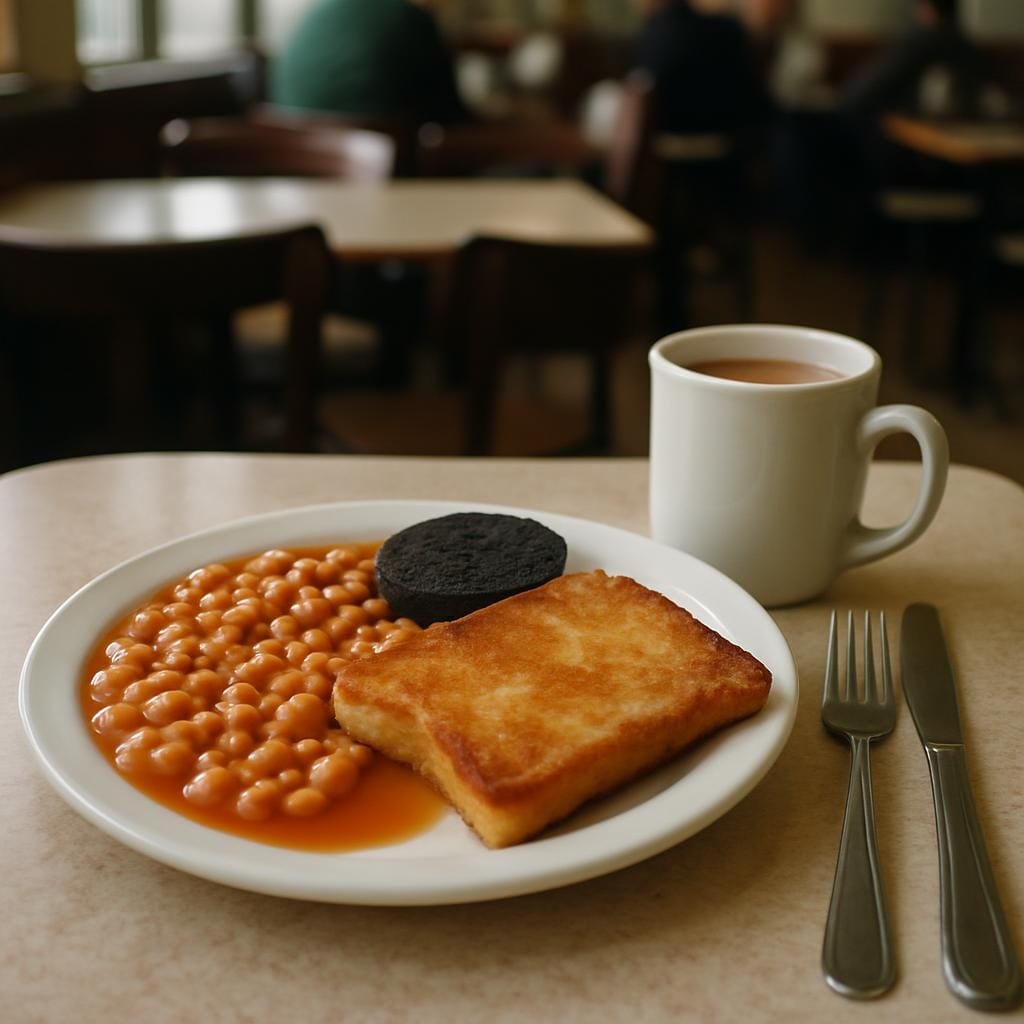
I ended up at Federal Café & Bar on Tib Street, which everyone talks about for the brunchy stuff, but the thing that really got me was a very local plate: thick slices of Bury black pudding, fried until the edges crisped up, with poached eggs and their house sourdough. You can actually see the steam rising on a cold morning as you sit by the window watching people leg it across the road to the Afflecks indoor market.
The pudding itself is Bury market style – heavy, peppery, and absolutely not the polite little circle you sometimes get elsewhere. Bury market is a tram ride away (get off at Bury Interchange; off-peak returns from the centre are usually under £6), and if you go there first you’ll understand why everyone in Greater Manchester regards black pudding as almost medicinal. One stall even has a sign claiming it’s “health food” because of the iron. I mean, technically.
About 45 minutes down the M6, you hit Stoke-on-Trent, home of one of my favourite regional British breakfast traditions: the Staffordshire oatcake. Think of a cross between a pancake and a tortilla, made of oats and cooked on a hotplate, then rolled up with fillings. The classic breakfast version is bacon, sausage and cheese, folded into a sort of floppy, beige envelope of comfort.
I went to Leek Road Oatcakes just opposite Staffordshire University. From the outside, it looks like a small takeaway with queue lines taped on the floor, but inside it’s sheer oatcake efficiency. Two ladies working flat out on the griddle, a menu board offering things like “double cheese & mushroom” or “full breakfast oatcake” for around £3–£4.50, and a steady stream of students clutching £5 notes like they’re backstage passes.
You can eat in, but most people take their paper-wrapped parcel to go. I sat on the low wall by the canal, oatcake in one hand, tea in a polystyrene cup in the other, watching a moorhen bully the ducks. The oatcake slowly leaked bacon fat onto my sleeve, which I’m told is part of the cultural experience.
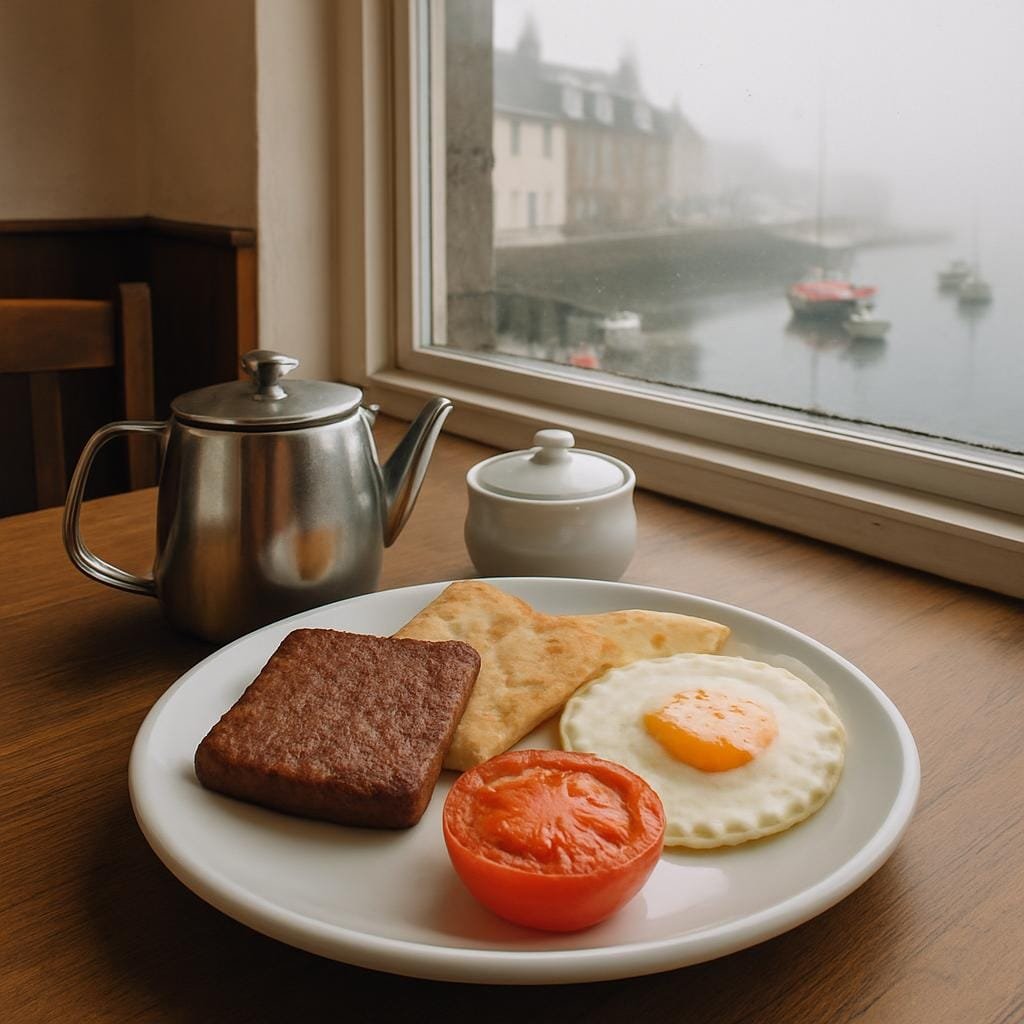
Edinburgh introduced me to the square sausage – “Lorne” if you’re trying to be respectable, “squa-saz” if you’re ordering half-asleep. It’s basically sausage meat pressed into a block and sliced. The first time I had it, at Loudons Fountainbridge, I thought they’d run out of round metal rings. Then I tasted it. Peppered, dense, and quite possibly designed specifically to fit perfectly on a morning roll.
Scottish breakfasts have their own set of regional British breakfast traditions. At Loudons, a “Scottish Breakfast” (around £13) came with square sausage, back bacon, black pudding, haggis, tattie scones, grilled tomato, mushrooms and eggs. I made the classic tourist error of eating the tattie scones first – they look harmless, but they’re basically compacted potato clouds and they sit in your stomach like a friendly paperweight. Pace yourself. Add brown sauce. Accept your fate.
Later that weekend I ended up in Spoon Café on Nicolson Street, partly because I’d heard a rumour about good porridge and partly because it was raining and they had big windows to stare out of. Their porridge comes with a dram of whisky if you ask nicely (and pay a couple of pounds extra), which feels very “I pay taxes, I deserve this” at 9am.
The subtle thing you notice in Edinburgh cafés: Tunnock’s teacakes and caramel wafers everywhere, often stacked in little pyramids behind the counter. At Spoon there’s a jar of them by the till, next to a slightly passive-aggressive sign about card minimums. I watched a man order a full breakfast and a Tunnock’s teacake as a “starter”. Ambitious. Inspiring.
Cornwall at breakfast is where I finally stopped arguing about what “counts” as breakfast and just went with whatever the person in front of me in the queue was ordering. In St Ives, at The St Ives Bakery on Fore Street, that meant a cheese and onion pasty at 9am, still warm from the oven, along with a saffron bun that left yellow crumbs all over my coat.
St Ives has its own small-scale morning routine: dog walkers on Porthmeor Beach, surfers struggling into wetsuits in the car park (usually paying around £8–£10 for all-day parking at the council car park above the beach), and a slow shuffle of people towards coffee. The bakery has this glass counter stacked high with pasties, splits and heavy cake. You can tell the locals because they know to ask for the saffron buns from the tray behind, the ones that haven’t yet made it to the front.
Cornish breakfasts don’t always look like breakfast. At Harbour View House, where I stayed once, they set out big jugs of local apple juice, Rodda’s clotted cream, and a cake stand of scones at 8.30am “for those going walking”. I watched a couple from Birmingham each take two scones, pile on an obscene amount of cream and jam, and call it their morning fuel. Frankly, icons.
Regional British breakfast traditions here lean heavily into baked goods. In Penzance, at Lavenders Deli & Bakery, I had a breakfast focaccia stuffed with bacon and egg, eaten at a table small enough to be legally classed as a saucer. There’s a narrow view down to the harbour from the front window and a handwritten chalkboard on the wall listing which local farms the ingredients are from. Also a big sign reminding you to order at the counter because they’re too busy to circulate. Respect.
On paper, the Black Country doesn’t sound like somewhere you’d go specifically for breakfast. In reality, if you like your regional British breakfast traditions hearty and a bit baffling, it’s brilliant.
I stayed near Dudley for a weekend visiting the Black Country Living Museum. Entry was about £22 at the time, and yes, it’s where they film “Peaky Blinders”, which explains the occasional hen party in questionable flat caps. But tucked inside the site is an old-style fish and chip shop where, from late morning, you can get orange chips – fried in beef dripping so they take on this deep golden colour – and grey peas cooked with bacon.
Technically it’s an early lunch, but I ate it at 11am, which my stomach filed under “breakfast, but make it confusing”. You queue along a tiled corridor that smells of malt vinegar and hot fat, pay around £6–£7 at a wooden counter, then try to balance a heavy paper tray while navigating cobbles. The peas look… challenging. But they’re rich, savoury and oddly perfect with a mug of strong tea from the corner café.
Outside the museum, local cafés around Tipton and Dudley often have “bread and dripping” on morning menus – thick doorstep slices of white bread with beef dripping and a sprinkle of salt. I tried it once at a tiny place opposite Tipton station whose name I’ve completely forgotten, but I do remember the bright orange “Breakfast served all day” sign and the fact the owner shouted every order back to the kitchen even though the grill was two metres away.
Wales brings its own chapter to the story of regional British breakfast traditions, especially around Cardiff and the Vale of Glamorgan. At the Cardiff Central Market, there’s a stall on the ground floor, tucked near the Church Street entrance, selling traditional Welsh produce – including tubs of laverbread (seaweed purée) and cockles.
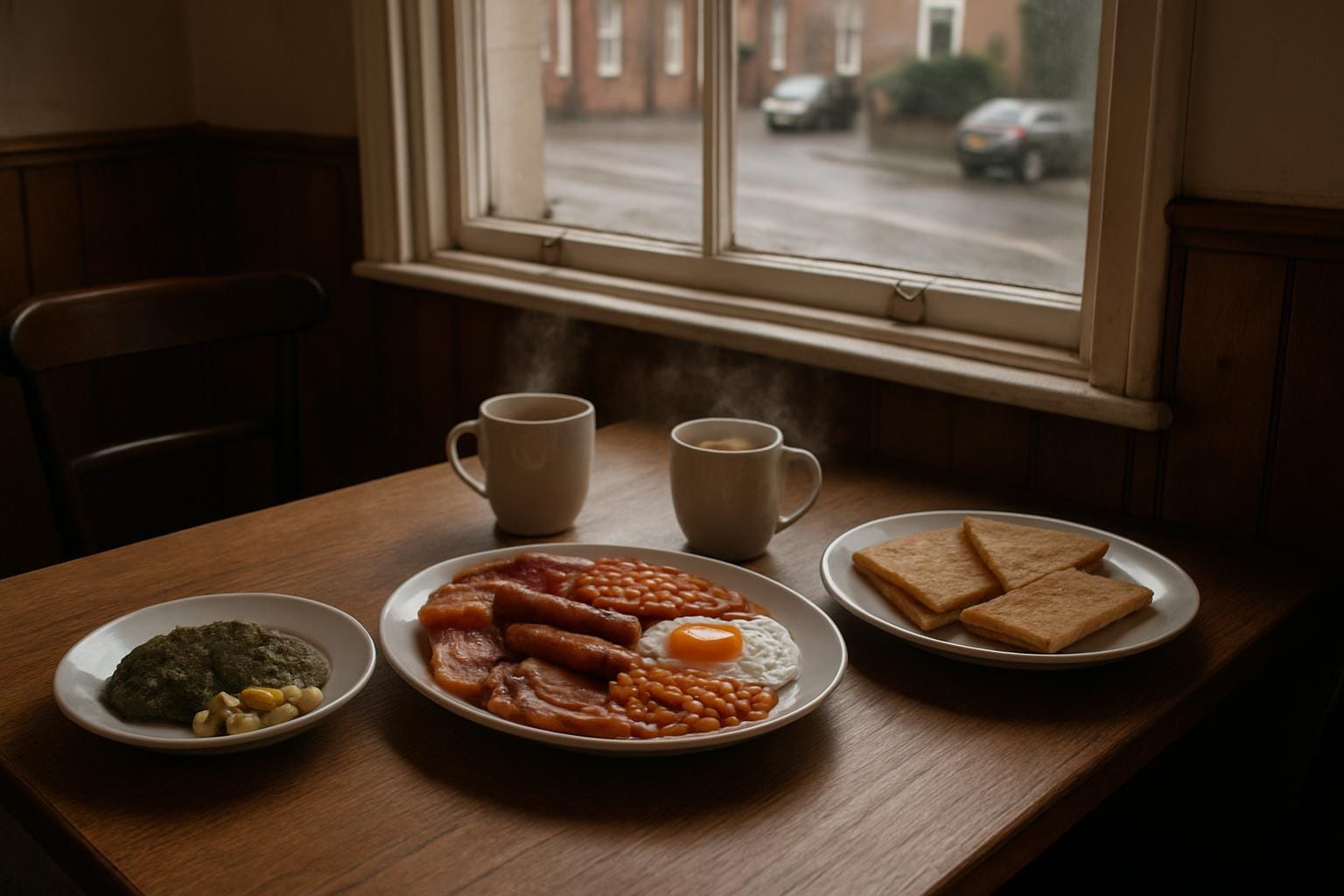
One Saturday morning I went to Planet Café inside the market – it’s on the balcony level, up the worn stone steps, with a view down over the fruit and veg stalls. Their “Welsh breakfast” (about £9) includes laverbread mixed with oatmeal and fried into little patties, served alongside bacon, eggs and cockles. It sounds like a dare, but actually it’s deeply savoury and oddly comforting. The cockles taste of the sea in a way that makes standard baked beans feel very, very dull.
Further along the coast in Barry, I went to Marco’s Café on Barry Island – yes, the “Gavin & Stacey” one, right on the prom. They’ll happily do you a more normal fry-up, but if you ask, they’ll add laverbread and cockles when they have them in. The inside is all laminated menus and photos of TV crews, and there’s a slightly battered sign asking you to return your tray. Tea comes in thick white mugs that could probably survive a nuclear incident.
After a few years of chasing regional British breakfast traditions, I’ve realised they’re one of the easiest ways to actually feel where you are, instead of floating through the same “smashed avo” menu in different cities.
In Manchester, the unapologetically heavy black pudding tells you you’re in an old industrial heartland that still likes its food to work hard. In Stoke, the oatcake is basically edible proof that practical carb engineering is alive and well. In Edinburgh, square sausage and tattie scones feel like they were designed for people who know what it’s like to walk up Calton Hill in a headwind. Cornwall’s saffron buns and morning pasties highlight a place shaped by fishing, farming and tourism colliding at the bakery counter. The Black Country’s grey peas and dripping talk about thrift and making the most of every scrap. Cardiff’s laverbread and cockles bring the sea straight onto your plate before most people have finished their cereal.
If you’re planning a trip, my honest advice is this:
You’ll spend a bit of money (usually £6–£15 per morning), but you’ll come away with actual memories instead of vague recollections of toast under a heat lamp. You’ll also learn the local approach to tea, which is arguably the closest thing Britain has to a national personality test.
And if you do end up with gravy on your sleeve at 9am or a seagull stealing half your saffron bun, welcome to the club. That’s breakfast, Britain-style.