
Medieval village life in England is usually described as if it were a diagram from a GCSE textbook: a neat row of peasant strips fanning out from a compact village, watched over by a manor house and a church. I remember revising exactly that diagram in the sixth form — tidy, labelled, oddly bloodless. Then, in my first year at Leicester, a tutor took us to Wharram Percy in North Yorkshire, a deserted medieval village now cared for by English Heritage. Standing in the hollows where houses had been, suddenly the tidy diagram felt like a lie by omission.
Because the thing about walking through surviving medieval village layouts — or the ghost of them — is that you stop thinking of “the peasantry” as a single mass and start thinking about Agnes, who had to walk half a mile to reach her furthest strip in January mud, or John, whose children slept in the same room as the family’s calf. The ground itself starts answering back.
Most of us who went through British schools carry that basic model of medieval village life in England: open fields, peasants tied to the land, a lord somewhere up the hill counting rents. It’s not entirely wrong, but it’s heavily flattened. The trouble is, villages were dynamic. They shifted, shrank, expanded, re-arranged, even moved. You see this most clearly in places where the physical pattern has survived.
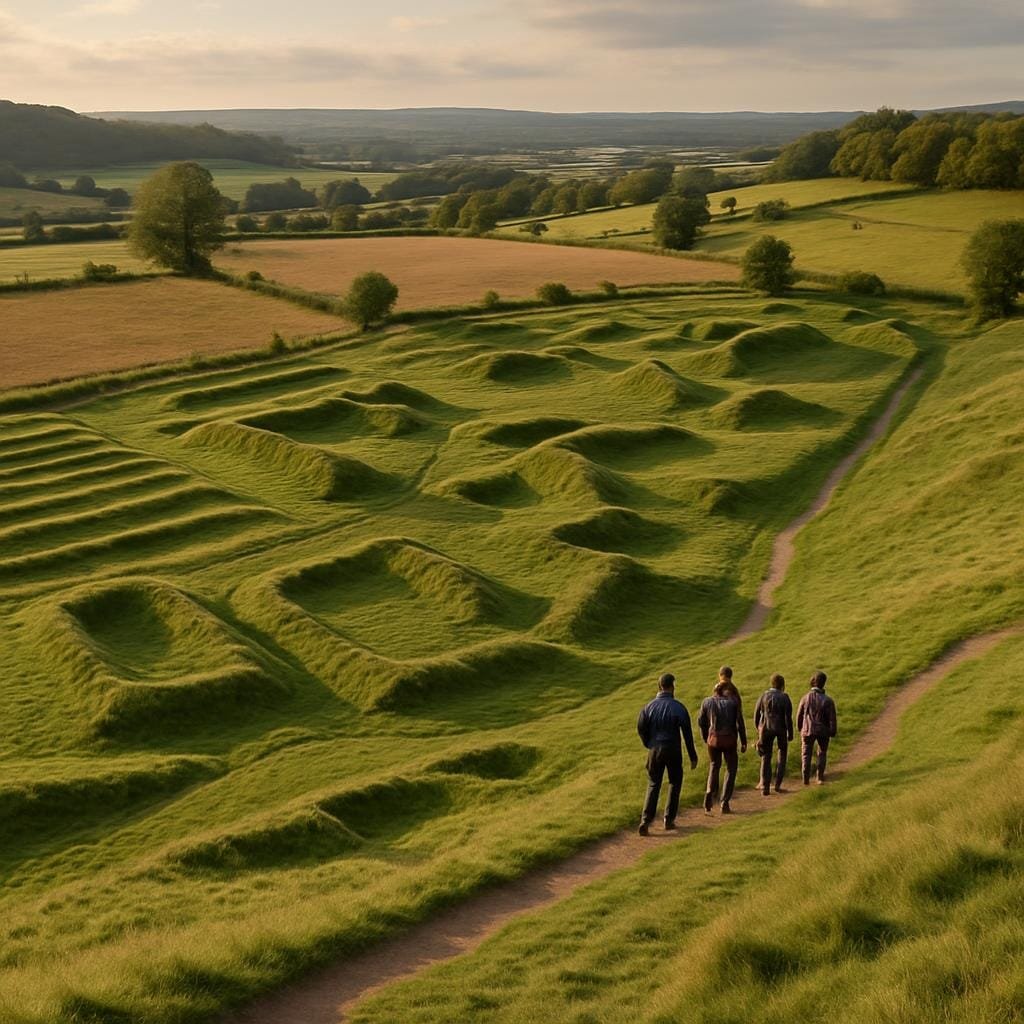
The first time I recognised ridge and furrow properly was in the fields outside Tansley in Derbyshire, on a dog walk. Parallel ripples across the grass, like someone had frozen a green sea. I’d seen photographs before, but in person you realise how high some of those ridges are — half a metre or more in older examples. These aren’t decorative. They are the fossil marks of ploughing with heavy ox-drawn ploughs, year after year, from roughly the eleventh century onwards in many areas. Each “ridge” could be the width of a peasant’s strip of land, the unit of their family’s whole economic existence.
Stand in a ridge-and-furrow field near a surviving medieval village and you can literally straddle different people’s plots with your feet. One ridge: the land a villein had to work for his lord. The next: the strip he held for his own subsistence. Same soil, different obligations. That distinction rarely appears in the clean schoolbook version, but it mattered to the people who trudged up and down those ridges with sore shoulders and bad boots.
The word “villein” sounds villainous in modern English, which hasn’t helped their reputation. In medieval terms, a villein was an unfree tenant of the manor. They weren’t slaves – they had houses, families, some customary rights – but they weren’t legally free to up sticks and leave the manor without permission. Their lives were shaped by “custom of the manor”, which sounds cosy until you read actual manorial court rolls.
Take the rolls from Elton in Cambridgeshire in the late thirteenth century, edited and translated by the Selden Society. They record fines for things like “brewing against the assize” (selling weak or overpriced ale), letting animals stray into the lord’s crops, and selling a horse without permission. These are tiny infringements, but you see the pattern: everyday life constantly bumped into regulation.
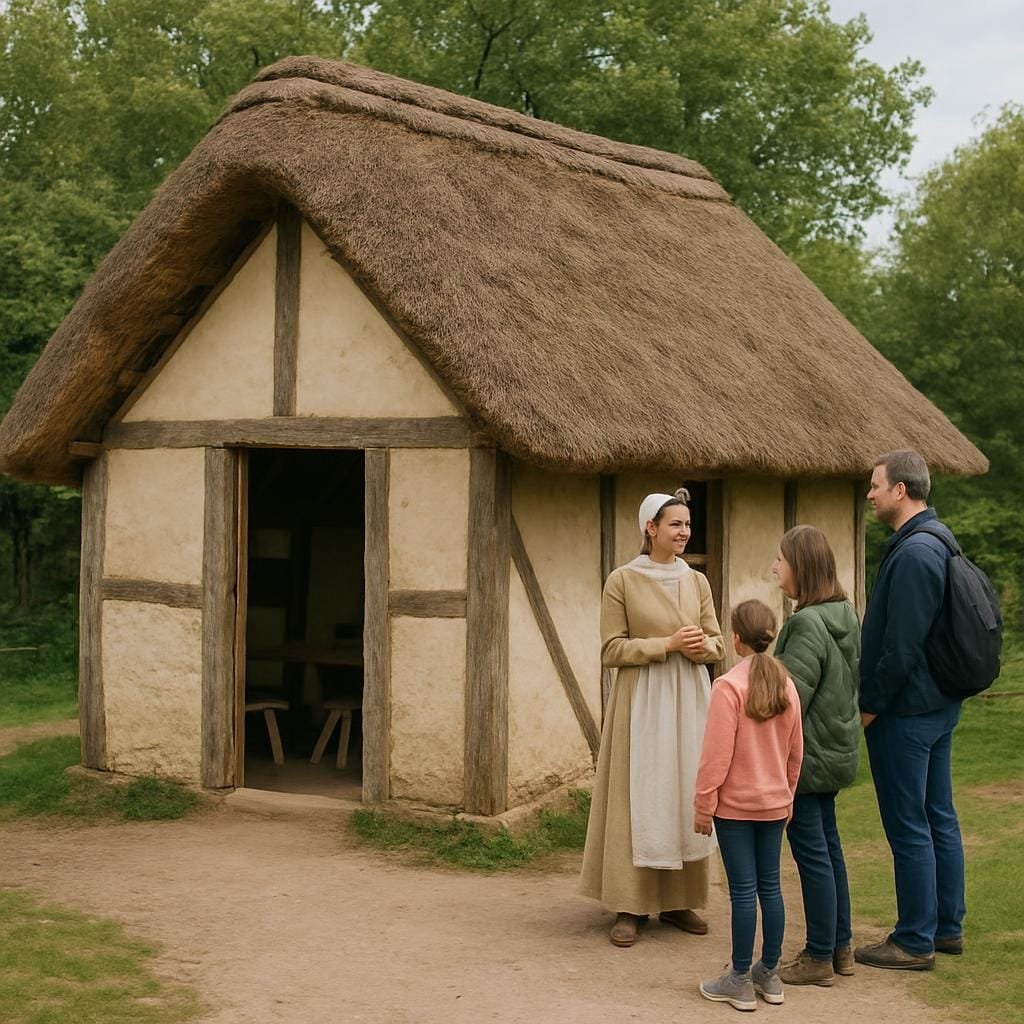
Yet villeins weren’t passive. They negotiated, complained, occasionally legged it. In one court roll from Halesowen (then in Shropshire), a villein woman is fined for “withdrawing herself” from the manor. She’d tried, however briefly, to leave. The language is dry, but you can fill in the gaps: what did she pack, who did she trust to help her, how long did she think she could stay away?
When you visit a place where the medieval street plan survives – somewhere like Lavenham in Suffolk or Ludlow in Shropshire – it’s easy to get distracted by the timber-framed merchants’ houses and skip past the smaller properties hunched behind. Those backplots, now often gardens or car parks, once held the makeshift sheds, pigsties and brew houses of people living much closer to the villein end of the spectrum. Medieval village life in England was defined as much by those backyards as by the church spire everyone photographs.
One of the largest holes in the standard story is how many villages simply don’t make it to the present. Around 3,000 sites in England are listed as deserted or shrunken medieval villages – the National Monuments Record has a slightly nerdy but useful summary of them via Historic England. Most of us are taught that “the village” is a stable thing. It isn’t.
Wharram Percy, which I mentioned earlier, is the poster child. Excavated from the 1950s onwards, it shows a layout that built up and then contracted over several centuries. Walking along what was once the main street, you move between house platforms like missing teeth. The church still stands, heavily patched, with a later farm building leaning into it. The graves go on into the fifteenth century, long after some of the houses were abandoned. So the “desertion” wasn’t a single drama; it was a slow, messy reshaping of human geography.
And the reasons were messy too. Enclosure for sheep, yes, in some places. Lords saw more profit in wool than in rent from smallholders. But also soil exhaustion, changes in trade routes, plague losses, inheritance tangles, sheer bad luck. At Wharram Percy, villagers were probably evicted around the early sixteenth century to expand sheep pasture, but by then numbers had already dropped. Standing there, you realise that medieval village life in England was precarious; your whole world could be literally removed from the map within a couple of generations.
That’s the bit the textbook never quite spells out. It talks about “enclosure” as if it were a policy change, not the moment someone came to your door and told you that your strips were now part of a big square field, and you would be moving.
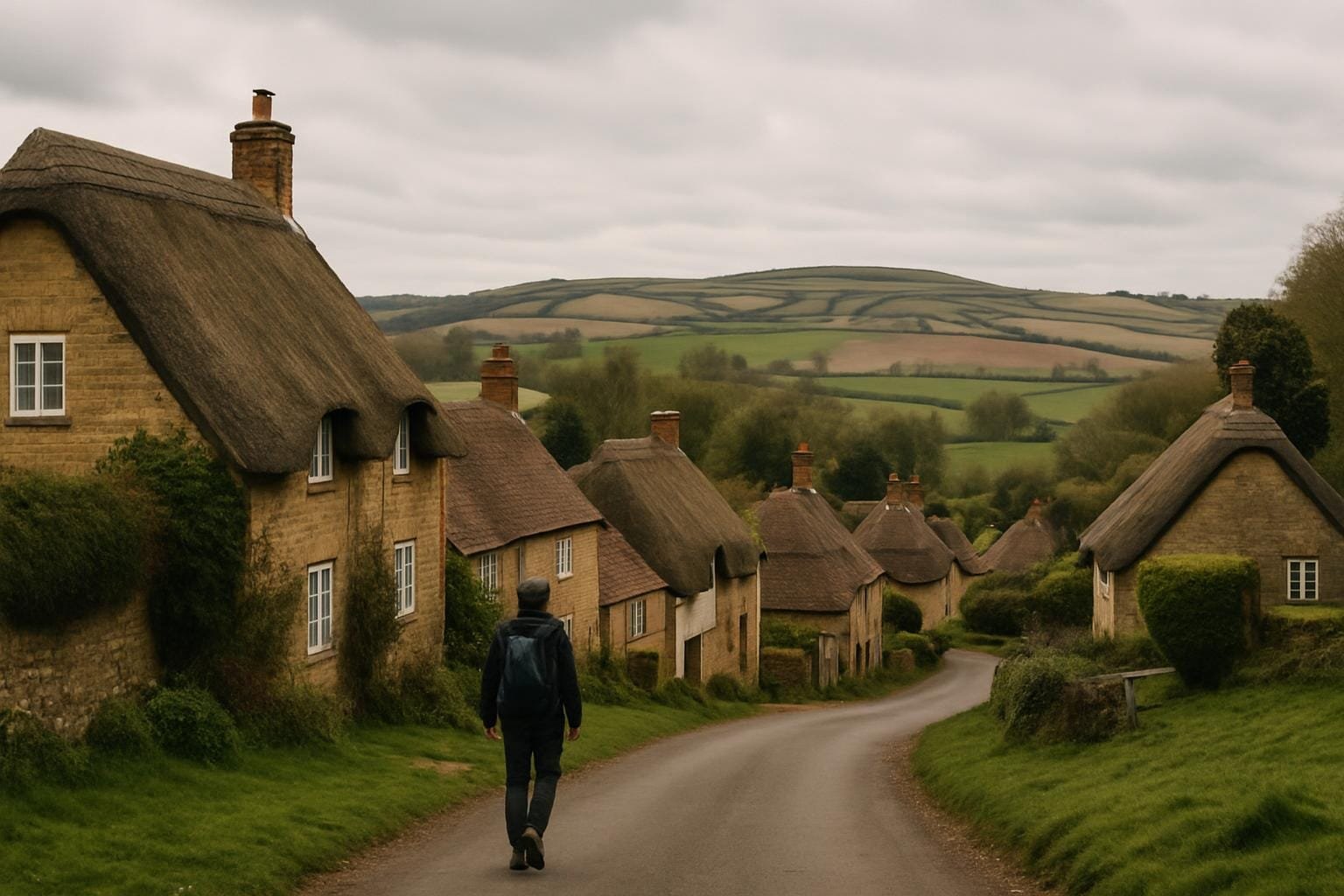
One thing that surprised me once I started visiting more sites is how varied medieval villages were on the ground. That flat, circular diagram really has a lot to answer for.
These shapes mattered for real people. In a green village, your animals were more visibly communal – your cow on the green was literally rubbing shoulders with your neighbour’s – which made disputes over grazing more immediate. In a street village, the long narrow plots meant you might have your workshop at the front and your crops at the back, so work, home and field blurred together.
When you read manorial court cases about boundary disputes, you start to picture the actual hedges and ditches. At Kibworth Harcourt in Leicestershire, for instance, the court in the early fourteenth century recorded an argument over who had dumped muck in a path and whether a hedge had been moved. Nothing grand, but these were the edges of people’s world. If someone nudged their boundary-stone a foot onto your strip, that was the margin between feeding your family and coming up short.
We’re fond of saying that medieval people were “superstitious” as if we’re not, and that their lives were ruled by religion in some vague, uniform way. Walking through surviving village layouts you realise just how many fears and hopes were physically built into the place.
Almost every medieval village had a church, of course, but it wasn’t just about Sunday mass. The churchyard was one of the safest places to be in a legal sense; sanctuary rights meant fugitives sometimes bolted for it. That’s not abstract. In 1287, a man called Robert of Kelling fled into the church at Wiveton in Norfolk after killing someone in a fight. He confessed and took the “king’s peace” there according to later records. When you stand in a churchyard that still matches its medieval footprint, you’re in a space that once doubled as a very literal get-out-of-jail card.
Then there are the crosses and wayside chapels on the edges of some villages. At Houghton-on-the-Hill in Norfolk, the tiny, early church stands slightly apart from later settlement. Paths lead away from it towards older trackways. It reminds you that villages were not closed bubbles; people walked between them constantly: to markets, to courts, to hired work, to visit kin. Medieval village life in England always included movement, gossip carried on muddy footpaths, not just static, hereditary labour.
Fear shaped the edges too. After the Black Death reached England in 1348–9, burial grounds ballooned, and plague pits appeared outside normal cemeteries. In London we have good archaeological evidence from places like the East Smithfield cemetery, now under part of the Royal Mint site, excavated by the Museum of London. In villages, mass burial was cruder, but you still see extensions to churchyards and occasional “extra-mural” burial areas. The school version says, “The Black Death killed between a third and a half the population.” True, but not vivid. In a village of 200 people, that meant 70 fresh graves in what might be one bad year, dug by men who had just buried their own families.
Another thing my early textbooks implied is that peasants worked every hour God sent. When you actually read details from wage records and customs of the manor, a more complicated pattern emerges.
Villeins owed labour services: ploughing, reaping, carting, sometimes up to two or three days a week in busy seasons, less at other times. The rest of the time they were expected to work their own strips. That makes it sound like two jobs, which in a sense it was, but there were also seasonal lulls. A fifteenth-century account from Cuxham in Oxfordshire, preserved in the so-called “Cuxham documents”, shows that in winter there were long gaps when there was very little field work beyond foddering animals and repairing tools.
What did people do then? Some took on craft work: spinning, weaving, making small metal items. Some brewed ale for sale; in some villages you can still trace “brew houses” later converted to cottages. Others simply socialised, if the fines for late-night alehouse fights are anything to go by. Medieval village life in England contained boredom as well as backbreaking work – evenings where you sat by a smoky fire listening to your neighbour complain about the reeve’s latest decision.
Pay was another tangle. Free labourers hired at day wages could, in good times, earn enough in the harvest months to support families, especially after the Black Death when labour was in shorter supply and wages rose. Villeins couldn’t legally roam for such work without permission, but plenty did. The fact we have fines for “leaving the manor without licence” from places like Halesowen tells you as much about their ambitions as their constraints.
The classic village diagram shows fields and men. Women turn up in the margins, if at all. Actual records say otherwise. Women appear constantly in manor court rolls as ale-brewers, smallholders, widows taking over holdings, or troublemakers in their own right. At Brigstock in Northamptonshire in the 1320s, for example, you see women amerced for brewing short measure ale and for “scolding” neighbours, which probably means a loud public argument rather than a quiet word over the hedge.
Think about spinning. Every adult female body in the village was, at some point, engaged in twisting fibre into thread. It was the precondition for almost all cloth. So when you stand in a surviving cottage row from the fifteenth century, like the houses at Lacock in Wiltshire, and see an upper chamber open to the roof, you can picture several women up there in winter, backs bent, hands raw, hearing church bells from down the street and the thud of boots on the lane below.
Another missing bit is childcare. Medieval village life in England involved a lot of communal minding of children. Court rolls mention boys acting as cowherds and gooseherds; girls fetched water, collected firewood, helped with weeding. The “village green” was also, bluntly, the village playground. When I walk through a surviving green in somewhere like Ashby St Ledgers in Northamptonshire, I picture it full of children doing annoying, risky things with sticks, because that seems to be a cross-cultural constant.
I used to think of medieval villages as the static backdrop to “real” history: kings, battles, the occasional revolt. Then I started paying attention to the ground. You don’t need a grand site; a footpath skirting an unploughed ridge-and-furrow field, a church whose nave still follows its twelfth-century footprint, a street pattern that feels oddly long and thin — all of these are clues.
The history you hear in a village hall talk will usually be about the big house, the famous rector, maybe a Civil War skirmish. Fair enough. But if you walk out from the church to the field edge and look back, you’re standing where a villein stood, judging the distance to the furthest strip and mentally adding up the week’s obligations. Medieval village life in England is still written into the humps and lines of the ground, if you know roughly what you’re looking at.
If you want to chase this further, the Victoria County History volumes for each county are a treasure trove of parish-level details, and Historic England’s National Heritage List will send you down rabbit holes of scheduled deserted villages. But I’d argue the books make the most sense once you’ve stood on a village green in February rain, trying to imagine it full of cows and gossip.
The medieval village isn’t a tidy diagram. It’s an untidy, evolving patchwork of obligation, resentment, co-operation and sheer survival, lived out by people whose houses may have vanished but whose footprints have, quite literally, reshaped the soil.