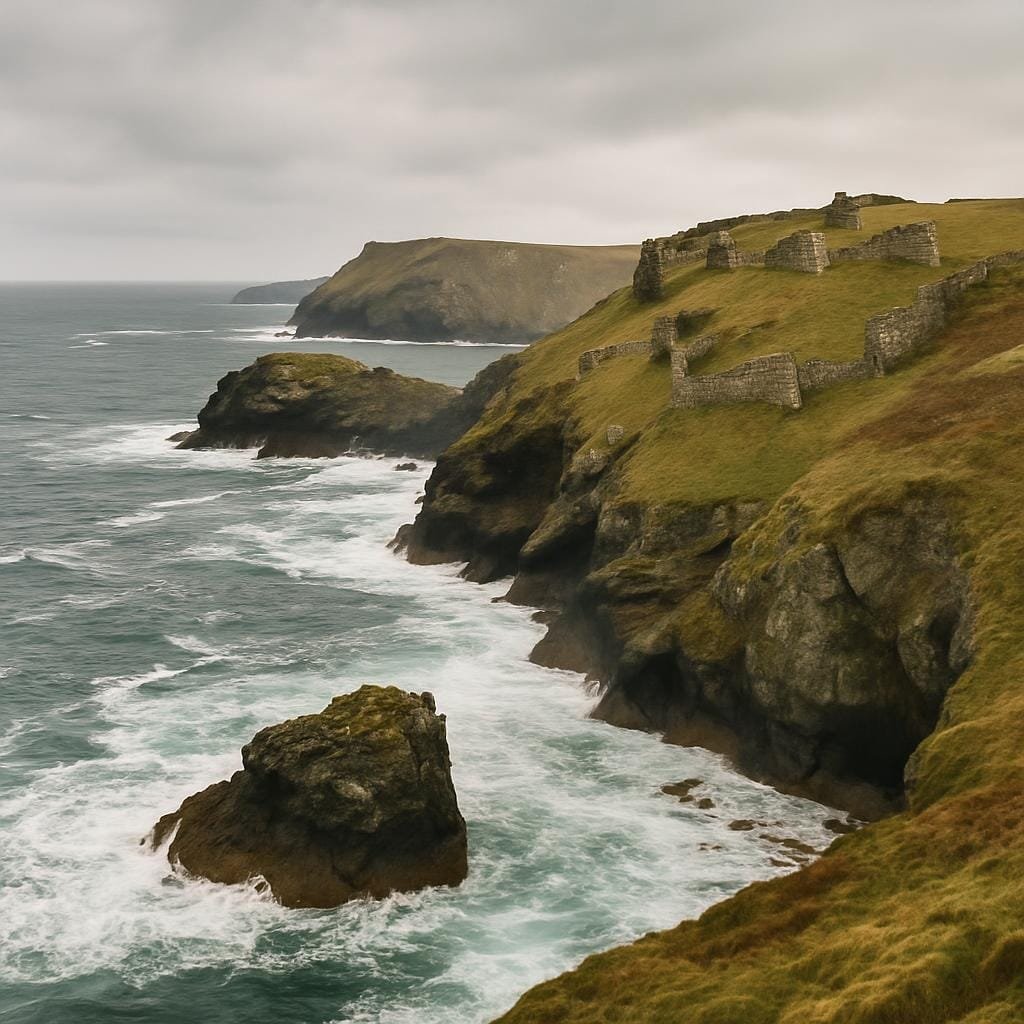
I first went looking for Merlin in a gift shop. That’s how a lot of people meet him now. My parents took me to Tintagel when I was about ten. I remember a plastic wizard staff with fake gems, an ocean of tea towels, and a slightly sticky “Arthurian” fudge. None of it told me why this supposed wizard from the “age of chivalry” had a Latin name, or why half the so‑called Merlin sites in Britain were nowhere near Tintagel at all.
I didn’t start joining the dots until years later at university, when I met the Merlin of manuscripts rather than merchandise. That Merlin is far messier and, to my mind, far more human. He wanders through Welsh poetry, mutters battle prophecies for Norman kings, and occasionally runs screaming into the woods. That complexity is exactly what you miss if you treat “Merlin sites in Britain” as a bucket list rather than a set of clues to how stories grow in real soil.
The first Merlin I learned to take seriously wasn’t called Merlin at all. He was Myrddin. In early Welsh poems like Afallennau and Oianau, probably composed somewhere between the 9th and 12th centuries, Myrddin is a traumatised war survivor living feral in the forest. He’s raving, prophetic, obsessed with a battle called Arfderydd (dated by later tradition to 573).
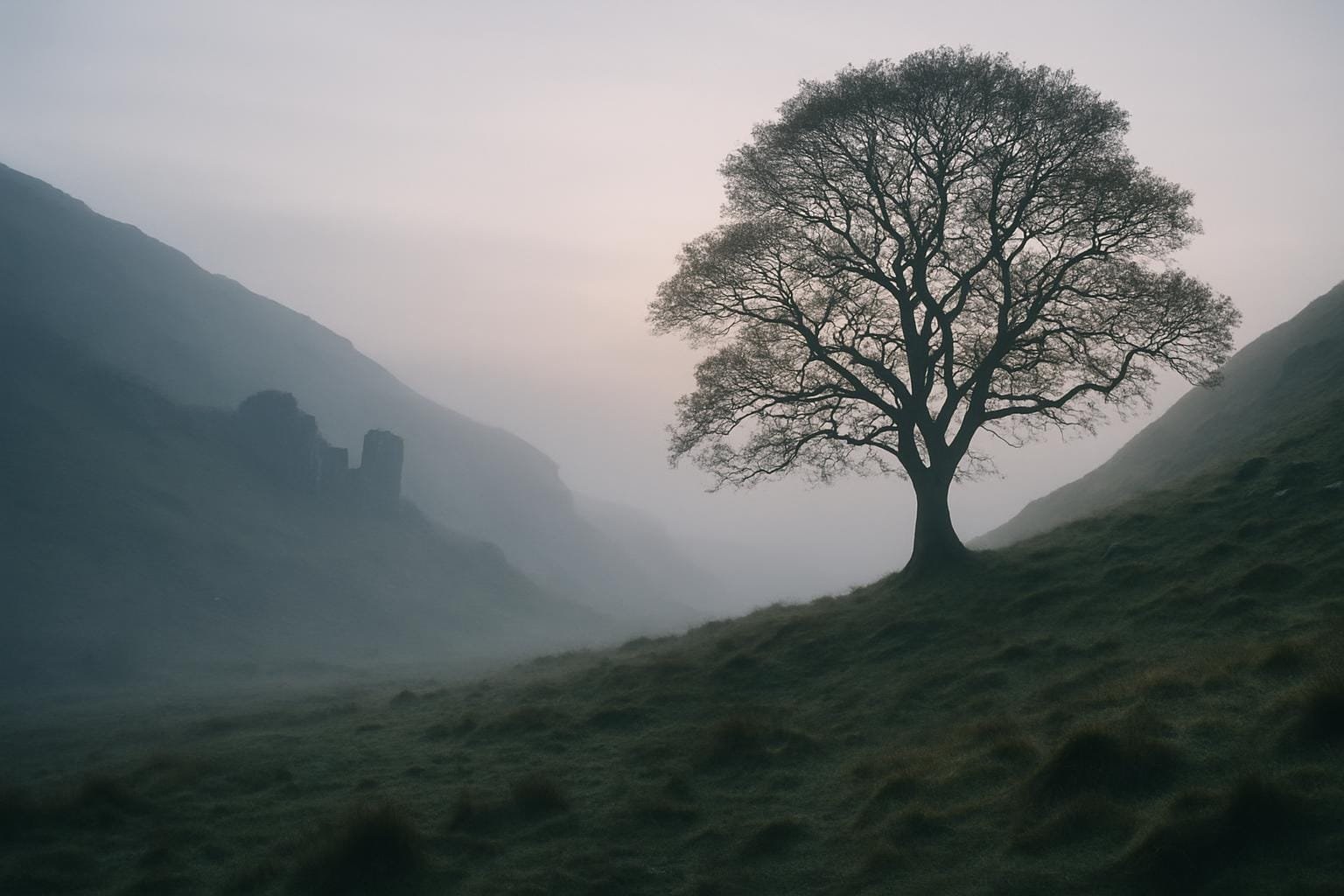
One afternoon in the National Library of Wales, squinting at a digitised manuscript on a wheezy old computer, I realised something: this “wizard” had more in common with a shell‑shocked veteran than with a stage magician. Myrddin flees into the woods after seeing comrades slaughtered. He talks to an apple tree. He can’t go home. This is what happens when you fight a Dark Age border war and lose everything.
The supposed Merlin sites in Britain linked to this version are up in the north: around the Solway Firth, southern Scotland, northern Cumbria. They’re not tourist honeypots; they’re working countryside. Near Lockerbie you get traditions about “Merlin’s grave” and “Merlin’s hill”. In the 12th century, the chronicler Geoffrey of Monmouth placed a mad prophet called Lailoken (closely related to Myrddin) in the woods around here, driven wild by guilt over the dead at Arfderydd.
Trying to picture that, you have to stop thinking in terms of misty legend and think in terms of farm labour. Someone had to strip the meat from the battlefield dead. Someone had to walk miles to tell a sister that her sons were gone. A shepherd leading his flock past these woods in, say, the 7th century might have been told: “That’s where the war madman lives. He sees the future.” The story gave shape to the raw fear that if war came this way again, nobody would be safe, not even in the trees.
So the first Merlin I trust is a broken man on the edge of society, remembered by people who lived close to the soil and even closer to violence. Not a court magician; a cautionary tale.
Then along comes Geoffrey of Monmouth in the 1130s, and Merlin gets his second life. Geoffrey wrote the Historia Regum Britanniae (History of the Kings of Britain), one of the most influential pieces of creative writing the Middle Ages produced. It reads like history, but with dragons, giant kings and political wishful thinking baked in.
Geoffrey does something clever. He takes stray figures from Welsh tradition – Myrddin, Ambrosius, various prophets – and condenses them into one Latinised character: Merlinus. (The “d” drops out; apparently Merdinus sounded too much like a rude Latin word for excrement.) This Merlin prophesies to kings, engineers Stonehenge’s relocation from Ireland to Salisbury Plain, and explains the two dragons fighting beneath a collapsing tower.
The received version tells us Merlin here is the wise adviser to kings. That’s only half the story. Geoffrey is writing for a Norman‑Welsh elite who have just spent decades carving up England and Wales. His Merlin reassures them that conquest has a long backstory. The Britons were once great, lost their way, and strong rulers will come again. It’s comfort food for nervous nobles.
Think about how that hits an ordinary person in the 12th century. If you’re a tenant farmer near a new Norman castle in south Wales, you’ve seen woodland cleared for timber, fields reorganised, your rent demands suddenly written down in a language you can’t read. A lord’s chaplain might preach that all this turmoil fits a grand pattern, foretold by Merlin. You’re living through another turn of a prophetic wheel, not just some baron’s land‑grab. That can be either consoling or infuriating, depending on how the harvest went.
One of the odder Merlin sites in Britain linked to Geoffrey is Stonehenge. In his version, Merlin moves the “Giant’s Dance” from Ireland using engineering tricks and a bit of arcane knowledge. I remember standing in the visitor centre looking at a display panel that mentioned Geoffrey in passing, almost apologetically, as though he were an embarrassing uncle at a family reunion. The archaeologists are rightly focused on Neolithic builders, not medieval fiction. But the fact Geoffrey gave Stonehenge a new origin story in Latin meant clerics and rulers suddenly had a way to talk about this strange ring of stones without admitting ignorance.
For the local population, that matters. Imagine growing up nearby in, say, 1200. Stonehenge is where travellers stop, leave offerings, scratch graffiti. Now priests have a story: a wizard of old moved it, for a great king. That doesn’t erase older, quieter superstitions, but it adds a layer. Stories accumulate like lichen.
The first time Merlin stopped feeling like a “legendary archetype” to me was at Tintern Abbey on the Wye. I’d gone expecting flying buttresses and Romantic poets. What I walked into was airborne geology and crows, and then in the shop (they do get you in the shops) a reprint of the Prophecies of Merlin linked to Geoffrey’s circle.
The book is dense with odd imagery: dragons, lions, raging men of iron. Most of it reads like a riddle about 12th‑century politics. You get things like “The hedgehog shall rebuild its home,” which scholars think may allude to Henry I or some other noble returning from exile. It’s half horoscope, half constitutional theory.
The monks here weren’t just chanting psalms; they were copying, glossing and occasionally arguing with texts like this. A Cistercian novice in the 1190s could be sent to the scriptorium to copy a passage where Merlin predicts disasters brought on by greedy kings. Then that same novice might be sent out on “grange” duty, helping supervise lay workers on abbey land. He’d be calculating tithes, checking if the tenants on the next valley had met their quotas, listening to complaints about bad winters and wolves.
Those tenants probably didn’t care about the finer points of Merlin’s genealogies. But when an abbot quoted a prophecy about famine as divine punishment, and then raised rents to pay for a new guesthouse, it was Merlin being dragged, once again, into very ordinary arguments about who gets what.
So Merlin here isn’t only a seer in flowing robes. He’s a text on a shelf, a Latin exercise, a way for monks to talk about power without pointing too directly at the baron across the river.
If you want the tightest knot of Merlin stories, go to Carmarthen (Caerfyrddin) in west Wales, which claims him as a local boy. The name has been folk‑etymologised as “Merlin’s Fort” for centuries, though linguists grumble that it probably comes from an earlier *Moridunum*. Still, by the late Middle Ages, people in Carmarthen were quite happy to trade on the association.
I visited on a damp Tuesday and, after the obligatory Merlin‑branded café, went looking for something older. You don’t get a great standing stone with “Merlin was here” carved on it. You get fragments. A blocked‑in bit of Roman wall. A late medieval street pattern clinging to the ridge. And somewhere beneath it all, the stories of a supposed “Merlin’s oak”.
That oak once stood near the old market and was linked by local lore to Merlin’s prophecy that Carmarthen will fall when the tree falls. We have 19th‑century newspaper reports of the town council arguing about it. The road needed widening; the tree was in the way. They pruned it, then cut it down in 1978. A panic followed – or rather, a flood of knowing, nervous jokes – when serious flooding hit the town in the years after. The stump is now in the local museum.
I like this story because it’s one of those moments where a “legend” interferes with municipal planning. Here’s Merlin, centuries after his supposed time, reaching into a council meeting about traffic management. And ordinary people have opinions. One shopkeeper quoted in a 19th‑century piece in the Carmarthen Journal said, almost in the same breath, that the prophecy was nonsense and that it would be bad luck to cut the tree down. That’s how legends live: half believed, half laughed at, but still strong enough to slow a road scheme.
For the market traders who once set up stalls under that oak, Merlin wasn’t an abstract part of “Arthurian Britain”. He was the name tied to a specific bit of shade, a specific warning about overreaching, a story you told an outsider while wrapping their cheese.
By the time we get to the Plantagenet and later courts, especially with writers like Robert de Boron in the late 12th and early 13th centuries, Merlin has been repackaged yet again. Now he is the half‑demonic, half‑holy architect of Arthur’s kingship, the one who engineers Uther’s seduction of Igraine and arranges the sword in the stone.
This is the version that flourishes in French verse romances and then in English prose like Malory’s Le Morte d’Arthur. Here, Merlin spends time in glimmering halls, whispers strategy into royal ears, then is trapped in a cave or a tree by the woman he loves (or lusts after), often called Nimue or Viviane.
The obvious reading is that Merlin becomes a symbol of good counsel ignored – male wisdom undone by female wiles, if you’re feeling uncharitable. But pay attention to the settings. Many episodes are located at recognisable English and Welsh Merlin sites in Britain: royal courts echoing Winchester, river crossings reminiscent of the Thames and Severn, forests that feel suspiciously like those around the Welsh Marches.
These stories were read aloud in great halls where real barons drank real wine and eyed their competitors. A 13th‑century nobleman listening at Ludlow, or at Old Sarum, might have heard in Merlin’s speeches a warning that you can’t keep your throne by force alone: you need prophecy, legitimacy, something “higher”.
In the same hall, a squire or lady‑in‑waiting would be hearing something slightly different. Merlin as fixer, orchestrator, spymaster. He arranges disguises, swaps babies, knows who slept where and when. There’s gossip politics in there, not just grand destiny.
And beyond the hall? At the castle gate, a charcoal burner waiting to be paid or a pedlar hoping to sell ribbons to the steward’s wife might catch odd snippets of the tale coming out in gusts of music and laughter. For them, Merlin was part of the noises of power: another story about how those up there justify what they do.
By this point you might be thinking: all right, so is Merlin Welsh, northern, Cornish, pan‑British, or what? The answer is: he’s as mobile as the scribes and minstrels who used him. That’s one reason the list of Merlin sites in Britain looks so scattered and contradictory.
A few patterns, though, do emerge:
When heritage leaflets talk about “traditional Merlin sites in Britain”, they often compress all this into a neat bullet‑pointed legend: wise wizard of Arthur, connected to these three photogenic places. You can see why. The full reality is messier and harder to sell in a brochure.
The mess, though, is where the history lives. When you walk through these places, you realise Merlin isn’t attached to them like a sticker on a map. He’s seeped into them in different ways. In one, he’s a veteran gone mad in the woods. In another, he’s a Latin voice in a monastic text. In another, he’s an excuse not to cut down a tree, until the traffic gets too heavy.
The standard schoolbook take on Merlin boils down to something like: “A legendary wizard, adviser to King Arthur, probably based on older Celtic traditions.” It’s tidy, and it gets you through an exam. It also flattens three uncomfortable truths.
Once you notice that, it’s hard to un‑see it. Next time someone mentions “Merlin sites in Britain” as if they’re interchangeable, it’s worth asking: whose Merlin are we talking about? The one who warned a prince? The one who scared shepherds? The one who made a town council nervous about cutting down a tree?
The second time I went to Tintagel, years after that childhood visit, I had Geoffrey of Monmouth’s Latin text in my bag and a much clearer sense of what was invented when. I stood by the newish statue of a robed figure with a sword – “Gallos”, sort of Arthur, sort of anyone you want him to be – and watched a family arguing over an audio guide. The teenage son wanted the version with “all the wizard stuff”. His dad wanted “the proper history one”.
The thing is, you can’t peel those versions apart cleanly. The wizard stuff is part of the history. Geoffrey’s creative writing had real effects. It shaped how later rulers thought about Britain’s past, how monks grouped kings into lines, how local communities told stories about their trees and stones. And at every stage, ordinary people bent those stories for their own purposes: to complain about rents, to mutter about the end of the world, to sell souvenir staffs.
So I keep going back to places linked to Merlin not to tick them off a legend tour, but to see how the story has been reincarnated. In a museum label about “Merlin’s oak”. In a guidebook that hedges between archaeology and romance. In a pub sign showing a white‑bearded man raising a pint.
Somewhere under all that is the man in the forest talking to trees after a battle he cannot forget. The monk copying a prophecy while the lay brothers count sacks of grain. The Carmarthen trader shading her stall under an oak she half‑thinks might bring the town down if anyone dares cut it.
If there’s a trail to follow across the Merlin sites in Britain, that’s the one that keeps me interested: not “where did Merlin do his tricks?” but “how did ordinary people use this wizard to make sense of their own, very non‑wizardly lives?”
For anyone who wants to go deeper into the sources rather than the souvenirs, the National Library of Wales has digitised key Welsh Merlin poems, while a readable English translation of Geoffrey’s History of the Kings of Britain is available via the Internet Archive. Just don’t expect the wizard on the page to line up neatly with the one on the fridge magnets. He rarely does.