
If you’d told my fourteen-year-old self in Newcastle that one day someone would ask for a “Britpop walking tour UK”, I’d have assumed it meant trudging from HMV to Our Price trying to find a copy of The Great Escape that wasn’t scratched. That was the tour: Metro into town, WHSmith for the magazines, Greggs for a cheese pasty, then home to argue with my brother about whether Blur or Oasis would win at the 1995 Brits.
I’m old enough now to say this without flinching: the whole Blur vs Oasis thing was brilliant fun but completely warped how we talk about 90s British guitar music. It turned a whole messy wave of songs, scenes and slightly shambolic gigs into a Premier League table. Still, it did give us a sort of accidental Britpop walking tour UK, drawn in bold marker between Camden and Manchester, with a few detours to Colchester, Burnage, Primrose Hill and some terrible service stations on the M1.
The cliché is simple: Blur are “London art school”, Oasis are “northern grafters”. Like most clichés, it’s half wrong. Damon Albarn grew up in Colchester. Noel Gallagher’s best lines owe as much to the Beatles and Slade as to any working men’s club. But there is something geographical going on.

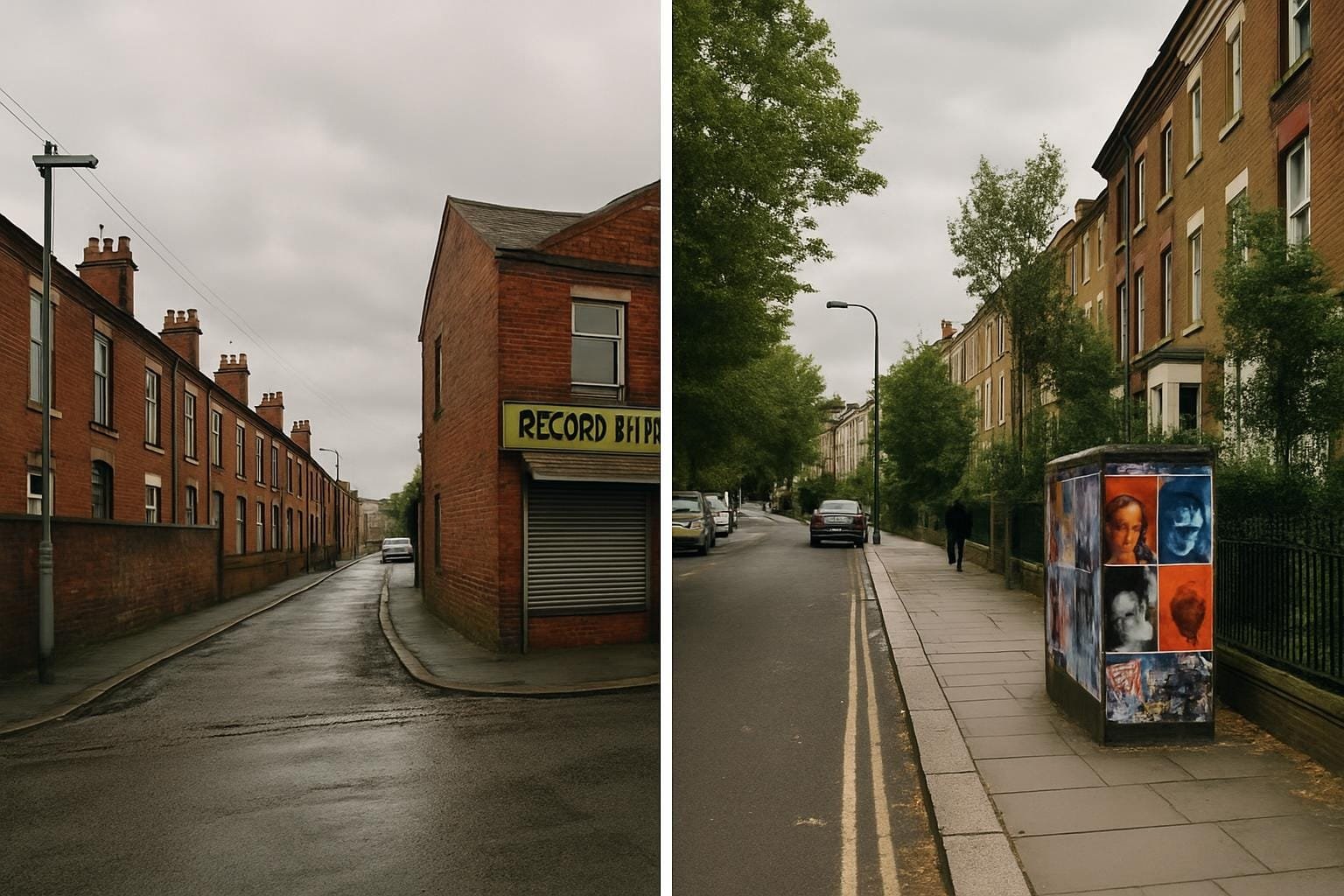
Blur’s early 90s arc feels like a tour of a certain version of the south: Modern Life Is Rubbish (1993) sounding like a delayed train out of Liverpool Street, Parklife (1994) like overheard chat in a dog track bar, The Great Escape (1995) like falling out of too many Camden pubs pretending you work in advertising. You can almost plot it on a tube map.
Oasis, meanwhile, are a straight line up the M6 from Manchester to the big fields: Maine Road 1996, Knebworth 1996, every indie disco in between where “Some Might Say” meant you were definitely going to miss the last bus. Their sound is dual carriageways and service-station coffee, music turned up so loud the speakers distort. No cleverness, just size.
Here’s the first arguable position, then: Blur were better at the time, but Oasis have aged better in the wild. In 1995 I would have died on the hill that “The Universal” wiped the floor with anything on (What’s the Story) Morning Glory?. Now, hearing “Champagne Supernova” slurred at last orders, it’s hard to argue with the way people still cling to it. Blur spoke to the moment; Oasis sank into the national bloodstream.
Blur’s London is very specific. Think of “For Tomorrow” and that line about taking the 15 bus — it isn’t just there for colour. When I first came down to London at 19, I hunted for that bus like a sad little pilgrim. By then, Camden was already morphing from scruffy-ish music haunt into stag-do strip. But you could still squint and see the version from the “End of a Century” era: the Good Mixer full of bands who looked like they’d slept in those clothes for a month, playlists heavy on Pulp and Supergrass.
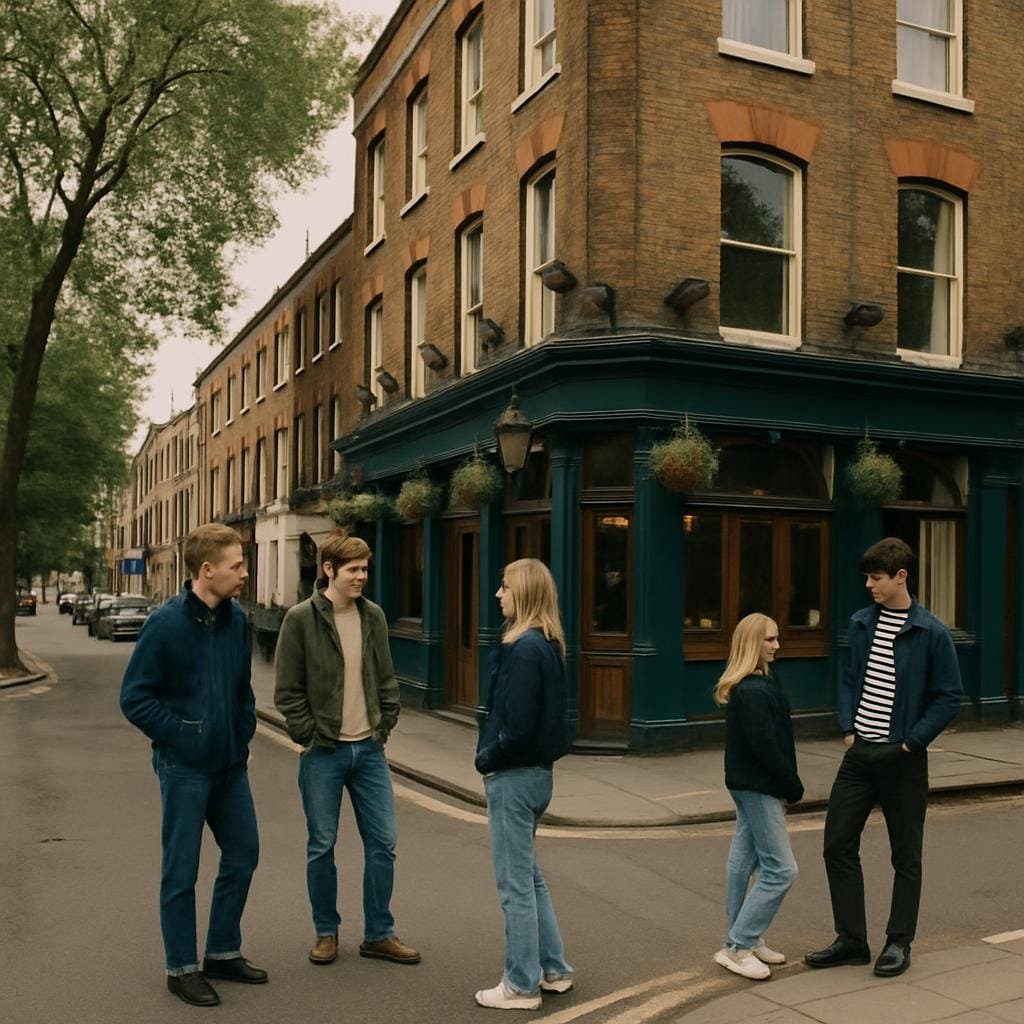
Those pubs and tiny upstairs rooms shaped Blur’s sound. Listen to Modern Life Is Rubbish again. “Advert” could only have been written by people who’d spent far too long in London, resentfully half-watching TV and clocking every jingle. There’s a jumpy, compressed energy to those songs — like a room full of people waiting to see the next band but pretending they’re too cool to move forward.
Now take Oasis. When Noel talks about writing “Live Forever” in a back bedroom in Burnage, you can hear that room in the record. The reverb on the guitars isn’t subtle; it’s there to make a small life sound huge. I remember hearing “Cigarettes & Alcohol” on the radio at my mate’s house in Byker — we were 15, arguing over the last slice of pizza — and thinking it sounded like a band trying to punch their way out of a tiny venue by sheer volume. That’s not London pub energy; that’s community centre PA system pushed too far.
There’s an old line that Blur wrote about characters, Oasis wrote about themselves. I don’t think that’s quite true. Blur’s “Charmless Man” and “Country House” are full of cruel little details because those people really were propping up certain bars in north London in 1995. Oasis, meanwhile, were writing fantasy versions of themselves: Liam as cosmic shaman on “Columbia”, Noel as stadium poet on “Don’t Look Back in Anger” long before he’d actually led a stadium through it.
I was in the school library, pretending to do homework, when I saw the NME cover in August 1995 with Blur and Oasis laid out like a boxing poster. “The Battle of Britpop” felt ridiculous and huge at the same time. Both bands releasing singles on the same day — “Country House” versus “Roll With It” — was pure stunt, but it worked. We picked sides. I taped the chart rundown on Radio 1 and rewound the bit where Damon did his fake humble speech about hitting number one.
Looking back, that chart battle did more damage than good. It froze Britpop into a Britpop walking tour UK with only two stops: Camden and Manchester. Suede’s knotty, pervy brilliance got demoted to “prelude”. Pulp’s civilian poetry — “Common People”, “Sorted for E’s & Wizz” — got lumped in as supporting feature instead of the sharpest writing of the decade. Elastica were treated like the cool support band instead of the group who put out a debut in 1995 that’s tighter than most things Blur or Oasis managed.
Here’s my more controversial take: the real casualty of the Blur vs Oasis fixation wasn’t any band; it was the next decade of British guitar music. We spent so long mythologising 1994–96 that by the time the early 2000s came round, too many groups were playing dress-up, reheating “Some Might Say” riffs and “Girls & Boys” basslines. You can hear it in half the 2004 indie landfill albums — all attitude, no new ideas.
I saw Blur twice. First time was 1994, Riverside in Newcastle — still the best venue the city ever had, and I will happily argue that over a pint. They were touring Parklife, but it didn’t feel like a victory lap yet. Damon was more twitchy than smug, Graham Coxon played like someone who’d listened to way too much Pavement, and “This Is a Low” came across like they were a proper band, not just cartoon cockneys.
About ten years later, I saw them again at the Royal Festival Hall. Excellent show, technically better, more precise. But some hunger had gone. The songs that landed hardest were the ones that weren’t peak Britpop: “Beetlebum”, “Out of Time”. It felt like they were slowly edging away from the 90s caricature people wanted them to be.
Oasis I only caught once, on the Be Here Now tour in 1997 at the Newcastle Arena. People talk about that album as excess, and they’re right, but it’s one thing hearing the bloat on CD and another feeling it in person. “D’You Know What I Mean?” went on for what felt like half an hour, great if you were hammered, less so if you were trying to get the last Metro. But when they did “Slide Away” and “Live Forever” back-to-back, it was like the whole place rose up. You can roll your eyes at the Gallagher soap opera all you like; thousands of people screaming “We’ll see things they’ll never see” still does something to a room.
Those gigs also reveal something about the supposed north–south divide. Blur in a packed Riverside, £8 tickets, £1.50 pints, everyone in trackie tops and DMs — they didn’t feel like a “southern” band. They felt like four blokes who’d turned up in a transit van to make a racket. Oasis in a huge arena, all branded beer and £20 t-shirts, felt more like U2 than some scrappy Manc outfit by that point. Class and geography in Britpop were always branding exercises as much as realities.
Every good Britpop walking tour UK isn’t really about pavements. It’s about the places written into the songs. Both bands did that, but they did it differently.
Blur’s geography is tight and detailed. The “bank holiday comes with six-pack of lager” of early tracks, the references to Primrose Hill and west London ennui on The Great Escape, even the seaside melancholy of “End of a Century” — you always know roughly where these people are. They’re in flats, pubs, small houses with twitching net curtains, motorways with service stations that sell grim sandwiches. Damon writes like someone people-watching out of bus windows.
Oasis write more in emotional postcodes. Apart from the odd nod to “standing at the station” or “walking down the hall”, their biggest songs float somewhere between Old Trafford and heaven. “Cast No Shadow” is about a person more than a place; “Don’t Look Back in Anger” is practically national anthem territory. But when they do go specific — “Sheffield steel” on “Talk Tonight”, the references in “Half the World Away” that ended up forever tied to The Royle Family — it lands hard because it’s rarer.
This might be why Blur feel like the better writers, but Oasis feel like the bigger band. Blur sketch individuals in actual spaces; Oasis beam generic emotion from the floodlights. You need both. A pub jukebox would be poorer without “Parklife”, but you can’t close down a festival with it in the same way you can with “Don’t Look Back in Anger”.
By the late 90s, the Britpop circus was winding down. Blur made their self-titled 1997 album with “Song 2” and the more American-influenced sound, which blew my teenage head off at the time. Suddenly the “quaint English” band were doing something that sat next to Nirvana on a mix tape without sounding small. Oasis, on the other hand, doubled down and gave us the overcooked sprawl of Be Here Now in the same year, which I defended for far too long because I’d spent my pocket money on it.
Here’s another opinion that tends to annoy people: Blur’s real masterpiece is 13 (1999), and it basically isn’t Britpop at all. “Coffee & TV”, “No Distance Left to Run”, all that fractured, fuzzy heartbreak — it’s miles away from “Girls & Boys”. Meanwhile, Oasis’ last truly great record is Definitely Maybe (1994), maybe sneaking in bits of Morning Glory. After that, they became the best tribute band to themselves.
The way the story’s told, though, you’d think both bands dominated the entire decade. In reality, the most interesting things happening in British guitar music at the time often had nothing to do with them. While Blur and Oasis were windmilling their way through Top of the Pops, you had Rough Trade nurturing lo-fi oddballs, Heavenly pushing Saint Etienne and Doves, and up in Leeds the Brudenell Social Club slowly building the kind of scene that would carry British indie long after Liam had put his parka away for the night.
But the map in most people’s heads still runs: Camden, Manchester, a sunburnt field at Knebworth, Brit Awards stage, curtain.
I re-listened to the big Blur and Oasis albums last winter, stuck in a rented flat in York with terrible insulation and even worse Wi-Fi. Two things surprised me.
First, how small Parklife actually sounds. In my memory it was huge, brash, everywhere. On headphones in a cold kitchen, you notice how tight and almost brittle it is. Graham’s guitar lines on “Tracy Jacks”, the way “Badhead” feels like it was recorded in the corner of a living room — this isn’t music built for arenas. It’s music built for the kind of 300-cap room every town used to have before developers turned them into flats.
Second, how confident Definitely Maybe still feels. “Rock ’N’ Roll Star” doesn’t sound like bravado now; it sounds like documentation. They really did believe it that much. “Slide Away” is still the one for me — that middle bit where Noel leans into the guitar line like he’s trying to wrestle something out of it that words can’t carry. Put it on in any pub in the UK and watch what happens. This is why, if you’re designing a Britpop walking tour UK in your head, you have to include a grim city-centre boozer on a Friday night; the songs aren’t alive until there’s ring marks on the table and someone’s spilled a pint.
The Blur vs Oasis story has a tidy ending for some people: Blur go arty, Oasis go stadium rock caricature, Britpop packs up its Union Jack and retreats to the nostalgia circuit. But walking around British cities now — Leeds, Sheffield, Newcastle, Manchester — you still hear those two bands leaking out of bar speakers, bleeding into football crowds, soundtracking supermarket runs. They never really left.
If you’re coming at this like an actual Britpop walking tour UK, here’s my honest suggestion: don’t bother chasing the big sites. The Haçienda is flats. Half the Camden venues have been gutted or rebranded. Manchester’s Albert Hall and London’s smaller rooms like the Lexington or Underworld will give you the feel of what it was like far better than standing outside a closed pub Damon once had a pint in.
Your real “tour” is this:
The tour is emotional, not geographical. It’s less “stand here, read plaque” and more “remember what it felt like to hear ‘Girls & Boys’ on Top of the Pops while your dad complained about all the shouting”.
In the end, I think Blur were the better, braver band. They took more risks, wrote with more detail, backed away from the easy money when they could have coasted. But Oasis lodged themselves deeper into everyday British life. People get married to “Wonderwall” and buried to “Don’t Look Back in Anger”. You don’t win against that; you just acknowledge it.
So walk it if you want: from Colchester to Camden, from Burnage to Knebworth, via every sticky-floored venue that still sells warm lager in plastic cups. But the real Britpop walking tour UK is in your own head — the route from the first time you heard those opening chords to the last time you shouted them hoarse in a room full of strangers who, for three minutes, all believed they were rock ’n’ roll stars too.