My relationship with the Domesday Book started with a bored teenage me in a draughty county record office, flicking through a modern English translation and thinking, “So this is it? A long shopping list?”
Years later, walking into tiny Deerhurst church in Gloucestershire and realising its tower was already old when Domesday was compiled in 1086, that “shopping list” suddenly had walls, damp sandstone and a faint smell of polish. Domesday stopped being an abstract document and turned into a map you can still walk around.
That’s what I want to trace here: not a tourist trail, but the way certain Domesday Book sites in England still feel as if the ink has barely dried. Places where you can stand and say: this field, this village street, this odd lump in the grass — someone measured it for the king almost a thousand years ago, and wrote down who owed what.
If you’ve skilfully avoided Domesday Book since school, a quick reminder. In 1085, William the Conqueror ordered a massive survey of his English territories. By 1086, royal commissioners had tramped across much of the country asking awkward questions such as:
The result is two surviving volumes, now in the British Library: Great and Little Domesday. The nickname came later — like the Last Judgement, there was no appeal. Domesday doesn’t care about your excuses for a poor harvest. It simply records.
School lessons often sell Domesday as a kind of medieval census for “the nation”. That smooth phrase hides the edge. This was about tax, control and anxiety. William faced threats from Scandinavia and from his own barons. He wanted to know exactly what he could squeeze from this kingdom he had taken so bloodily twenty years earlier.
For ordinary people, Domesday wasn’t some grand constitutional moment. It was strangers arriving in the village with questions and probably an armed escort. Someone like “Alwine the reeve”, named in the Domesday entry for Derby, guiding the officials round, pointing out boundaries, hoping his neighbours wouldn’t accuse him of favouring his cousins.
The received picture of Domesday villages — I grew up with this one — is strangely neat. A manor, a lord in his hall, peasants lined up in rows: feudalism illustrated by Sunday-school diagrams. Then you read the actual entries and go to some surviving Domesday Book sites in England, and the neatness falls apart.
Take Shapwick in Dorset. The Domesday Book says it had 30 households in 1086, a substantial village. Archaeological work around Shapwick long barrow and the medieval settlement earthworks shows a place that shifted over centuries — houses moving, plots re-arranged, parts abandoned. Stand on the footpath there now and you see humps and ditches under pasture. The people recorded under a single tidy entry were in reality arguing about grazing rights, extending gardens, marrying in and out, being evicted, making quiet deals.
Domesday-level detail is like a freeze-frame during a rugby match: everyone stopped in mid-scrum, hair at odd angles. Shapwick’s peasants are frozen at the moment when the king wanted to count them, not when they thought anything historically special was happening.
One thing most school versions skip is just how bruised much of England still was in 1086. The north in particular had been devastated by William’s own campaigns. The textbook phrase is “Harrying of the North”. That sounds medieval and distant. Then you look at the Domesday entry for places like Crakehall in North Yorkshire and see “waste” written straight in — land that used to be productive, now ruined or depopulated.
“Waste” doesn’t mean pleasantly rewilded. It often means that, a decade or two earlier, someone like a woman called Leofwen had lost her home, her grain store, her family. The chronicler Orderic Vitalis talks about people in the north in this period surviving on roots and horse-flesh, dying in “multitudes”. Domesday doesn’t mention the famine deaths; it quietly tallies the ruined manors.
When I first drove through that part of Yorkshire with Domesday in my bag, I kept thinking: somewhere under these modern fields were people who watched soldiers burn their winter stores. Then twenty years later, someone came round to calculate what tax the survivors might now pay to the king who had ordered those burnings.
That loop — violence followed by paperwork — is one of the threads you see clearly if you trace Domesday Book sites in England on the ground instead of only on a page.
If you want to feel Domesday’s economic side in your bones, go to a salt or sheep place. The survey is obsessed with them. Salt works and flocks show up like highlighter pen marks across the text.
Droitwich in Worcestershire, for example, appears as a royal salt centre long before 1086. Domesday records hundreds of “wich houses” — people engaged in boiling brine. Salt wasn’t a luxury; it was the difference between bacon that kept and bacon that killed you. Imagine living in one of those salt houses: eyes sore from the steam, hands cracked from brine, always carrying heavy brine-pans to and from the brine pits. We tend to picture medieval hardship as mud and bare feet in fields; Domesday quietly records industrial fatigue too.
Over in Deerhurst, on the Severn, Domesday lists a church and a community belonging to the Abbey of Westminster. It’s one thing to read “a church” on a line; another to stand in Odda’s Chapel and the adjacent priory church and realise parts of their stonework are older than the Norman Conquest. Domesday’s monks and priests had to maintain buildings that were already antiques, in a village where people worked the Severn meadows, dealt with floods, patched boats, and listened to the bell that punctuated all of that labour.
The neat Latin entry doesn’t say, “Also, the roof leaks and the lay brothers keep ‘borrowing’ tools without putting them back.” But that’s the level I now think about, wandering between the pillar bases that were already there when the royal commissioners asked who held the manor.
Domesday shows regional quirks. East Anglia is full of “sokemen” and “freemen” — theoretically better off than unfree villeins. Textbooks often present this as evidence that some peasants had it fairly good.
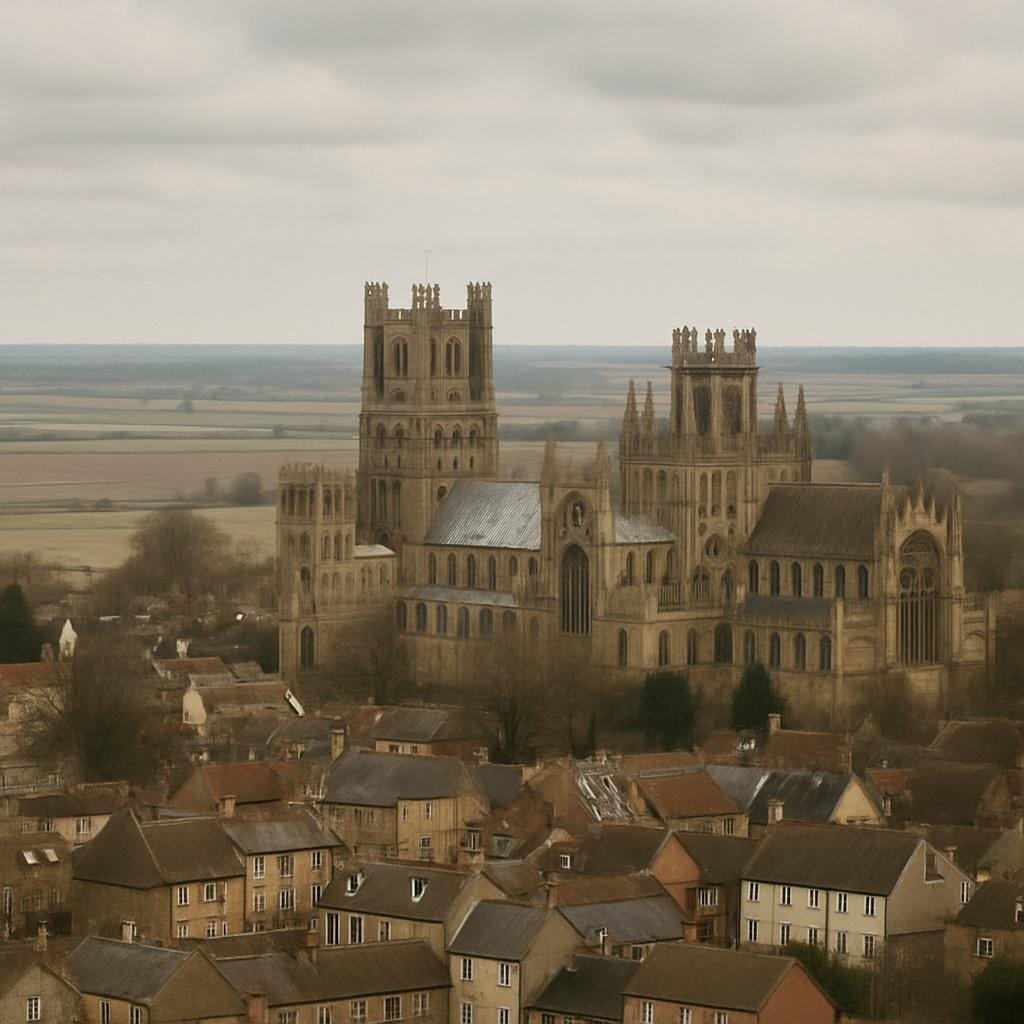
Then you read the Ely entries. The abbey at Ely (the current cathedral’s ancestor) held huge estates. Many “free” men in Domesday Ely owed heavy labour services: ploughing the abbot’s demesne, carting wood, repairing fishponds. “Free” here often means “can sell his land with the lord’s permission and owes slightly different duties”, not “wanders about making life choices.”
Stand in the nave of Ely Cathedral now and you’re looking at later architecture, but on roughly the same footprint as the great church Domesday knew. The “freemen” in the survey helped feed the masons, the carpenters, the monks. One man recorded in the Liber Eliensis, the abbey’s own chronicle, complained that the abbey officials forced him to work more days than his status required. That kind of argument never reaches the Domesday summary, but it bubbles underneath.
This is where the standard school picture goes wrong: “peasants vs lords” as two solid blocks. Walk round Domesday Book sites in England like Ely, and you notice the layers — monks arguing with bishops, reeves caught between villagers and sheriffs, “freemen” pushing back at demands. The survey flattens all that into taxable units.
Another awkward gap in the cosy version: Domesday Book is virtually silent on the Battle of Hastings. You might expect some grand note. Nothing. There is, however, a thick cluster of entries around Hastings itself, and later sources tell us that William founded Battle Abbey, which Domesday dutifully records as holding local manors.
Walk the field at Battle now and it’s grass and informational boards. In 1086 this was still, in living memory, the place where dozens of local families had lost their sons. Somewhere among the Domesday entries for nearby villages are parents who remembered buying burial shrouds for lads killed in 1066. The survey counts their ploughs but says nothing about why the plough teams might be short on manpower.
This is one of those places that shifted my sense of Domesday. I’d been taught to think of the book as the aftermath of conquest, as if the conquest were cleanly over. Standing on Senlac Hill with the Domesday translation in my backpack, it felt more like an account book drawn up before the blood was fully washed away.
I live in Derbyshire, so I feel obliged to drag you briefly to Derby, which appears in Domesday as a small but busy borough with 243 houses “less 9 that are ruined”. I used to skim that line. Ruined houses. Oh dear. Then one day it hit me: that means nine families who lost their homes within living memory of 1086, probably during the struggles of the 1060s and 1070s.
The Domesday entry also notes a castle. Derby’s Norman castle has almost entirely gone, but if you stand above the bus station and squint through the modern clutter, there’s a raised area behind the multi-storey car park that corresponds roughly to the old castle mound. In 1086, that mound was new, raw, a physical reminder that Danish and English rebels had been pushed out. The people in those 243 houses lived in sight of it. They paid rent, brewed ale, traded in the market, perhaps grumbled about the garrison’s behaviour after a few drinks.
When I read the Derby entry now, I see a widow at her doorway watching her grandson tramp up to the castle with a load of firewood, muttering that they never had to do this under “King Edward’s men”. Domesday itself is mute on that kind of resentment, but once you’ve walked the modern streets and traced the old boundaries, it’s hard not to picture it.
Another correction to the simple version: big holes in the record don’t always mean absence. County Durham is famously “missing” from Domesday. The standard explanation: as a palatinate under the powerful bishop, it lay outside the scope of the royal inquiry.
That doesn’t mean Durham was some untouched Eden. The bishops ran their own administration; peasants still paid rents and performed labour services. Standing under the high vaults of Durham Cathedral, you’re inside a place that owed its authority partly to being beyond this one royal survey. I find it helpful to think of Domesday not as “the book of England”, but as one layer of paperwork among many. The king’s layer, yes, but not the only one.
Same with those “waste” entries across Yorkshire and Cheshire: the land wasn’t empty in a modern sense. Shepherd boys still walked out with what flocks remained; widows still scratched peas and barley out of crofts. “Waste” is the taxman’s term, not a neutral description of human life.
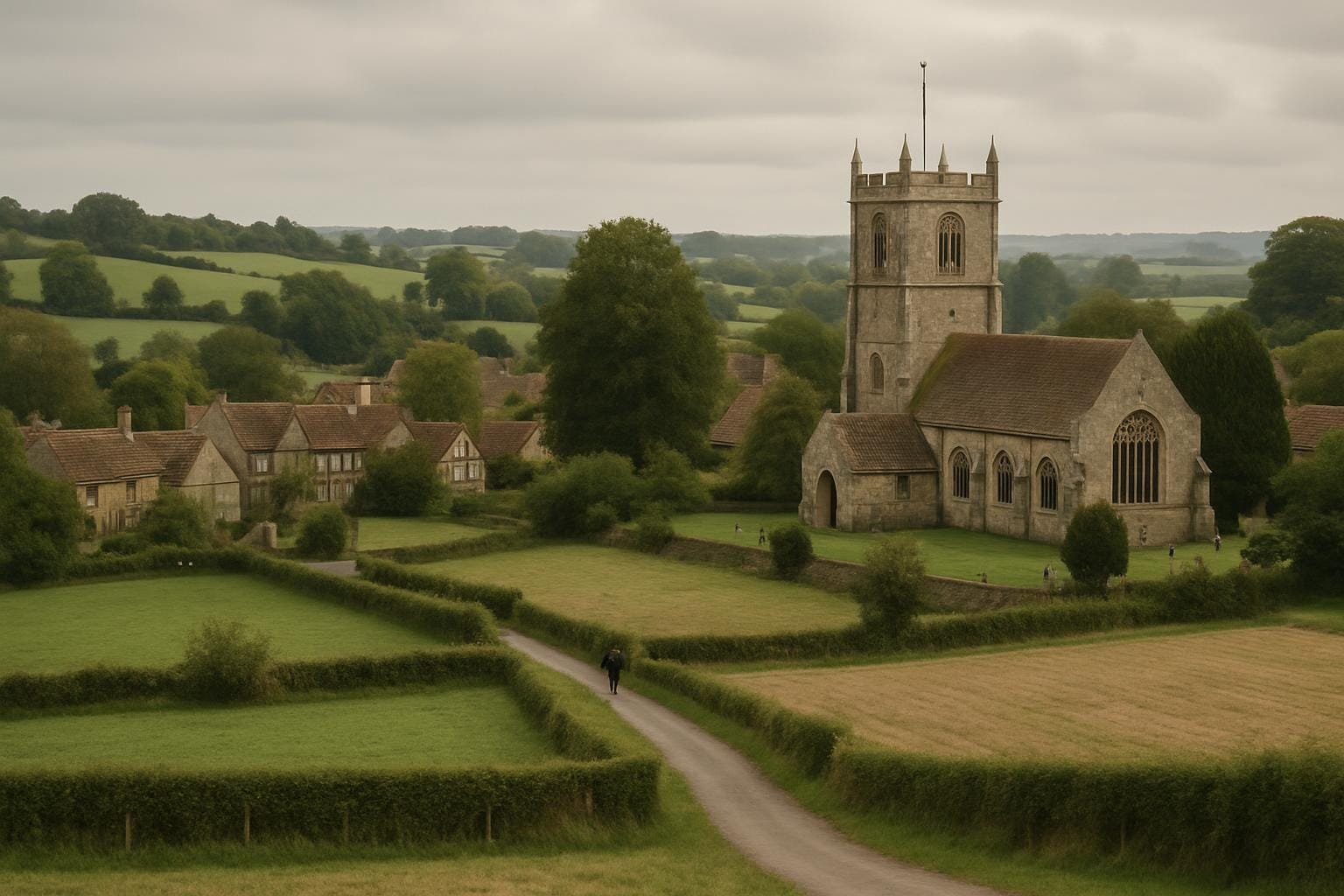
This is the part that keeps pulling me back to Domesday Book sites in England. Reading the printed text or the online database at Open Domesday gives you quantity — names, figures, a sense of spread. Going to the actual place gives you texture: the slope of a field, the way a church tower dominates a tiny settlement, the distance between a manor house platform and the river that probably flooded far too often.
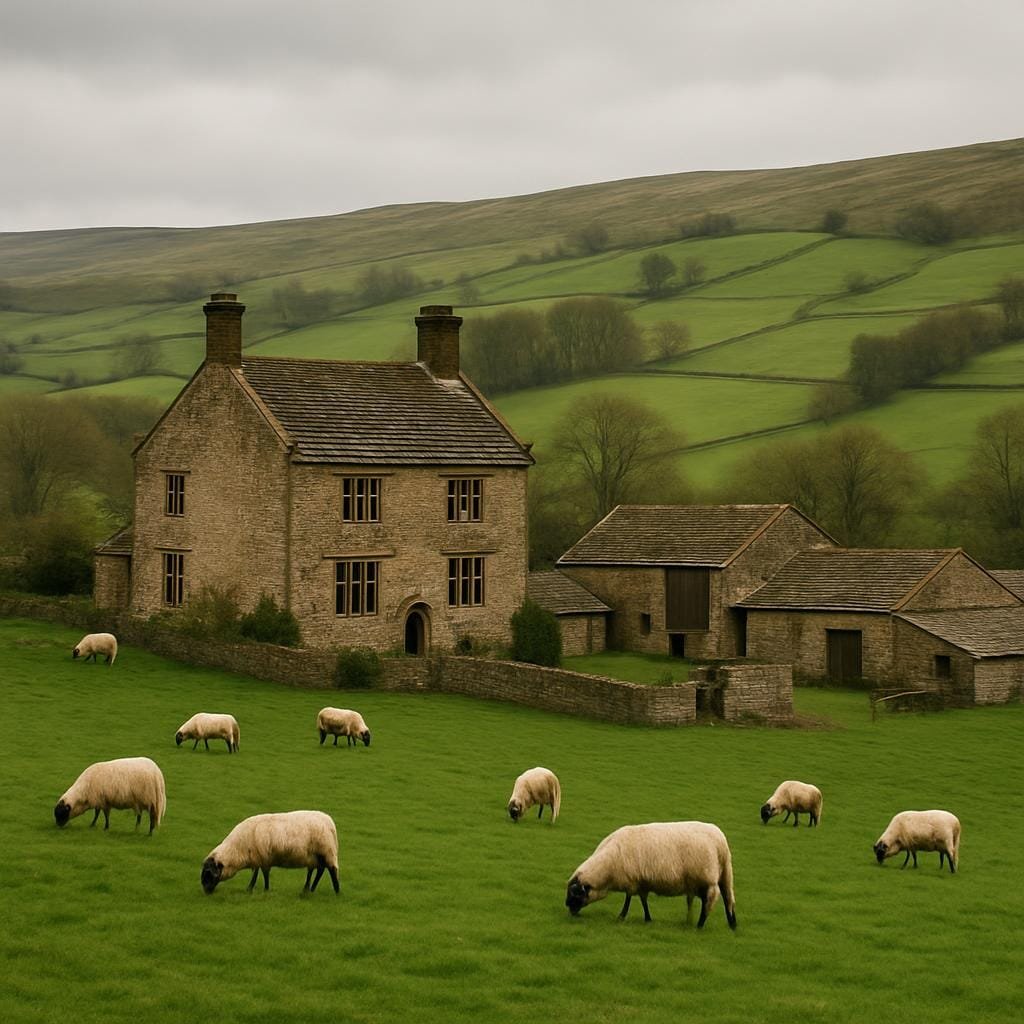
At Wharram Percy in North Yorkshire — a deserted medieval village, recorded in Domesday as “Warran” — the ruined church stands above the hollowed-out house platforms. When I first walked there, the main thing I felt was wind. Strong, insistent, blowing straight up the valley. Domesday tells you “6 villagers, 2 smallholders, meadow 12 acres”. The wind isn’t on the page, but it shaped their daily grinding walk up and down the slope, the way they built their houses, the way smoke dragged from their hearths.
Standing there, you grasp why the king’s commissioners asked about meadow and ploughs: because getting food out of this kind of marginal land was a constant, bodily effort. A woman in Wharram Percy in 1086 didn’t lie awake worrying about constitutional change. She worried that the ox with the bad foot might go lame before ploughing was done.
I used to treat Domesday like a reference book: useful, slightly dull, good for essays. Then I started visiting the places and got ambushed by the human detail Domesday doesn’t bother recording but completely depends on.
A mill in the book means a man whose hands smell permanently of wet grain and woodsmoke, a girl sent to the mill from an outlying farm with a sack too heavy for her, cursing the miller’s toll. “Woodland, 2 leagues long” in the survey means people going in to cut firewood, arguing about who can take what, telling stories about wolves or outlaws as they walk back in the dark.
If there’s one thing I’d rewrite in the textbook version, it’s this: Domesday wasn’t the final word on a fixed medieval order. It was one hurried attempt, in an unsettled kingdom, to pin down a messy, breathing, arguing society long enough to tax it. The marvel is that so many of the places pinned to the page — from Deerhurst and Ely to Derby and Droitwich — still exist in ways you can feel under your feet.
Next time you see a Domesday entry quoted on a heritage panel, it’s worth asking: what has been left out for neatness? And if you have the time, go and stand where those 11th‑century peasants stood and read it again. The book doesn’t change, but your sense of it absolutely does.