
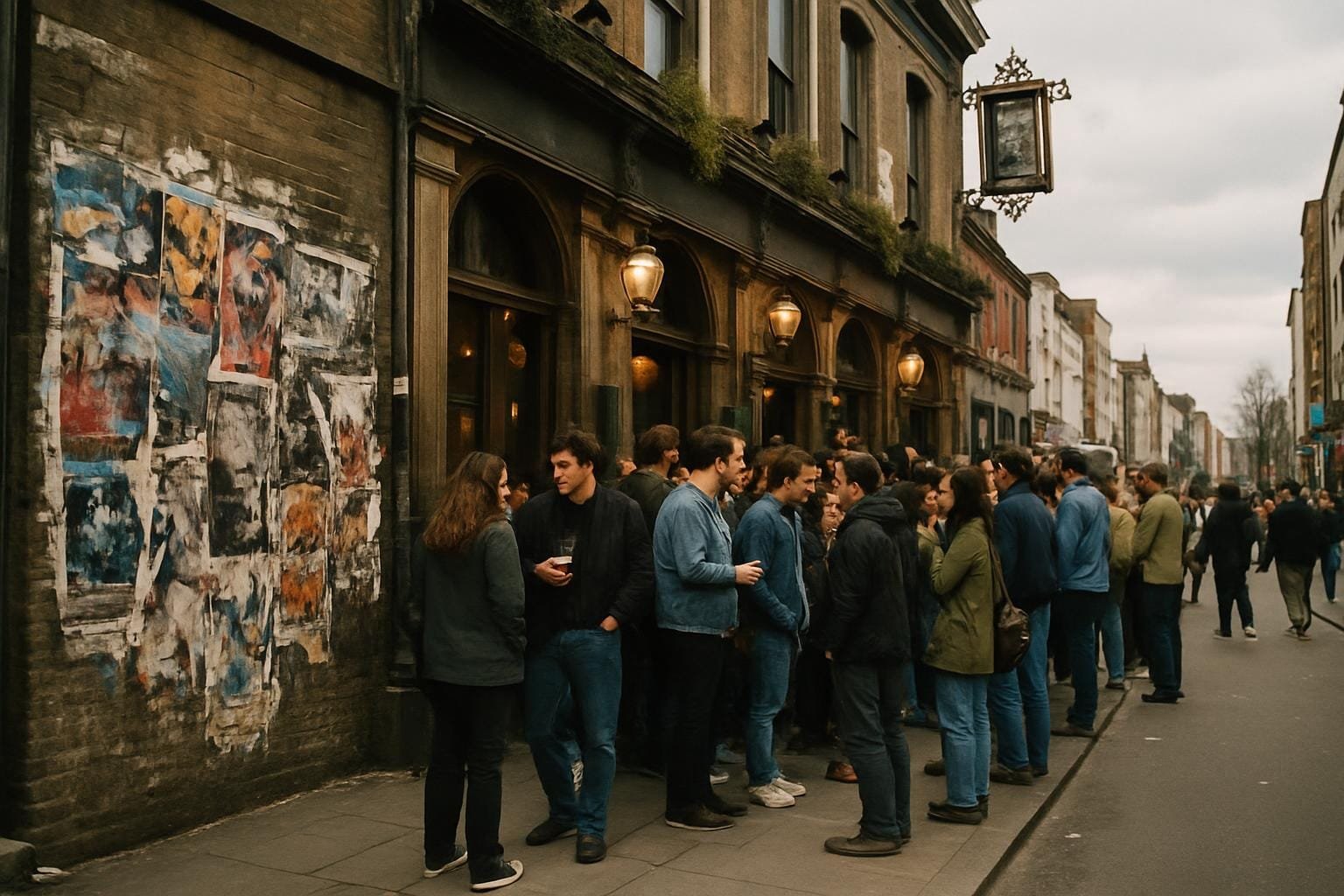
If you’d told me at fourteen that one day someone would ask me to write about a “Blur Britpop London walking tour”, I’d have laughed and gone back to taping “Girls & Boys” off the Top 40 on Metro Radio. I was a Newcastle kid; London was that place southerners moaned about on the telly. But the odd thing is, for a lot of us outside the M25, 1990s London lived in our heads because of Blur. It was on cassette in our Walkmans, in The Word performances we watched past our bedtimes, and in the singles rack in HMV that smelt faintly of plastic and teenage panic.
This isn’t a walking route so much as a set of Britpop battlefields stitched together in my memory – pubs, rehearsal rooms, chart shows – most of them in London, none of them tidy enough for a tourist map. Blur happen to be the spine of it, but the story is really about how one city’s hangover from the 80s Thatcher years turned into a kind of national cartoon we all bought into. Some of us still haven’t quite sobered up.
I first heard Blur properly round about 1994, in my mate’s bedroom in Gateshead. He’d nicked his older brother’s copy of Modern Life Is Rubbish. I remember “For Tomorrow” coming on and feeling oddly homesick for a city I’d never been to. The way Damon Albarn tossed in mentions of Primrose Hill and “the Westway” made London sound grubby and real, not glamorous. Not the postcard stuff, the bus stop stuff.
What hooked me wasn’t just the place names, though; it was the very English boredom in there. You can hear drizzle on that record. “Advert” is just pure supermarket anxiety turned into a guitar track. Looking back now, it’s obvious they were reacting to American grunge – all those interviews where they moaned about “imported angst” – but at the time it just felt like someone had finally clocked that sitting on a British bus is weirder than anything in Seattle.
Here’s my first arguable opinion, then: Modern Life Is Rubbish is a better album than Parklife. Parklife might have the big moments – the title track, “Girls & Boys”, “End Of A Century” – but Modern Life is the one that actually understands England. The sadness in “Blue Jeans”, the commuter stasis of “Miss America” – that’s the country as it really was, not the lager advert version that came a year later.
And yes, you can do your own Blur Britpop London walking tour and trace some of those places. Go up to Primrose Hill, stand by the bench, try to feel deep about it. But the thing that made those songs work for a kid 280 miles away was the smallness, the specificness. I didn’t need to see the Westway to feel the clatter of it.
The thing people forget is how much Britpop was sold as a London story even when it wasn’t. Oasis, Pulp, Suede, Elastica, Sleeper – half of them weren’t actually from London, but once the press decided Camden was the centre of the universe, that was that. Every band had to have a Good Mixer anecdote.
Blur, though, really did turn certain bits of the city into shorthand. Camden Palace gigs in ’92. The “Country House” video sending up stately home nonsense. The “Parklife” single launch with greyhounds at Walthamstow Stadium in 1994 – I only saw that on TFI Friday clips later, but it lodged in my head. Greyhounds, tracksuits, Phil Daniels doing his mockney routine like your dad’s mate who won’t stop quoting Quadrophenia. This was a cartoon of the south but, annoyingly, an effective one.
By the time I finally got to London in 1997 for a sixth-form college trip, I’d already built a sort of internal “Blur Britpop London walking tour” in my head. We came out of King’s Cross and I half-expected to see Graham Coxon sulking by a phone box. Instead it was Greggs and diesel fumes. Which, in fairness, is fairly Blur.
I was sixteen for the infamous Blur vs Oasis chart scrap in August 1995. You won’t catch me pretending I was above it. I picked sides like everyone else. In our school it split along predictable lines: Oasis for the lads who played five-a-side; Blur for the oddballs who drew band logos on their rucksacks and had opinions on b-sides.
We all know the stats: “Country House” outsold “Roll With It” and went to number one. I queued in Our Price in the MetroCentre the Monday it came out, because you did that back then, watching the single covers spin round on those wire racks. The CD single had that horrible early CGI artwork; it looked like a Mega Drive game. It didn’t matter. Buying it felt like signing up for something.
In hindsight, it was a ridiculous thing to hang the future of British guitar music on two overproduced singles. “Roll With It” isn’t Oasis at their best – it’s “Supersonic” and “Live Forever” watered down. “Country House” is probably the weakest of Blur’s big hits; I’d take “Charmless Man” or “Chemical World” over it any day. But that fake war in August 1995 did something bigger: it made Britpop feel like a sport. Newspaper back pages, News at Ten segments, the whole bit.
Here’s another opinion some people won’t like: the real casualty of the Blur/Oasis chart spat was Blur themselves. Not in sales – they shifted millions. But “Country House” locked them into that lairy, knees-up image just as they were starting to write far stranger, better songs. Go back and listen to “He Thought of Cars” from The Great Escape; that’s not music designed for “lad culture” pull-outs in The Sun. That’s paranoid, queasy pop that already sounds like it wants to escape the Union Jack bunting.
I saw Blur twice. First time was in 1995 at the (then) Newcastle Arena on the Great Escape tour. I remember the queue snaking round past the car park, denim jackets and Adidas everywhere. They came on, kicked into “Tracy Jacks”, and the whole place surged like a badly poured pint. Damon in a Fred Perry, Graham in his charity-shop cardy, Alex looking like he’d walked out of a bar shift at 3am.
They were tight, but there was this slightly manic edge, like they were working too hard at fun. “Stereotypes” live that night sounded almost nasty, in a good way – the crowd chanting the chorus like a football song. When they did “This Is A Low” near the end, though, you could feel the air change. Suddenly all the cartoon Britain stuff dropped away and it was just this big, oddly moving thing about shipping forecasts and feeling tiny.
Second time I saw them was about ten years later, in 2009, at Hyde Park. Different band, really. Reunion Blur; Graham back in the fold. It felt more like a day out than a gig. Pet Shop Boys DJ set, people with kids on their shoulders, those stupid reusable cups they always run out of by 5pm.
But here’s the interesting part: by then, London itself had changed enough that their old songs felt like period pieces. When they played “End Of A Century” and Damon did his little “renting a flat above a shop” line, I remember thinking: in 1994 that sounded like mundane normality. By 2009 it sounded like fantasy; no one I knew could afford to rent above anything in Zone 2.
So if you want to talk about a Blur Britpop London walking tour, start there. Not at Camden Lock, but at the gap between the city they sang about and the city you can barely afford to buy a sandwich in now.
As someone who grew up in the north-east and now lives in Yorkshire, I’ve always been slightly wary of London myth-making. Britpop made that worse. The press you’d buy in WHSmith – NME, Melody Maker, even Select – written in Soho offices, pretending a bar in Camden mattered more than, say, the whole of Sheffield.
Blur fed that a bit, whether they meant to or not. The “London” in their songs was a certain kind of London: the studenty, art-school version, all second-hand suits and ironic tea-drinking. It left a lot of people out. Yet at the same time, they were the band most interested in the rest of the country. “Bank Holiday” isn’t set in Soho. “Tracy Jacks” could be any nowhere town. The Great Escape is packed with characters who clearly live miles from Zone 1.
Here’s my third contentious point: Blur did more to capture life outside London than Oasis did, even though Oasis had the Manchester card to play. Liam and Noel wrote feelings – huge, big-hearted feelings – but most of their songs exist in some vague pub-heaven where it’s always Friday night. Damon wrote about rented flats, crap jobs, seaside towns. Listen to “Yuko & Hiro” or “Best Days” from The Great Escape – that’s the exhaustion of young people who aren’t going anywhere, which is how a lot of the country felt by the mid-90s.
The first time I heard “Beetlebum” on the radio in early ’97, I was in the kitchen at my mam’s, scraping burnt cheese off a grill pan. It came on Radio 1 between some forgettable Eurodance track and a news bulletin about John Major. The intro sounded like someone had taken a Britpop anthem and left it out in the rain. Slower, heavier, less keen to please.
People love to say this was Blur “going American” – Albarn banging on about Pavement and so on – and sure, the self-titled 1997 album has bits nicked from US indie. But what struck me then, and still does now, is how London-grey it sounds. “Beetlebum”, “On Your Own”, “Death Of A Party” – these are songs by a band who have seen the inside of too many night buses. The drizzle from Modern Life is still there, but now everyone’s twenty-eight and tired.
By this point the big Britpop circus was already winding down. Be Here Now landed like a hangover in August 1997. Kula Shaker and Ocean Colour Scene were clogging up the charts. And suddenly Blur weren’t the cartoon English band anymore; they were this slightly uncomfortable, twisted pop group who sounded more like the weird art kids they’d probably always been.
Another hill I’ll die on: Blur (1997) and 13 (1999) are why the band actually matters. Britpop is why people remember them. The late-90s stuff is full of odd production touches – William Orbit on “Tender”, the broken-radio noise all over “Bugman”, the choir on “This Is A Low” at those 2009 Hyde Park gigs – that showed where British guitar music could have gone if we hadn’t all got nostalgic and conservative once the millennium hit.
I write mostly about food and local culture now, and one thing that always hits me is how certain places soak up certain sounds. There’s a café in Leeds I go to edit pieces in – proper old laminate tables, white mugs strong enough to stop a bullet – and they still have “Coffee & TV” on the playlist, tucked between newer stuff. Every time it comes on, the whole place feels 1999 again. You can smell Marlboro Lights and see those old cardboard coffee loyalty cards.
London in the 90s is like that, only bigger. Even if you never set foot there, Blur wired you into it. The Roundhouse in Camden, the student nights at the Electric Ballroom, dodgy rehearsal spaces in the East End – that circuitry made its way to bedroom stereos in Sunderland and Sheffield and Swansea.
But I think there’s a danger, especially with the way people talk about a “Blur Britpop London walking tour” now, of reducing all that to a heritage trail: here’s the pub, here’s the studio, here’s the flat. It turns something messy and conflicted into something you can stick on a tote bag. Britpop already did that to itself once; we don’t have to do it again.
Since we’re being opinionated, a few quick score-settling notes.
If you really want to make a Blur Britpop London walking tour, you can. Start in Camden, wander past the Good Mixer, nod earnestly at Primrose Hill, cross the river to somewhere Albarn once mentioned in passing. Take photos of graffitied walls and pretend you’re living the lyrics.
Personally, I think the better version is this: pick a Blur album – Modern Life Is Rubbish, Blur, whatever you’ve ignored the longest – stick it on your headphones, and walk round the bit of Britain you actually live in. Through your own city centre, along your own tired high street, past your own closed-down pubs and awkward new-build flats. See how much of it matches what they were singing about.
Because the truth is, the real Britpop battlefields weren’t the London pubs and promo shoots. They were the schools where we argued about singles, the living rooms where we taped the Top 40, the cheap venues where we saw these bands in their messy in-between phases – before the reunion cheques and the polite retrospectives.
Blur just happened to be the band that turned all of that into songs that still fit a bus ride home in Newcastle, a hungover walk through Leeds, or, yes, a sulky trudge across a rainy bit of north London. That’s why they lasted. Not the Britpop branding, not the Parklife lager adverts in waiting – the fact that they sounded like everyday British life was slightly ridiculous and slightly sad, and people were making the best of it anyway.
And if that doesn’t win any arguments about which band “won” Britpop, good. The whole thing was a daft competition to begin with. The records are what stuck. The rest is walking tours and pub stories.