
I always trace my obsession with Amy Winehouse back to a scratched supermarket CD copy of Frank I bought in late 2004, chucked in one of those two-for-£10 deals between Keane and The Killers. I was 19, back home in Newcastle for Christmas from a rubbish first term at uni, working breakfast shifts in a greasy spoon and smelling of chip fat 90% of the time. Somebody had mentioned this jazz-y singer from London with “a voice like she smokes your granddad’s fags” – that was the line – and I thought it sounded daft enough to be interesting.
I stuck Frank on my cheap little CD player in my childhood bedroom. “Stronger Than Me” came in all lazy drums and shrugging guitar, and then that voice – conversational and slightly irritated, like she’d been made to repeat herself one too many times. I remember thinking: this isn’t show-off singing, this is someone telling you off in a pub. It felt closer to a row outside Mood Bar on the Bigg Market than anything I’d been sold as “jazz” before. That was my first step into what people now shorthand as “Amy Winehouse Camden”, as if it’s a neat little brand. It wasn’t neat. It was messy as hell – that’s what made it real.
By the time Back to Black landed in 2006, I’d started coming down to London a couple of times a year. Cheap coach from Newcastle, £1 shots in somewhere sticky off Oxford Street, then the Northern Line up to Camden because that’s where the bands were. Or so everyone said. It was the era when every student flat had Whatever People Say I Am and Back to Black on the shelf, like compulsory modules.
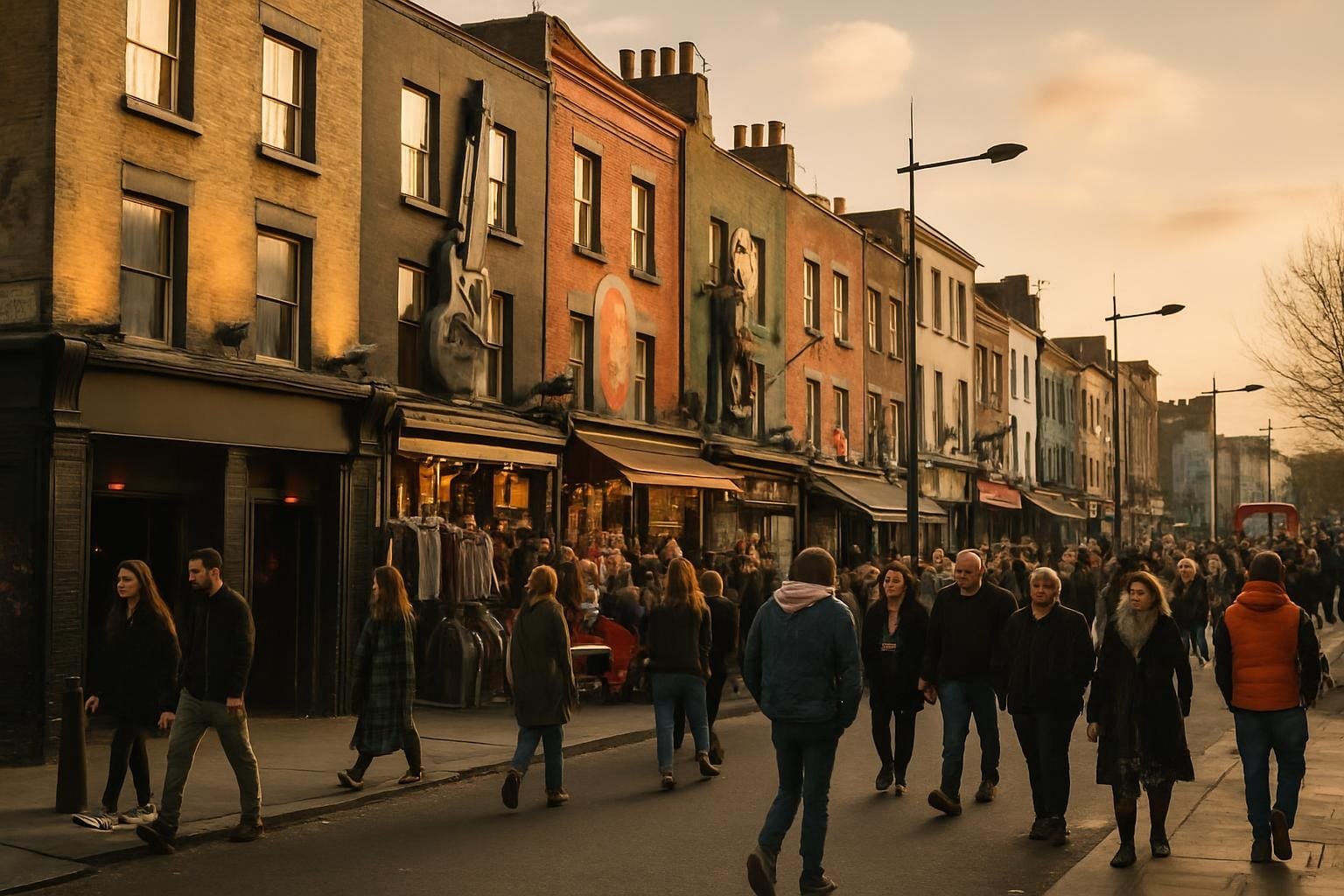
People talk about “Amy Winehouse Camden” now like it’s all murals and guided walks, but back then what stood out to me wasn’t the mythology – it was how ordinary the area felt for somewhere that loomed so large over British music. Electric Ballroom looked smaller in real life than it did in the NME pages. The Dublin Castle felt like any other decent pub venue, just one that happened to have shaped whole chunks of British guitar music. That’s the thing about Camden: half of its reputation rests on how small and human the buildings actually are.
Amy fit that scale. She wasn’t some stadium pop star airlifted in with dancers and pyros. She’d turn up at The Hawley Arms, at the Monarch, at Jazz Café – or so every bloke at the bar said. I only ever saw her once in Camden, and it was nothing glamorous: she walked past KFC near the station one afternoon, big beehive, skinny jeans, a vest that had seen better days, carrier bag on one arm. She looked like any other local with a hangover. That was 2007, around the time “Rehab” had hit number one in the UK and the Americans were pretending they’d discovered her.
I’ve argued about this in more than one beer garden: did Amy shape Camden, or did Camden shape Amy? I honestly think we overstate the Camden bit sometimes. The real roots of her sound are in the records she rinsed – Sarah Vaughan, Donny Hathaway, girl groups on scratched vinyl – and the producers like Salaam Remi and Mark Ronson who wrapped her songs in that 60s soul and boom-bap hip hop shell. Frank doesn’t sound “Camden” at all in the lazy indie sense; it sounds like a jazz nerd who’s spent as much time with Nas as with Ella.
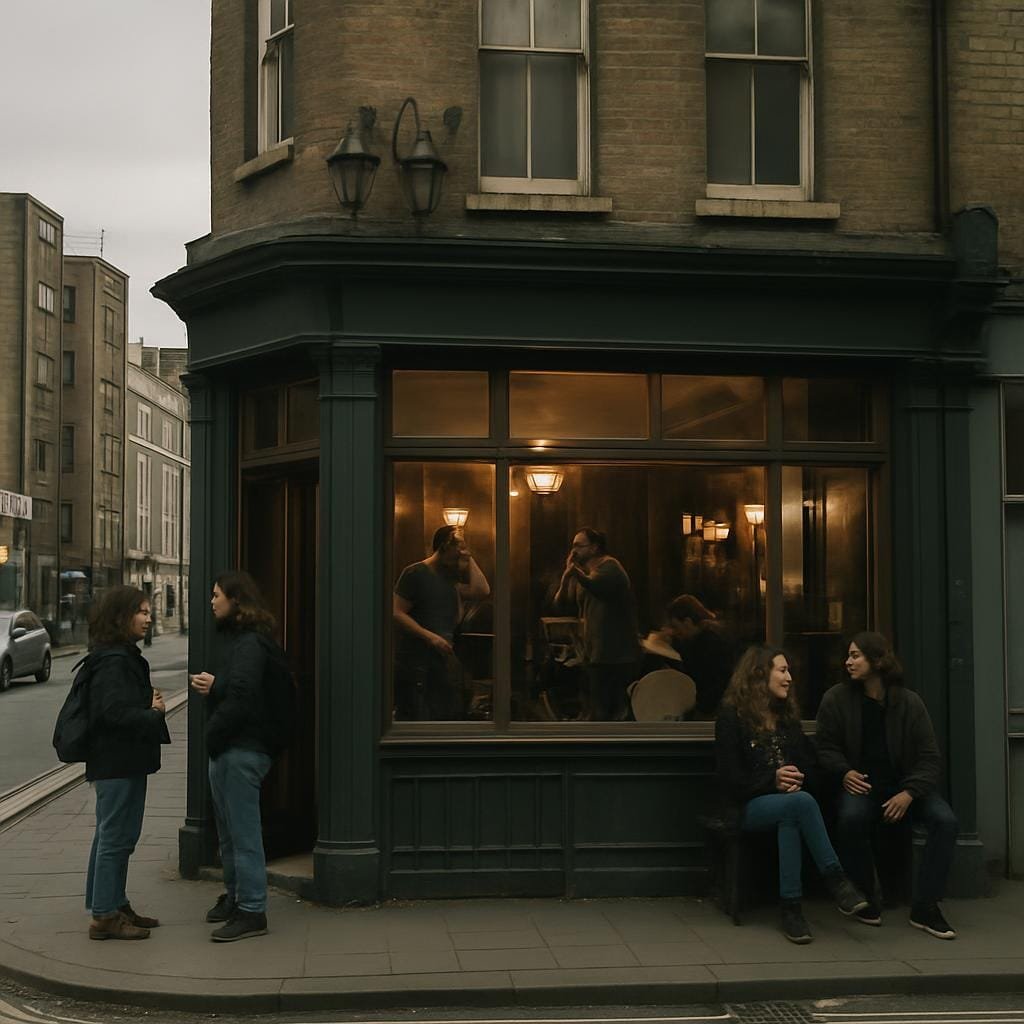
But Camden did give her two things that matter: the pub-as-living-room culture, and the feeling of being permanently watched. Old Camden – pre-chain burrito bars – was built on those dark corners where the staff know your name and your drink and your recent disasters. You hear that in the lyrics to “You Know I’m No Good” and “Love Is a Losing Game”: it’s booze-soaked, chatty, full of people who know each other’s business. That’s not some generic “London” thing; it’s the pub microclimate, and Camden has it in spades.
The second bit – being watched – is harder. Amy became Camden’s unofficial mascot around 2007–2010. Every late-night phone shot of her rolling out of the Hawley, every stalkerish tabloid piece about her on Parkway, turned the area into a sort of permanent stage set. If you walk around the market now and see her face on tote bags and T-shirts, that’s the residue of how much she was used as a selling point even while she was still alive.
I’d go as far as saying this: Camden did for Amy what Britpop did for guitar bands – it gave her a bigger story to be squeezed into, and then it swallowed her whole. That doesn’t mean Camden killed her. It means the obsession with “Amy Winehouse Camden” can sometimes flatten the actual person behind those songs. She deserved better than to be turned into a postcode.
The clearest memory I have of Amy’s music in Camden isn’t a gig. It’s a shuffle of punters crammed into the bar at Electric Ballroom before The Cribs played in early 2007. The DJ – one of those indie lads who thought he was John Peel because he’d heard a Pavement B-side – dropped “Rehab” between The Twang and The View.
Instantly, the room shifted. People who’d been too cool to dance to “Chelsea Dagger” five minutes earlier were singing along word for word. The lads in Fred Perry, the girls in Topshop tube dresses, the older bloke in a Stooges T-shirt – all of them. You could feel something connect that went beyond “here’s a good pop tune”.
What struck me was how un-bombastic “Rehab” is for a song that big. The horns strut, the drums clip along, but the vocal is almost conversational, like she’s leaning over the bar telling you exactly what happened with the record label. No grand chorus, no gospel key change. That looseness made it slot into Camden nights in a way a more polished song never would have. It was bar talk with an arrangement.
Looking back, that’s when Camden became a shorthand for that whole mid-2000s soul revival. If you liked Amy, you probably also had the first Duffy singles, maybe some Corinne Bailey Rae, a bit of Adele before Adele-mania. But Amy’s scruffier phrasing and messy life made her feel like the one who really belonged to the boozed-up, late-night side of the city. “Amy Winehouse Camden” stopped being a location and turned into an attitude.
The Hawley Arms has almost become a theme park of itself since the fire in 2008 and the subsequent rebuild. I liked it before the blaze, and I still like it now – the upstairs terrace is one of the better places to lose a Sunday afternoon if they’ve got a decent beer on. But I’m suspicious of how much the place has been folded into the official Amy story.
Ask anyone doing a sentimental recap and they’ll tell you Amy “held court” at the Hawley, smoking and chatting to locals like a queen. Sure, she drank there, sang there, and reportedly poured pints more than once. But here’s my arguable claim: the pub is less important to her music than Camden likes to admit. The emotional heft of Back to Black doesn’t come from a specific bar. It comes from the rawness of a relationship that she then framed through all those 60s girl group tropes – Phil Spector atmospheres without the syrup.
You want to hear the Camden that actually fed into her sound? Go to Jazz Café. It’s where UK soul and hip hop quietly got on with it when the music press was still obsessing over The Libertines. In the early 2000s, before Amy broke big, that room hosted people like Guru’s Jazzmatazz project, Jill Scott, and a raft of neo-soul acts that never got daytime Radio 1 play but massively shaped the scene. When Amy slipped rap cadences into songs like “You Know I’m No Good”, that wasn’t some random quirk. It was the sound of someone steeped in that cross-pollination.
I saw a young Plan B do a support set there in 2005 – before he went all Motown gloss and chart choruses. Just a scrawny white kid with a guitar, half-rapping, half-singing about council estates. When Amy later brought him on for a remix of “She Said” and talked about loving his early stuff, it made absolute sense. That mix of soul vocals and raw storytelling was all over Camden long before anyone printed Amy’s face on a shot glass.
I can’t write about Camden without mentioning the food, because that’s how I measure any area. Mid-2000s, the market was a mess of falafel, cheap noodles, greasy burgers and the odd jerk chicken stall if you were lucky. It wasn’t destination dining; it was fuel. You’d grab a polystyrene tray of something saucy, stand by the canal, and hope a pigeon didn’t nick your chips.
What always struck me was how unfussy it all was. No one was Instagramming their skewers. You ate to soak up the booze or to get through a long afternoon of record shopping and people-watching. In a strange way, that chimes with Amy’s whole thing. For all the retro styling, her singing was unvarnished. Listen to “Wake Up Alone” on Back to Black. You can practically hear her lungs strain on the higher notes, that tiny rasp at the end of a phrase where someone more schooled would have rounded it off. It’s the vocal equivalent of grabbing a doner at midnight because that’s what’s there – imperfect, direct, exactly what’s needed in that moment.
People love to bang on about “authenticity” with Amy – the fags, the eyeliner, the tattoos. I think that misses the point. What made her feel real wasn’t the look, it was the way she let rotten thoughts sit uncomfortably in the songs. The line in “Back to Black” where she basically admits to going back to someone who’s awful for her – there’s no redemption, no Instagram-quote empowerment. Just weakness, set to a drum sound nicked from a 60s B-side. Camden, in its better moments, has the same refusal to tidy itself up. Even now, with every other stall selling bubble tea, you still get whiffs of weed, burnt onions and stale beer under the perfume of gentrification.
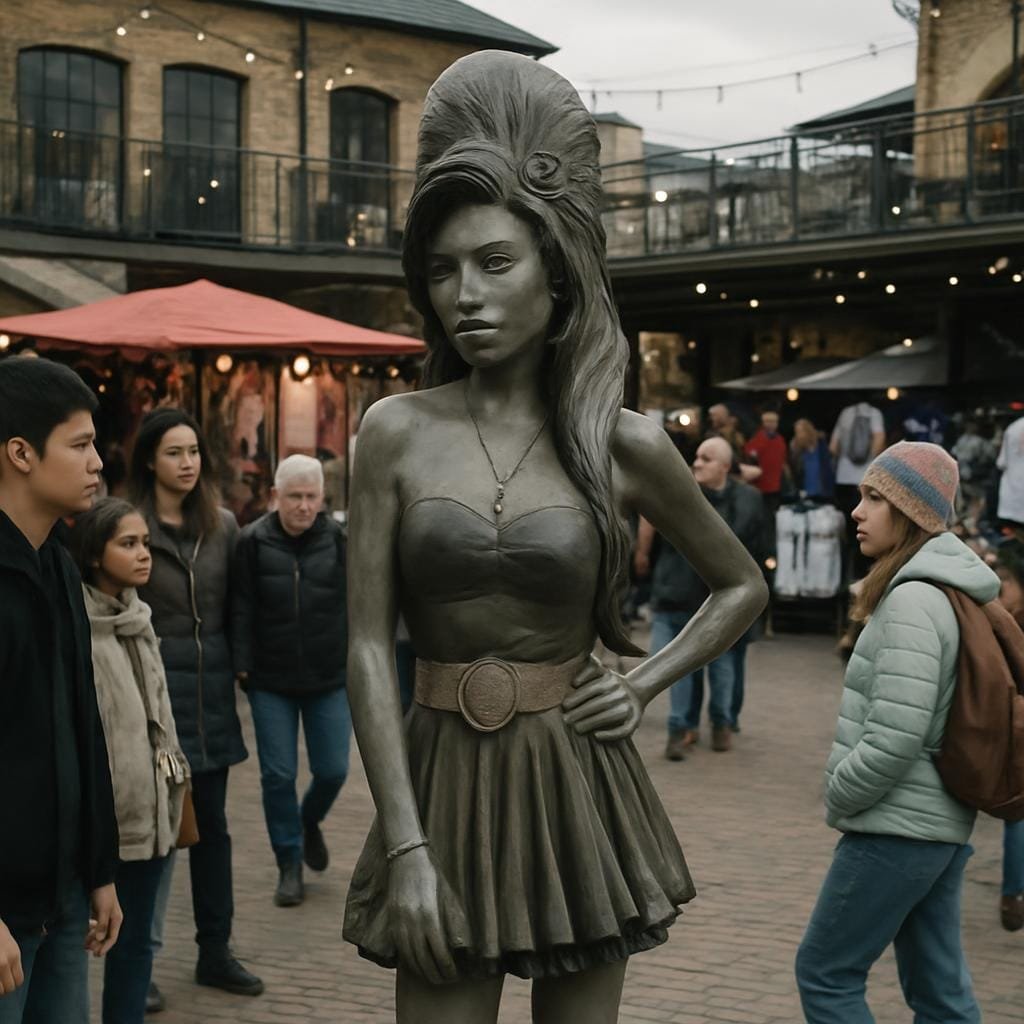
The first time I saw the Amy statue in Stables Market – the bronze one by Scott Eaton, unveiled in 2014 – I didn’t know how to feel. It’s a good piece, nicely observed, hand on hip, beehive intact. People queue to take selfies with it. I watched a group of American tourists in matching raincoats doing duck faces beside it while one of them hummed “Valerie” like that’s all she’d ever recorded.
Here’s my problem: “Valerie” has almost swallowed her catalogue. The 2007 Mark Ronson version – which hit number 2 in the UK – is a banger, yes, but it’s a cover of a Zutons tune, and sometimes I think it lets people off the hook from engaging with her own writing. If your Amy playlist is “Valerie”, “Rehab”, and maybe “Tears Dry on Their Own” because it sounds a bit like Motown, you’re missing the bite in tracks like “Addicted” or the way she talks about family in “What Is It About Men”.
The statue, the murals, the “Amy Winehouse Camden” T-shirts – they all freeze her in the Back to Black era, mid-2000s, beehive and ballet flats. They don’t leave much room for Frank, for the earlier, jazzier Amy taking the piss out of boyfriends over brushed drums. They definitely don’t leave room for the idea that she might have changed, grown, done something completely different if she’d had the time.
I stood there that first time, watching people try to find the best angle for a photo, and felt oddly protective. Like they were crowding someone who’d already been crowded to death.
It would be easy to write Camden off as a museum of its own past, coasting on faded roughness and Amy’s ghost. That’s lazy. For all the chain shops and overpriced street food, it still has the thing that mattered most for Amy: rooms where the sound comes first and the polish second.
Walk into the Dublin Castle on a Tuesday night and you’ll still find guitar bands trying to chase the same local-to-national path Madness did in the late 70s. Head to Jazz Café and you might catch a future Mercury nominee on an early tour doing the hard work before anyone’s printed T-shirts. Sit in The Hawley on a rain-dragged Monday and hear a singer-songwriter testing new material at an open mic to a room half-full of people actually listening. Those are the conditions that made Amy possible – not the giant posters, not the merchandise, but the repetition of small, semi-anonymous nights where love of music is the only reason anyone’s there.
I sometimes think the best way to honour Amy in Camden isn’t to join the fan circuits, but to duck into a gig by someone you’ve never heard of, buy a 7-inch from the support, then argue with your mates about whether the headliner was all that over chips on Camden High Street. That’s the cycle she came from. She was a punter and a fan before she was a statue.
The last time I did a full wander round Camden thinking about Amy was 2018. I’d come down from Yorkshire for a few days, supposedly to write about London bakeries, but I snuck off one afternoon, hopped on the tube and let myself fall back into old habits. Coffee from a stall, a nosey in Rough Trade, half an hour people-watching by the canal.
“Back to Black” floated out of a vintage clothes shop – the title track, not the album as a whole. I caught the bit near the end where the backing vocals almost overwhelm her lead, like the past is trying to swallow her whole. I thought: that’s what’s happened with this whole “Amy Winehouse Camden” thing. The backing track – the area, the stories, the tabloids, the statue – has got so loud that it can be hard to hear the woman at the centre.
But if you tune your ears right, she’s still there: in the way a young singer on a tiny stage phrases a line slightly behind the beat; in a DJ slipping “Me & Mr Jones” into a set between grime and garage; in someone ordering a double at the bar and muttering that line about trying to make them go to rehab like it’s an in-joke.
I walked back towards the tube, past the usual mess of traffic and tourists, thinking about how small Camden actually is compared to its reputation – a handful of streets, a few pubs, some sticky-floored venues. For all the murals and the myth-making, it’s still, fundamentally, a place where you can duck into a room and hear someone risk embarrassment onstage in front of a handful of people. That’s the Camden that shaped Amy, and the Amy who, in turn, gave Camden a face it’s still struggling to live up to.
If you care about her, don’t stop at the statue. Put the records on. All of them. Hear the jazz nerd of Frank alongside the heartbroken 60s soul of Back to Black. Argue about which is better over cheap noodles or an overfilled pita from the market. That’s the best kind of music pilgrimage: one where the songs aren’t background to the streets, but the other way round.