

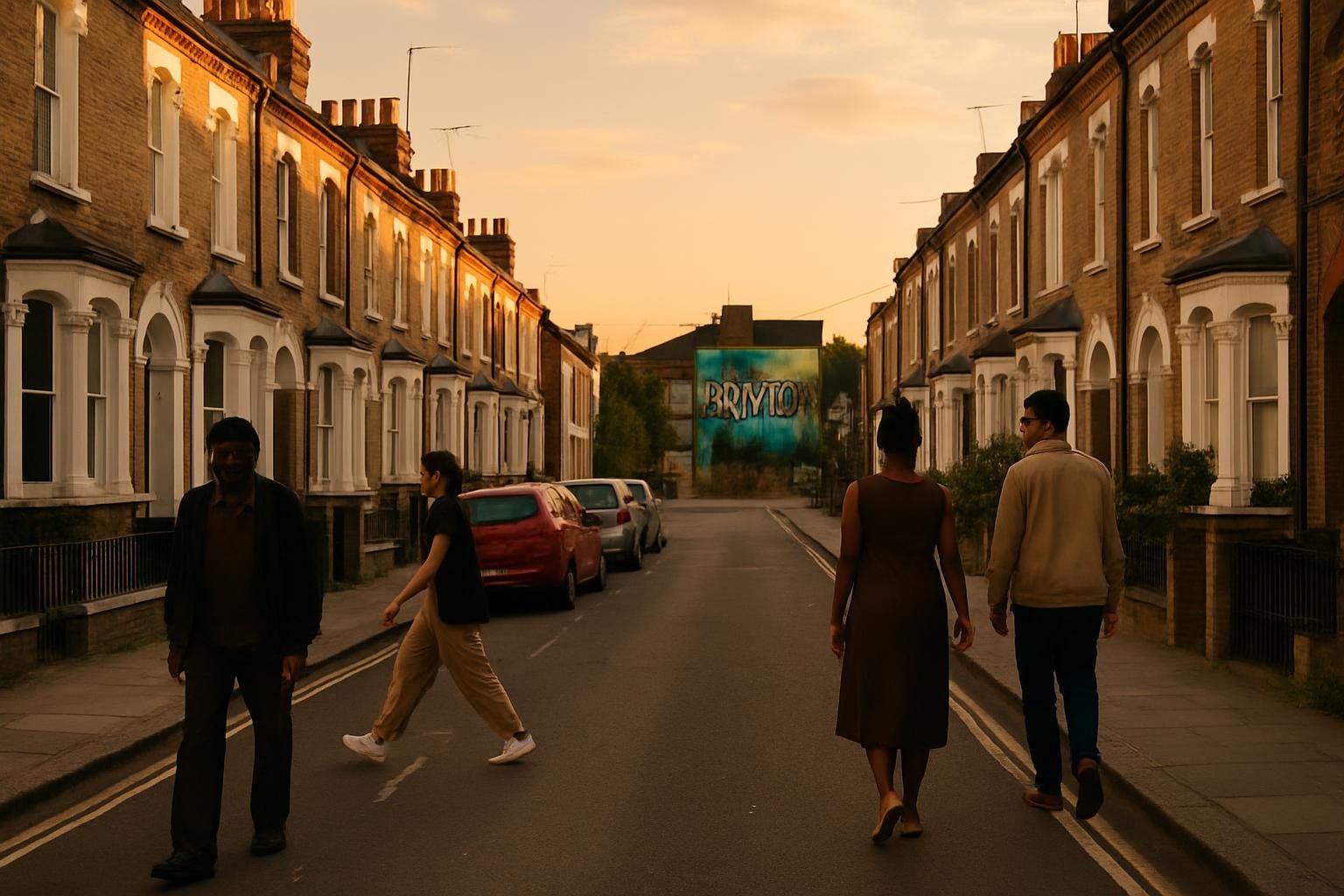
I’ve always hated those “David Bowie London travel guide” listicles that tell you to stand outside Brixton station, take a photo with the mural, then go for a flat white and feel like you’ve touched greatness. Bowie deserves better than being reduced to a mural crawl. If you’re going to follow his trail through Britain – London and beyond – the point isn’t ticking off locations; it’s chasing sounds, accents, and bad decisions. Bowie used places the way he used personas: as raw material. The geography is in the grooves if you’re actually listening.
I grew up in south-east London, and that matters here. By the time I was about thirteen – this would’ve been late 90s, when every second lad in my school had a Nirvana hoodie – I pinched my dad’s copy of The Rise and Fall of Ziggy Stardust and the Spiders from Mars. He’d bought it in 1972 from some record shop long gone near Lewisham Market. I didn’t care about the cover story; I cared that “Moonage Daydream” sounded like aliens starting a pub fight.
Knowing Bowie was born in Brixton then dragged out to Bromley turns the early records into social history. You can hear grey south London bus routes all over the first album and David Bowie (the 1969 one, the “Space Oddity” one). Those slightly too-theatrical vocal affectations? That’s a kid from the suburbs practising being anyone else. The often-forgotten Deram period isn’t just juvenilia; it’s a boy from Beckenham trying Carnaby Street on for size and finding out it doesn’t quite fit.
People go on about Berlin shaping Low, but for me, London is all over “The London Boys” from 1966. It’s literally about bus-hopping into town for the Saturday night mod fix, pills, and validation. You don’t need a David Bowie London travel guide to hear the city – it’s in the way he sings “London” like it’s both a prize and a trap. Anyone who’s ever trudged home on the night bus in a ridiculous outfit knows that tone.
Here’s my arguable position: Bowie’s real creative ignition doesn’t start in Soho or Berlin; it starts in drab, commuter-belt Beckenham. People romanticise the King’s Road and the Thin White Duke staggering through Los Angeles, but the Beckenham Arts Lab at the Croydon Road Recreation Ground is where the weirdo community thing began. Without that scene, Ziggy’s just fancy dress.
When I finally wandered down there in my twenties, it was because I’d worn out “Memory of a Free Festival” on some cheap compilation. The song is Bowie trying to turn a fairly shambolic local event into a hymn. He sings about kids, sunlight, and a pipe organ, but what’s really going on is social: a bunch of outsiders building their own culture because Bromley High Street wasn’t going to do it for them.
Beckenham explains something about Bowie that people miss when they only talk about the fame years. He knew suburbia’s boredom intimately, which is why he could write a character like Ziggy who felt like both salvation and con. The Spiders from Mars weren’t just a band; they were every half-decent local group that suddenly finds a frontman with delusions of grandeur and a manager with coke money.
I was around sixteen when Hunky Dory properly landed for me. A mate put “Queen Bitch” on at a party – everyone else was arguing about who was better, Blur or Oasis, and this Velvets pastiche came swaggering out of the speakers like it owned the house. That was the moment I clocked that Bowie’s London was as much in his record collection as in any postcode.
Listen to “Changes” and “Life on Mars?” now and it’s impossible not to picture an imaginary London: part West End musical, part Camden freak-out. You can hear the influence of BFI-season arthouse cinema in the way he writes – jump cuts, close-ups, then pulling back for a chorus that feels like Piccadilly Circus at rush hour. It’s no accident that “Life on Mars?” was filmed as a promo at BBC Television Centre in 1973 with just Bowie, a blue suit, and a white backdrop. That clip turned up endlessly on late-night TV; I remember seeing it on Top of the Pops 2 around 2001 and realising half of Britpop had nicked its sense of theatre.
Here’s the thing: London doesn’t just appear in the lyrics. It’s in the way those records sound like they were made by someone who spent as much time in libraries and cinemas as in gigs. That’s a very British kind of self-education – cheaper than art school, richer than any “scene”.
Everyone knows the Heddon Street cover shot for Ziggy Stardust. It’s basically turned into a compulsory box-tick for every David Bowie London travel guide. I’ve walked through there a few times in the rain, just to see what it felt like. Truth? It mostly felt like a loading bay behind Regent Street with a plaque and somewhere that sells overpriced burgers.
What matters about Heddon Street isn’t the physical spot; it’s what that alleyway did to British kids’ minds when they saw the cover in 1972. It said: your grey, grubby capital can be a stage set. The same way the Beatles turned a zebra crossing into pop mythology, Bowie turned a service alley into a portal. But we get it backwards if we go there like pilgrims and ignore the music.
“Five Years” and “Suffragette City” don’t sound like Soho as it really was; they sound like Soho as a Bromley boy imagined it – seedy, glamorous, and slightly ridiculous. By the time he brought the Ziggy tour to the Hammersmith Odeon in July 1973 to “retire” the character, you had provincial kids turning up in make-up, treating west London like a theatre foyer. That gig isn’t famous because of the venue; it’s famous because Bowie gave everyone permission to be the weirdest person on their street for one night.
I’d argue we’ve started treating sites like Heddon Street the way boomers treated the Cavern Club – as shrines. It’s heritage rock. Unless you’re actively thinking about what Bowie was doing to gender, to performance, to rock star behaviour, you might as well be queuing for a selfie at Madam Tussauds.
Here’s where I’ll fight another corner: Bowie is routinely framed as a London artist who temporarily went abroad, but a lot of the most interesting British textures in his work come from being away from the capital. I’m convinced Station to Station – that glossy, paranoid record from 1976 – makes more sense if you think of it as spiritual motorway music, the sound of someone mentally driving up and down the M1 without ever stopping.
Take “Station to Station” itself: the crackling intro, the slow build, then the shift into something that feels almost like glam-krautrock designed for service stations at 3am. It’s got more in common with staring out of a train window between London and Birmingham than with LA sunshine, despite being partly recorded there. It’s a British insomnia disguised as continental cool.
I didn’t get that until I started doing band runs up and down the country in my twenties, crammed in the back of a Transit, watching industrial estates flick past. Stick that track on somewhere between Watford Gap and Leicester, and suddenly Bowie’s Thin White Duke persona – all aristo zombie and grand gestures – feels like a posh kid going quietly mad in the quiet carriage.
If you want a real David Bowie London travel guide, pull up old clips from Top of the Pops and ITV instead of chasing plaques. The 1972 “Starman” appearance is the obvious one – him putting his arm around Mick Ronson and causing half the country’s parents to choke on their tea. But it’s the context that matters: this was prime-time BBC, same slot as the football results, broadcasting from Television Centre in W12, straight into semis and terraces across Britain.
When BBC4 repeated that episode in the mid-2000s, I remember watching with a group of mates in a cramped kitchen in Walworth. One of them – usually a punk purist, deeply suspicious of anything “theatrical” – just went quiet and said, “Imagine seeing that when all you had was Showaddywaddy.” That’s the thing: Bowie didn’t overwrite British pop; he sat next to it on the sofa and made it look old.
The late-career Glastonbury 2000 headline set does a similar job. Yeah, Glasto’s in Somerset, not London, but you had Friday-night festival TV on the BBC beaming this lean, hits-heavy Bowie into living rooms again. When he slid from “Life on Mars?” into “Ashes to Ashes”, it was like skipping through the 70s and 80s on an old VHS. I watched it taped off the telly, hungover on a Sunday afternoon, and thought: he’s still ours, still on our screens, even after all the New York years.
I’m going to say something that winds people up: Bowie’s 90s British work – especially around Outside and Earthling – is more interesting than most of Britpop. Not better in a comforting singalong sense, but more curious, more restless. While half the country was throwing pints in Wetherspoons to “Roll With It”, Bowie was on Later… with Jools Holland in 1995 performing dense, awkward stuff like “The Heart’s Filthy Lesson”, sounding like art-school murder music.
I was too young for those albums when they came out, but I caught up at uni in the mid-2000s, when every house party had Definitely Maybe or (What’s the Story) Morning Glory? lying around like furniture. Sticking on “I’m Deranged” after a night out in New Cross felt like Buckinghamshire commuter ennui pushed through a meat grinder – all cut-up lyrics and twitchy rhythms that owed as much to British rave and jungle as to rock.
“Little Wonder” from Earthling is basically Bowie trying to chat with the Prodigy and Goldie at the same time. People mocked the d’n’b snare rushes and his baggy trousers, but I’ll take that over yet another band from Camden doing their best Kinks karaoke. He was still listening, still paying attention to what kids in Hackney and Bristol were cooking up in small studios. That alone makes his 90s British output worth more than the nostalgia acts that clogged up Top of the Pops around the same time.
By the time The Next Day dropped in 2013, I was working near Soho and walking past the Brixton mural on the Victoria line at least once a week. I remember that album launching with that cover – the Heroes photo defaced by a white box – and thinking: here we go, nostalgia bait. Then I actually played it on the bus home down the Old Kent Road and heard something else entirely.
“The Stars (Are Out Tonight)” and “Where Are We Now?” feel like songs written by someone who can still picture mid-60s London, with bomb sites and coffee bars, but is now standing behind a Waitrose till. There’s a sort of dignified bafflement in the way he sings about time passing that hits harder if you’re physically watching familiar shops turn into luxury flats on your commute.
Then Blackstar happened in 2016, and every pavement in Britain felt haunted for a bit. I remember playing the title track walking from Elephant & Castle to Waterloo two days after he died. “Lazarus” had been on Channel 4 the week before, that video of him in the bed, and suddenly everyone at work had a story: seeing him at Milton Keynes Bowl in 1983, or queuing outside Virgin Megastore on Oxford Street for Let’s Dance. What struck me was how firmly everyone placed him in British space – venues, record shops, TV sets – even though he’d spent decades based in New York.
If you came here for a step-by-step David Bowie London travel guide with postcodes and coffee recommendations, sorry. The better route is this:
That’s Bowie’s Britain: bus routes and TV studios, youth clubs and art labs, provincial festivals and motorway service stations. London is central, of course – the Royal Albert Hall shows, the Soho all-nighters, the Heddon Street photograph – but the music is bigger than any plaque.
If you insist on using the phrase “David Bowie London travel guide”, let it mean a guide to hearing the city in his work: the yearning of the suburbs, the lure of the centre, the dull ache of leaving and the strange comfort of coming back. Walk wherever you like. Just make sure you’ve got the right record on.