
Until my late twenties, Hadrian’s Wall lived in my head as a single line: one emperor, one big decision, a neat stone barrier keeping “Romans” on one side and “barbarians” on the other. If you’d asked me to picture it, I’d have drawn a straight cartoon wall with a legionary on top and a Scot glowering on the far side. Then I actually went to a few Hadrian’s Wall frontier sites, read a stack of excavation reports, and that cartoon started to fall apart very quickly.
The first shock was how busy the northern frontier was. Not a desolate edge of empire, but a chain of forts, small towns, temples, farms, industrial yards, and the kind of petty bureaucracy that means someone, somewhere, was paid to count every sack of grain. The second shock was how little of this makes it into the tidy version we learn at school. “Hadrian built a wall to keep the barbarians out” is efficient, but it misses out the people whose lives were shaped by that decision – and by the decades of improvisation that followed.
A good place to start is with something that isn’t there anymore: the Antonine Wall. Around AD 142, Antoninus Pius pushed the frontier north into what’s now central Scotland and ordered a new turf wall from the Forth to the Clyde. For about twenty years, that – not Hadrian’s Wall – was the edge of Rome. Then, around AD 160, Rome pulled back to Hadrian’s line.
This is the first thing the textbook version smooths away. The “northern frontier” wasn’t a single, eternal boundary; it moved, sometimes within a single lifetime. If you were a farmer near Corbridge in, say, AD 120, the army arrived and suddenly your quiet patch of the Tyne was a militarised zone. By AD 150, the real action had shifted north. A generation later it was back again. None of that feels tidy if you’re trying to teach twelve-year-olds Roman Britain in two lessons, but it matters for the people living through it.
Archaeologists at Antonine Wall sites have dug up evidence of Roman forts being hurriedly built and then just as hurriedly abandoned. At Bar Hill, for instance, storage pits were filled in and ramparts dismantled in an orderly way – a controlled withdrawal, not a rout. Somewhere in those last weeks a clerk was ticking off inventory: “Two iron shovels, three amphorae, assorted cooking pots, one unlucky auxiliary who drew latrine-cleaning duty until the end.”
For the local communities caught in this shifting line, the frontier meant disruption followed by opportunity followed by disruption again. The army brought coin, contracts, and demand for food and raw materials. Then it moved, and so did the money. A potter with a thriving contract to supply a fort at Rough Castle could find himself, twenty years later, with stock and skills but no customers in armour.
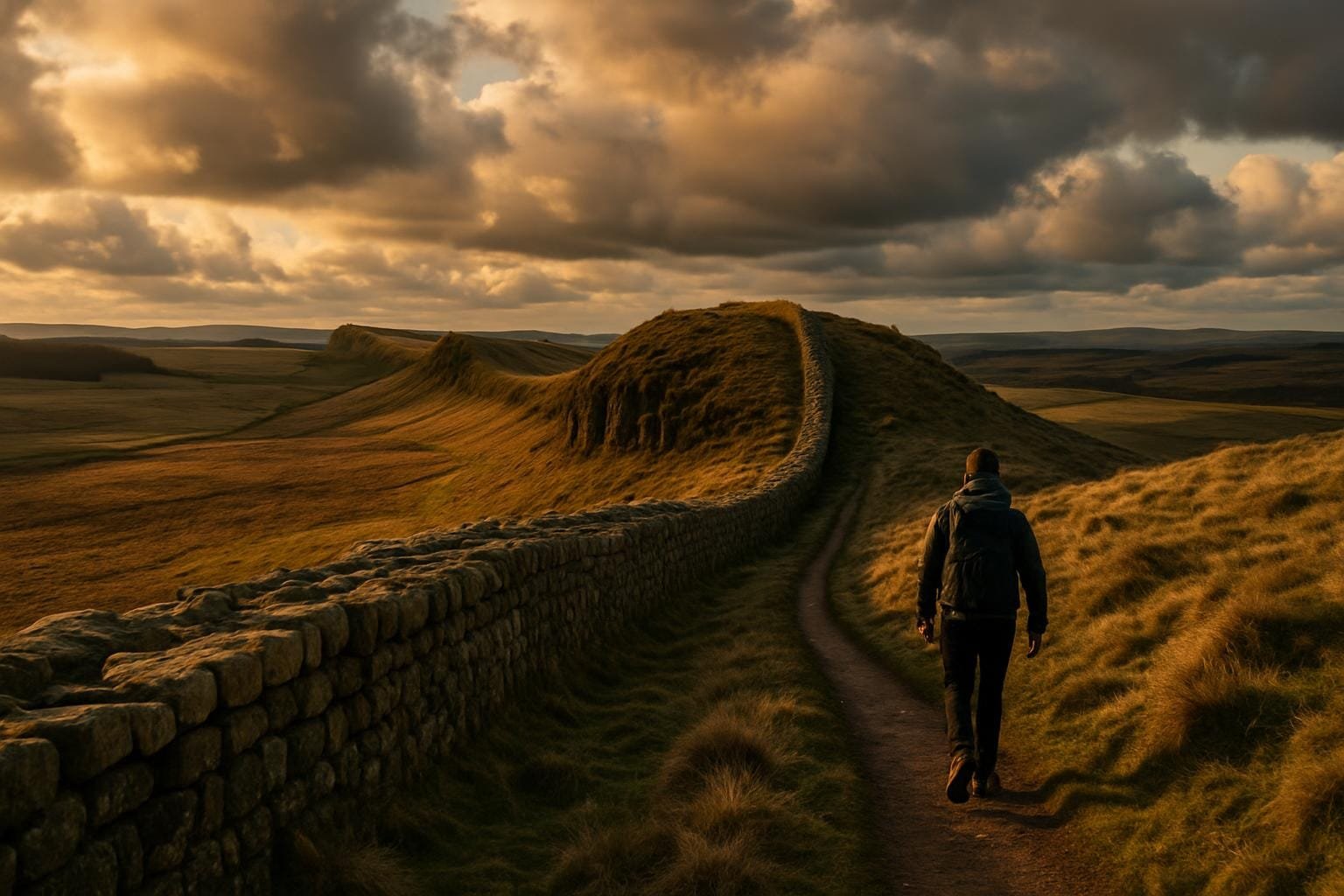
Standing on the Wall at Housesteads one November – cold enough for the wind to feel like it had sharpened its teeth – I tried to picture it from the point of view of someone who wasn’t a general. The official line tends to look down from the top: Hadrian visited Britain in AD 122, ordered a wall “to separate Romans from barbarians”, the legions built it, job done.
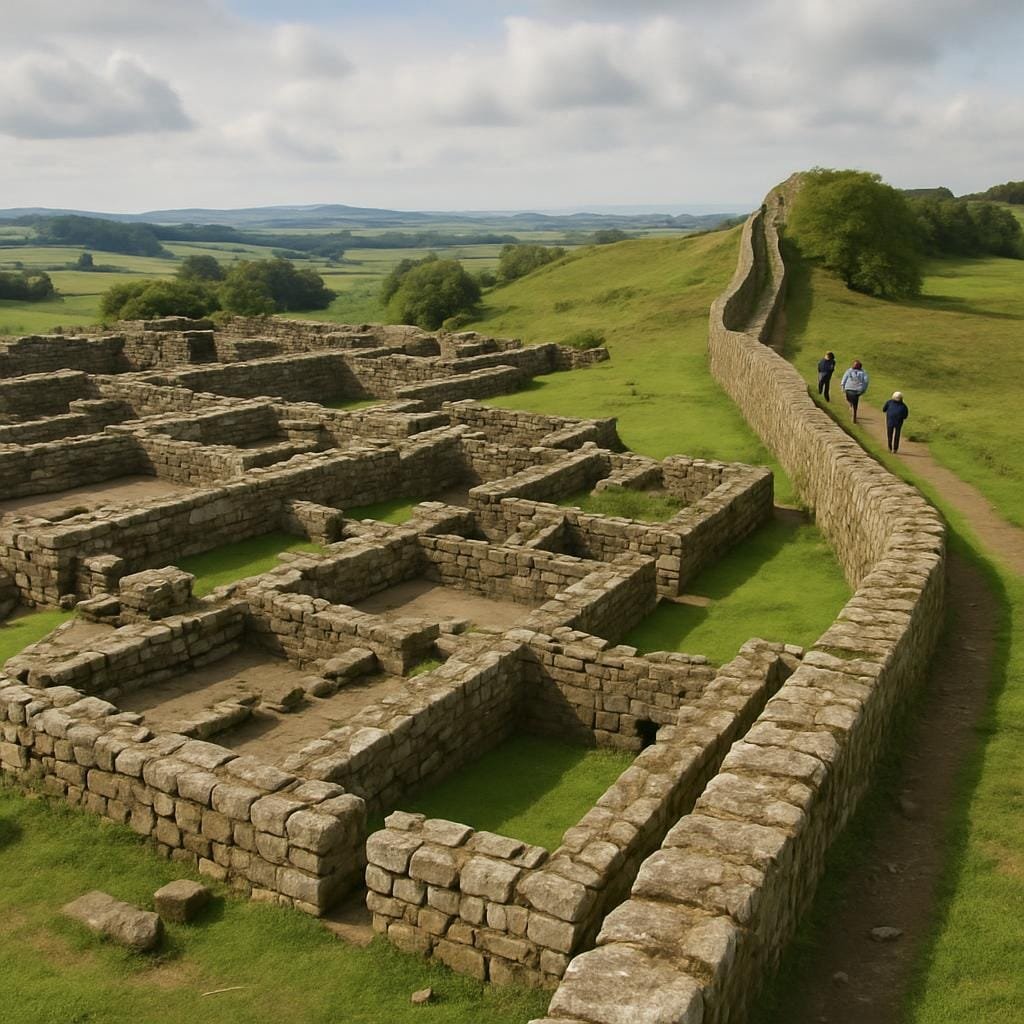
From below, it looks different. For one thing, a lot of the labour was done by auxiliaries, not full citizens of Rome. Units from what’s now the Netherlands, Spain, and Syria spent years moving stone, digging ditches, and arguing over whose turn it was to haul mortar up an icy slope. Inscriptions at various Hadrian’s Wall frontier sites name specific units – the Second Legion Augusta at Walltown, the Sixth Victrix near Heddon-on-the-Wall – but they don’t list the men slogging through the day-to-day work. Yet those are the hands that actually shaped the line we walk today.
Building the Wall altered local work too. Take the quarries. At Haltwhistle Burn, excavation has shown heavy quarrying linked to Wall construction: spoil heaps, cut faces, tool marks. Before the army turned up, this was a rural valley. During construction, it became a noisy, risky industrial zone. Someone had to feed those quarry gangs. Someone had to cart the stone. If you owned a cart and a half-decent horse, the Roman presence could double your income. If you relied on grazing rights where the new quarry road went through, your life just got harder.
And then there’s the garrison life. One of the things that shifted my thinking was reading the Vindolanda tablets – thin wooden letters found in the anaerobic mud at the fort just south of the Wall. They reveal officers grumbling about supplies, a birthday party invitation (“I shall expect you, sister… to make the day more enjoyable for me by your arrival”), complaints about underpants and socks being in short supply. This isn’t the history of big events. It’s the texture of a working frontier: queues at the granary, bullying on sentry duty, trying to keep your shoes dry.
Every major fort on the northern frontier had a vicus – a civilian settlement – stuck to it like Velcro. These weren’t formal “towns” in the way we tend to imagine; they grew up because the army, collectively, had money and needs. Traders, craftsmen, unofficial partners, discharged veterans, and their children all crowded into streets of timber-framed buildings just outside the walls.
At Vindolanda, archaeologists have uncovered rows of such buildings: workshops, taverns, small shrines. A butcher’s shop was identified from the animal bones and waste left in the yard – mostly cattle, some sheep and pigs, cut in a way that matches Roman butchery methods. That tells us people here were eating Roman-style meat cuts, probably stewed with imported herbs or sauces. So if you were a young woman from a native family in the area, moving into the vicus to live with a soldier, your diet might shift from barley porridge and local lamb to beef stew thickened with wine and fish sauce from the south.
This is where the tidy narrative really breaks. Textbooks talk about “Romanisation”, as if Roman culture simply washed across Britain in one direction. On the ground, it looks more like negotiation. In one building at Vindolanda, an altar to a Roman god shows up alongside local religious objects; in others, “Celtic” style metalwork turns up in thoroughly “Roman” contexts. People picked and mixed what suited them.
There’s a human detail I keep coming back to: at several frontier sites, including Vindolanda and South Shields (Arbeia), archaeologists have found small, child-sized shoes. Dozens of them. Soldiers officially weren’t allowed to marry, but they did, informally or later in service, and they had families. Those children ran up and down muddy streets, played near the ramparts, got underfoot in the workshops, and outlived exactly none of the official paperwork. The empire’s northern frontier, in other words, was also the sort of place where someone shouted “Mind the ditch!” at a toddler for the third time that morning.
One thing that broad surveys often sidestep is just how colonial the frontier was. This was an occupation zone. Land was taken for forts, roads, and supply depots. Native communities were divided into those who cooperated and those who didn’t. The historian Tacitus, writing about his father-in-law Agricola’s campaigns in Britain in the late first century, cheerfully describes teaching local elites to wear togas and enjoy Roman-style entertainments as a way to keep them compliant. “And they called it civilisation,” he adds, with acid.
We tend to focus on the glamorous side of Roman presence – the baths, the underfloor heating, the wine amphorae. But for many people north of what’s now York, the northern frontier meant military requisitioning. Evidence from the granaries at forts like Birdoswald shows huge quantities of grain moving towards the Wall: someone had to grow that food, often under pressure. If you were a local landholder in the Tyne valley, refusing to supply grain wasn’t really an option. Your tenants, in turn, had to produce more or face the consequences.
Yet the picture isn’t simply “Romans bad, natives oppressed”. Some local families did very well under this system, gaining status by acting as middlemen. Inscriptions show British names adopting Roman trappings by the second and third centuries: a stone from Carrawburgh commemorates a woman called Regina, a Catuvellaunian by origin, who became the wife of a freedman from Palmyra and lived near the frontier. Her epitaph is in both Latin and Palmyrene, with an image of her seated in Roman-style dress. This is a frontier where an ex-slave from Syria and a woman from south-eastern Britain could build a household together under northern skies and pay for a stone to say so.
Even the phrase “beyond the Wall” is misleading. The neat story suggests Rome stopped cold at the stone line. In practice, the army maintained a web of outposts and influence north of Hadrian’s Wall well into the second and third centuries. The fort at Newstead (Trimontium), near Melrose, is one of the best studied. Excavations there – some going back to the early twentieth century – have revealed multiple phases of Roman presence, including a large Flavian-period fort and later smaller structures.
Newstead’s finds read like a catalogue of frontier life: cavalry equipment, altars, storage pits, imported pottery, and, again, evidence of workshops. What I find telling are the wear patterns on objects. A cavalry harness ornament that’s been polished by years of use. A cooking pot with a mended crack, patched because the supply train wasn’t guaranteed. Life at Trimontium wasn’t a glamour posting; it was a grinding mix of patrols, maintenance, watching the weather, and wondering if the next winter would cut the road to the south.
These farther-north forts also complicate the easy line between “Roman” and “barbarian”. Indigenous groups in what’s now southern Scotland and northern England had long-established networks that cut across the line the army was trying to impose. Some of them cooperated, trading livestock and information for Roman goods. Others raided. The same family might do both across two generations. That messiness rarely appears on classroom maps coloured in neat shades of red and blue.
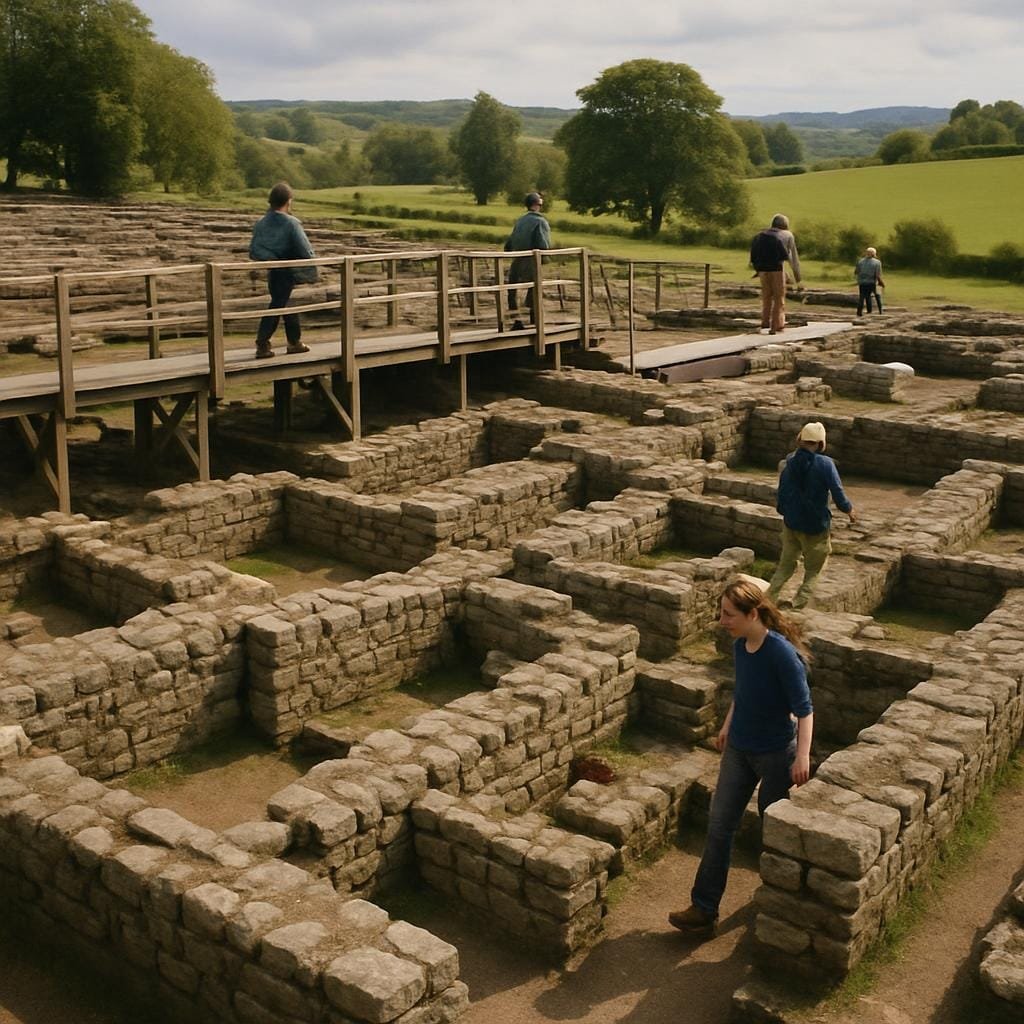
If you want to feel the civilian side of all this, Corbridge is hard to beat. Coria, as the Romans knew it, began as a supply base for campaigns further north and evolved into something that looks very like a small town. When I first walked through the site – past the remains of granaries with their raised floors and into a street lined with foundations of shops – what struck me most was the clutter. Not architectural clutter; interpretive clutter.
You’ve got the official stuff: headquarters buildings, temples, a fountain. But wrapped around that are workshops full of metal slag, evidence for glass-working, a courtyard that seems to have turned into a sort of haulage depot with cart ruts worn into the stones. One building went through at least three different uses, including a period when it looks suspiciously like someone was running an unofficial bar or lodging house out of it.
So, picture a typical day for someone in Coria around AD 200:
None of this feels like the static, defensive “line” that phrase “Hadrian’s Wall” suggests. It feels like a border town cycling through booms, busts, and bar fights.
Of course, the frontier didn’t last forever. By the early fifth century, imperial authority in Britain was fraying. The famous AD 410 letter from the emperor Honorius telling the civitates (city councils) to look to their own defence is often trotted out as the moment Rome “left”. On the northern frontier, the reality was muddier and slower.
At some forts, like Birdoswald, there’s evidence that the community adapted rather than walked away. The granaries were converted into big timber halls – less efficient for storing grain, better suited to housing people with status in a post-imperial order. Coins stop coming in, imported pottery dwindles, but life carries on. Someone kept animals in the old fort interior. Someone re-roofed parts of it with whatever materials they could scavenge. The line between “Roman” and “post-Roman” is, again, anything but clear.
For ordinary families scattered around the frontier, the slower changes must have been the ones that mattered. Losing regular pay from the army garrisons. Having to negotiate with new local power-holders instead of distant officials. Watching roads fall into disrepair until carting surplus grain further than the next valley became a guessing game about bandits and weather. A woman whose father had served as an auxiliary, who’d lived her whole life near the Wall, might have memories of childhood chalked in Latin on a tablet, and grandchildren who didn’t use Latin at all.
So why dwell on this? Why fuss about Hadrian’s Wall frontier sites, fort vici, and quarries instead of enjoying the cleaner story of a wall between civilised Rome and hostile north?
Because the cleaner story invites us to think of borders as simple. Lines that can be drawn, held, and explained in one sentence. The northern frontier of Roman Britain shows something else: borders are relationships, arguments, payrolls, love affairs, tax demands, sore feet, and occasional open conflict. They shift. They reach out feelers – like the forts at Newstead – and then retreat. They leave scars in the countryside long after the ideology that justified them has blown away.
Standing on the Wall now, with hikers pacing along the National Trail and sheep ignoring two thousand years of history under their hooves, it’s easy to fall back into postcard thinking. A ruined turret, a wide view, “the edge of empire”. But the more you read – excavation reports from Vindolanda, site summaries from English Heritage, research on the Frontiers of the Roman Empire – the less certain that edge feels.
I used to stand on the Wall and think of the people down south, in London or Rome, who ordered it built. Now I think more often about the teenager told to carry stone for yet another repair in sleet, or the weaver in a vicus who watched her customer base vanish when a fort was abandoned, or the child who outgrew those tiny frontier shoes and later told his own children that the line of old stone on the ridge was where he’d once watched eagles hunt in the updrafts.
If there’s a lesson here, it’s this: whenever you hear someone talk about a “border” or a “frontier” as if it’s a simple thing, imagine the forts, towns, and people who have to live with it. The Wall is still there; the arguments that built it haven’t really gone away.