
If you type “Alfred the Great historical sites” into a search engine, you mostly get a neat heroic tour: the wise king of Wessex, the cakes, the burnt fingers, the birth of England. The usual package. I used to accept that version without thinking too hard. Alfred was the good king on the schoolroom wall chart; Athelstan and Æthelred were for people who joined re-enactment groups. It took standing on a windy hill in Somerset, staring at a lumpy earthwork that might – or might not – be his fortress, to realise how much of Alfred’s story has been flattened into myth.
This isn’t a guide to ticking off monuments. It’s about how certain places – a marsh, a ridge, a ruined abbey gate – shift your sense of what Alfred was actually doing, and what that meant for the people who had to live through it. Because behind every chunk of Anglo-Saxon Latin about “the salvation of the English people” there’s someone just trying to keep a cow alive during a bad harvest.
My first Alfred was the textbook version: King of Wessex, late ninth century, fights the Vikings, loves books, somehow invents England. When I studied history at Leicester, he only came up as part of the big constitutional story – the slow shuffle towards a unified kingdom. We talked a lot about the Anglo-Saxon Chronicle, supposedly started at his court, and about the reforms he ordered: fortified towns, legal codes, translated religious texts. The human fallout didn’t get much of a mention.
It was only later, working in museums and then visiting some supposedly “Alfred the Great historical sites”, that the gaps began to glare. Every time a panel called him “nation-builder”, I found myself thinking: whose homes did he put walls around, and whose fields ended up inside those new defences without them being asked? And how many people got fed up of having their silver hoovered up for yet another line of burh defences?
Alfred’s most famous low point – and the bit that never made it fully into the classroom when I was at school – is 878, when the Viking leader Guthrum suddenly attacks Chippenham in winter. Alfred ends up on the run, hiding in the marshes of Athelney with a handful of followers. Cue the story of the burnt cakes, which appears first in a twelfth-century text, long after anyone involved was alive.
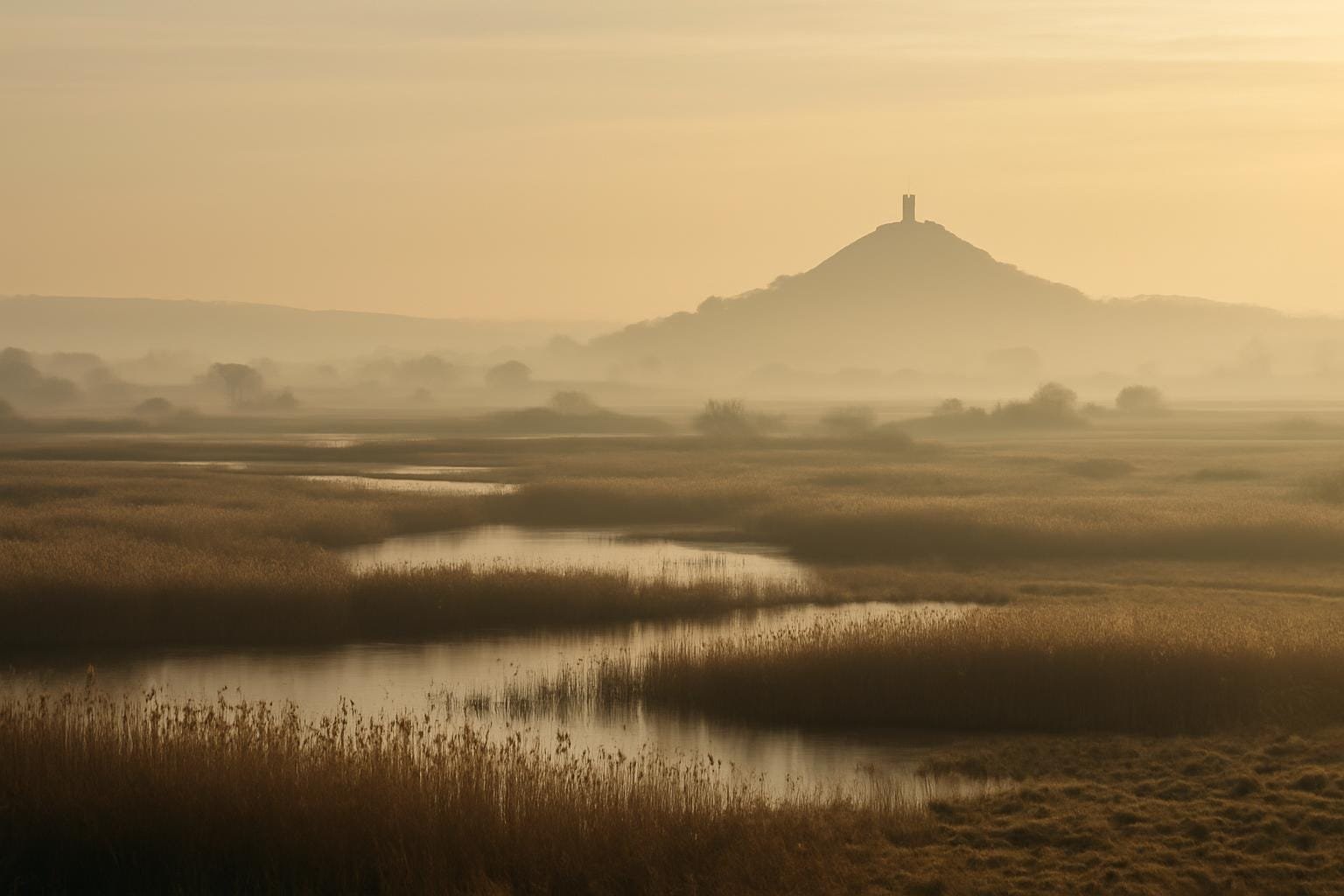
The first time I went to Athelney, I didn’t quite get it. There’s a monument (erected in 1801) in a private field, and you can’t actually reach it without permission. The spot is raised above low-lying ground, but the modern drainage makes it hard to imagine Alfred’s boggy hideout. It felt oddly remote from the drama it’s supposed to represent.
It made more sense when I started looking at what the marshes actually meant to ordinary people. This was not empty “wilderness” kindly lending itself to royal myth. The Levels were worked: people cut reed, grazed animals on higher islands, moved about on causeways and in small boats. When Alfred and his entourage turned up, they weren’t just bravely roughing it; they were landing, uninvited, in somebody’s fragile economy.
Imagine being a small farmer near Athelney that winter. You’ve already been paying food rents to an ealdorman and church dues to an abbey. Now a half-destroyed royal household turns up needing boats, food, local knowledge, and absolute secrecy. Refuse, and you risk a king’s anger if he ever gets back on his feet. Cooperate, and you risk any Vikings still patrolling the region deciding you’re part of the resistance. That’s the mess the neat statue versions leave out.
From his marsh bolt-hole, Alfred gathers forces and meets Guthrum’s army at Ethandun. Usually this gets summarised as: “Alfred wins decisive victory at Edington in 878.” That’s tidy, but when you try to attach it to actual ground, things wobble. Is it Edington in Wiltshire, near Bratton Camp and its white horse? Or somewhere else entirely?
I spent an afternoon tramping the ridgeway above modern Edington, looking down towards Bratton, trying to picture a line of shield walls grinding into each other. The historian in my head was muttering about sources: Asser’s Life of King Alfred (c. 893) calls it Ethandune, the Chronicle follows him, but place-name evidence and archaeology can’t prove a battlefield. The public history boards down the hill quietly fudge the uncertainty.
Whatever we call it, that battle wasn’t an abstract clash of cultures. Contemporary accounts describe eighth- and ninth-century armies “devouring the land like locusts” as they move – eating, stealing, trampling. If you worked one of the estates near Edington, you didn’t experience a glorious turning point; you experienced men taking your winter fodder, pulling down fences for firewood, and impressing your teenage sons to carry equipment or dig ditches.
We like to freeze Alfred on his white horse (a Victorian imagination, by the way, not a ninth-century one) and talk about the “birth of England”. For the people whose oxen were lifted that spring, it was probably remembered as the year both sides looted them.
Once the immediate crisis with Guthrum is over and the peace of Wedmore is made (again, probably at Wedmore in Somerset, although the treaty itself survives only in later copies), Alfred turns to fortification. This is where the phrase “Alfred the Great historical sites” usually comes in: the burhs.
The burh system is recorded in the Burghal Hidage, a document probably put together in the early tenth century. It lists more than thirty fortified places in Wessex and Kent, along with the number of hides each one is assessed at. Roughly 1 hide = enough land to support one household; 4 hides were needed to defend one pole of wall. So you can almost hear the sums: want a 900-yard circuit? That’s a lot of hides, and therefore a lot of tax and labour.
I’ve walked sections of the former ramparts at Taunton and Winchester, trying to keep those equations in mind. Winchester’s later medieval walls roughly follow Alfred’s fort. It’s one thing to read that “Alfred reorganised his kingdom’s defences”. It’s another to stand where someone once hauled soil day after day, under obligation, because the king said their community had to become a fortress or be left exposed.
For a smallholder in, say, late ninth-century Wareham (another burh), Alfred’s reforms meant:
In other words, defence policy altered daily routines. The burhs are often presented as Alfred’s stroke of strategic genius, but they’re also an early example of central government reaching deeper into village life.
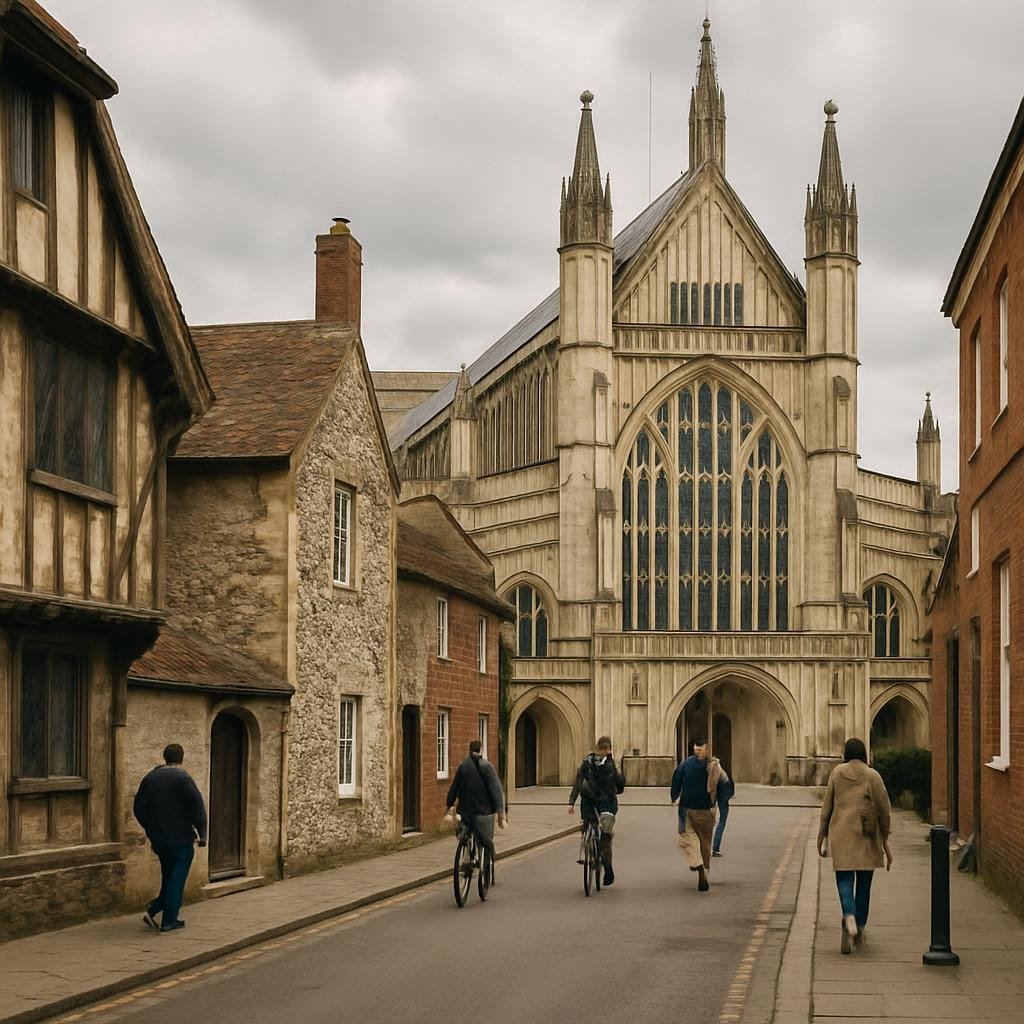
Of all the Alfred the Great historical sites, Winchester looms largest in the official story. The city was already a royal centre for the West Saxons, but under Alfred it becomes something closer to a capital. His “palace” doesn’t survive above ground, but its outline has been tentatively traced under and around the current Cathedral grounds and the City Museum.
The image we like: Alfred in a royal hall, discussing translations of Gregory the Great with scholars from Mercia and beyond. The messier reality: Winchester as a building site, with craftsmen reshaping streets for the new burh grid, earth and timber moving constantly, and the smell of pits and livestock never far away.
Alfred famously complained – in the preface to his translation of Gregory’s Pastoral Care – that there were very few men south of the Thames who could understand Latin. His answer was to bring educators to court and encourage teaching in English. That’s usually described as a visionary step, and in some ways it was. But it also meant reorganising how young nobles and clerics spent their days. Less hunting, more classroom; less oral tradition, more book-based authority.
Stand in contemporary Winchester, in the little square by the Cathedral close, and it’s easy to forget the children. Imagine being a younger son of a thegn from, say, Dorset, sent to Alfred’s court to learn. You’re lodged with strangers, picking your way through Latin grammar on cold mornings while craftsmen outside hack at timber for yet another phase of building. That’s where “educational reform” lands if you step down from the high politics.
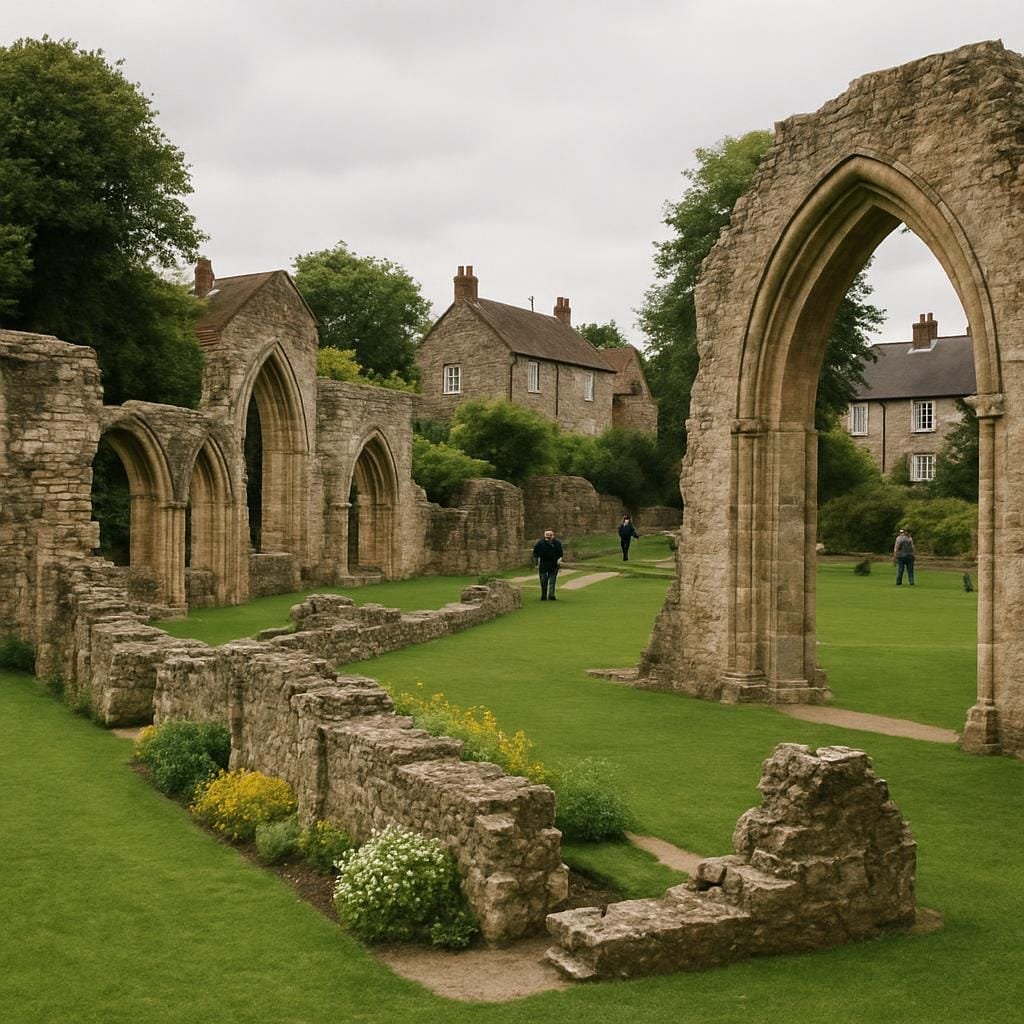
Alfred later founded a monastery at Athelney. The ruins were pretty much flattened after the Dissolution, though some earthworks and buried features remain, and a small excavation in the 1920s produced fragments of stonework and glazed tiles. When the abbey went up in the late ninth century, it turned a former emergency hideout into a permanent religious site.
This is where my annoyance with textbook Alfred really set in. Founding an abbey is seldom just piety; it’s also spin. By turning Athelney into a monastery, Alfred fixed his version of events into the landscape. Worship would now happen at the place where the king had “suffered” for his people and trusted God. There’s a memorial aspect there which later hagiographers were only too happy to work with.
Local people, though, would see something more prosaic as well:
The spiritual narrative – Alfred the humble exile thanking God – sits alongside a very earthly shift in who could demand work and food from whom. Again, the great man’s experience is threaded straight through ordinary livelihoods.
Alfred is the only English king popularly given the label “the Great”, though that title is not contemporary. It appears in the twelfth century, when writers like William of Malmesbury were polishing the royal back catalogue for a Norman audience. They had reasons to talk up figures who looked like proto-unifiers of the English.
The usual story: Alfred defends Wessex, starts the burh system, promotes literacy, sets the stage for a single English kingdom. All of which has truth in it. But the emphasis on him as benevolent founder skims over a few harder edges.
For one thing, the Viking threat does not vanish after Edington. Raids and larger armies keep coming; Alfred’s own navy experiments mostly fail. The burden of “defence” continues to fall on peasant households, who have to turn out for the fyrd (militia), repair walls, and stock royal supply centres.
Then there’s Alfred’s legal code. It begins with a heavy dose of biblical material before quoting earlier West Saxon law. The king says he has gathered, compared and improved earlier rules. Sounds very reasonable. But law codes, as any half-sleepless museum curator will tell you, record ideals and aspirations as much as actual practice. When a code sets heavy penalties for people harbouring runaway slaves, or outlines weregild (compensation) levels based on rank, it is also defining who matters most in that society.
An enslaved man on an estate in Alfred’s Wessex would have felt the “greatness” of his reforms in very constrained ways: through a lord more conscious of his legal rights, perhaps, and through expectations of participating in defence works without any choice. When we praise Alfred for tightening royal control, we are also praising a system that made it harder for some people ever to escape their position.
That’s not to say Alfred was uniquely harsh – by early medieval standards he wasn’t – but the halo tends to hide those continuities of power.
So where does all this leave the modern visitor roaming between “Alfred the Great historical sites”? For me, it’s changed how I move through them.
In Winchester, I pay more attention to the grid of streets that probably derives from Alfred’s reorganisation, and I think about carts grinding their wheels along new market routes. At Athelney, I think less about burnt cakes and more about whatever deal was done between royal refugees and marsh workers to keep that little resistance base fed.
At Edington, or wherever Ethandun actually was, I find myself watching the fields as much as the hill forts, picturing the livestock driven hurriedly away at the sight of banners on the ridge. The site stops being simply a “battlefield” and becomes a place where lots of people really hoped the armies would move on without noticing their hamlet.
History interpreted through place always runs the risk of overconfidence. We want plaques to tell us “X stood here, Y happened exactly here.” With Alfred, so much of the material is later, polished, or agenda-driven that the ground often refuses that certainty. Strangely, I’ve grown to like that. The doubts are a reminder that people like Alfred weren’t destiny; they were improvising in mud and smoke, and so were the farmhands and cooks and slaves around them.
If you go looking for Alfred, you’ll find statues (Winchester has a big one, sword raised), plaques, and the usual shop magnets. What has stayed with me more are the ditch lines, the half-visible earthworks on the edge of housing estates, the reused burh street patterns that nudge your walk a few feet left or right without you knowing why. That is where his reign still pokes through the tarmac.
And that, for me, is the real value of circling these Alfred the Great historical sites. They don’t prove the legend; they complicate it. They make it harder to talk about “the making of England” without also picturing the people who shored up the walls, grumbled about new tolls, hid their pigs in the woods when the fyrd came calling, and tried – in the middle of someone else’s grand strategy – to live an ordinary life.