
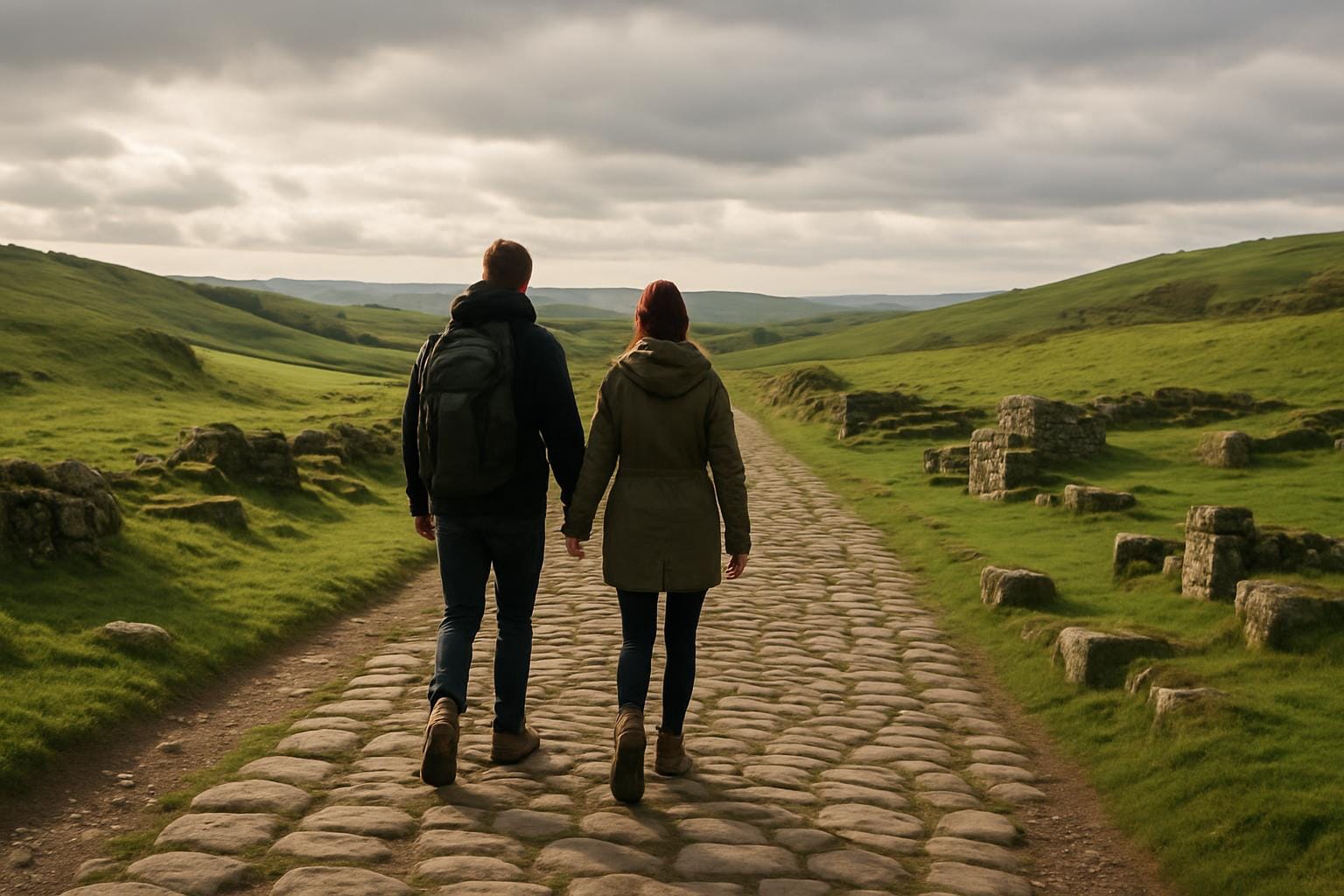
I used to think Roman Britain everyday life was all about emperors, battles and those straight roads you get stuck behind tractors on. Then I started actually visiting the places where people lived, gossiped, bathed, shopped and complained about the weather 1,800 years ago – just like we do now. It turns out the Romans weren’t that different from us. Slightly better at central heating, maybe.
This isn’t a grand historical survey. It’s how it feels to walk through the bits of Roman Britain where the ordinary stuff happened – markets, baths, workshops – with some honest talk about crowds, car parks and where to get a decent coffee without needing a senator’s salary.
Let’s start with the obvious one: the Roman Baths in Bath. I’d put it off for years, assuming it was going to be overpriced and overhyped. I was half right.
Adult tickets are around £27 if you book online, and yes, you absolutely should book ahead. They do timed entry, and if you rock up on a Saturday afternoon in August like I did the first time, you will queue down Stall Street, past the bloke playing Wonderwall on a guitar for the third time that hour.
Once you’re in, though, the sense of Roman Britain everyday life hits quite quickly. The main Great Bath is impressive, of course, with that weird green water (don’t touch it, they tell you repeatedly – which makes you want to touch it, obviously). But it was the side rooms that did it for me:
The audio guide is decent, but the real trick is to pause and just listen. You still get the echo of modern voices off the stone, and it’s not hard to picture it packed with people discussing business, flirting, sorting out deals. Roman Britain everyday life with steam.
Worth knowing before you go – Bath edition
And for something completely non-Roman afterwards, head to Society Café on Kingsmead Square. Their flat white is better than anything you’ll get from a chariot-side vending machine in the baths, if such a thing had existed.
If Bath is Roman life with a bit of Georgian polish, Vindolanda by Hadrian’s Wall is where you get the raw, muddy version. It’s a Roman fort, yes, but also a small town that wrapped around it, full of workshops, homes and all the things archaeologists get excited about and my dad calls “old bricks”.
I arrived on a drizzly Northumberland morning (standard) and parked in the main car park – £3 for the day last time I went, paid at the machine by card or coins. The walk down to the site takes you past a slightly earnest sign asking you to watch out for excavation areas and archaeologists with trowels. The archaeologists mostly look cold and slightly muddy, by the way. Very British.
Vindolanda is all about Roman Britain everyday life in the details:
On the actual site, you can walk through the remains of the vicus – the civilian settlement. It’s a jumble of low walls, drainage channels and stone workshops. One room still has a flagged floor with a central drain, likely a workshop or tavern; try not to slip if it’s been raining, because those stones are lethal when wet. I speak from sliding, flailing experience.
My favourite corner? A small reconstructed street with a shop front and a two-storey timber building. It feels slightly like you’ve wandered onto a film set, but it helps you picture how cramped and busy it would have been. You can even smell the wood – a change from the usual museum polish and school-trip crisps.
Worth knowing before you go – Vindolanda edition
They do decent coffee and cake in the café – the lemon drizzle is suspiciously good for a museum café. I’m not saying the Romans would have approved, but they’d have given it a go.
Over the border in South Wales, the remains at Caerleon are some of the best for seeing how a Roman legion lived day-to-day – and what that did to the surrounding town. This was Isca, base of the Second Augustan Legion, and 5,000 soldiers have a certain impact on local nightlife.
The main bits are walkable from each other, which is good because parking can be a bit of a puzzle. I ended up slipping my car into a tight spot on Museum Street, opposite a bright blue house with an overenthusiastic hydrangea trying to escape its front garden. There’s also a small car park by the amphitheatre, but it fills quickly on sunny days.
Three places here really bring Roman Britain everyday life into focus:
Free to enter and looked after by Cadw, the amphitheatre is a huge grassy oval with stone seating remains. Standing in the middle, you can see the banks rising around you and imagine 6,000 people watching training exercises or, more grimly, animal fights. Sheep now graze around the site, which is an improvement in terms of audience behaviour.
Look for the small information board near the eastern entrance, where it points out the original main gate that the soldiers would have marched through from the fortress. It lines up perfectly if you stand facing the legionary barracks ruins across the field.
Across that field – mind the dog mess, it’s apparently a favoured route for local labradors – you’ll find the outlines of the legionary barracks. These are basically the shared rooms where soldiers slept, cooked, gossiped and complained about their officers.
You can walk down the central street, with low walls marking each contubernium (the eight-man rooms). At one end, there’s a slightly larger room thought to be for the centurion, with a small stone threshold still visible. It’s not luxurious, but it’s definitely “managerial.” Some things never change.
The National Roman Legion Museum is free (donations encouraged) and has a reconstructed barrack room that smells faintly of wood and old canvas, plus actual legionary armour you can try on. It weighs more than the average teenager’s revision guilt.
Round the corner are the remains of the Roman baths complex. There’s an £8-ish ticket for adults to see the baths, but it’s worth it. You walk along an elevated walkway over the old swimming pool, with atmospheric lighting and sound effects. One corner still has the stepped seating where people sat around the pool, which makes it feel more like a Roman leisure centre than a temple of culture.
Worth knowing before you go – Caerleon edition
For said coffee, The Stable café on High Street does decent cappuccinos and a good line in paninis. You can see part of the old fortress wall from the road outside if you look up the lane towards the church.
Fishbourne, near Chichester, is on a different scale. Fishbourne Roman Palace is thought to be the largest Roman residence north of the Alps. Which sounds grand, but it’s the domestic stuff that lingers in your head.
Tickets are roughly £14 for adults. The approach alone is slightly surreal – you walk past an unassuming modern housing estate, down a road with a red “20 is plenty” sign, and suddenly you’re at a palace. The car park is free but fairly tight; I nearly reversed into a hedge the first time because I got distracted by a sign about a “Roman underfloor heating demonstration.”
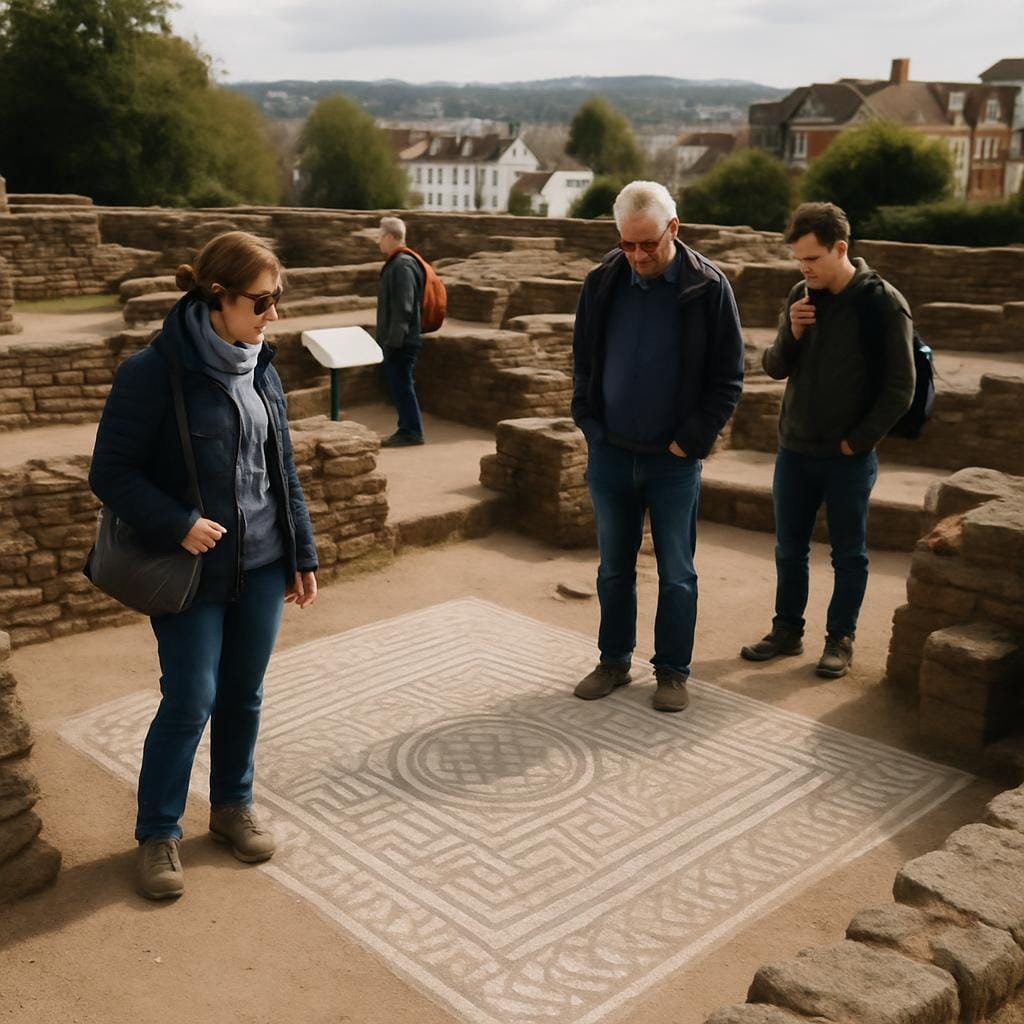
Inside, you tread along raised walkways over a huge patchwork of mosaics. Two details stood out for me:
Outside, don’t skip the reconstructed Roman garden. It’s laid out with box hedges in geometric patterns and a central water channel. Stand near the small wooden pavilion and look back at the palace building and you’ll see how the whole garden is centred on that view – very Instagram before Instagram existed. In summer, you get herbs and lavender scents; in winter, it’s mostly the smell of damp soil and your own cold hands.
Worth knowing before you go – Fishbourne edition
The café does very acceptable tea and a sausage roll that I’m fairly sure could qualify as a building material in its own right. Sit by the window and you can watch kids trying on Roman helmets in the education room, heads lolling forward under the weight.
Finally, Verulamium, just outside St Albans. A Roman city turned park and museum, it’s one of the best places to stroll through Roman Britain everyday life without feeling like you’re in a theme park.
The Verulamium Museum costs around £7 for adults. It sits at the edge of Verulamium Park, which is full of dog walkers, picnics and, in summer, the smell of someone inevitably burning sausages on a disposable barbecue near the lake.
Inside the museum:
Outside, walk across the park towards the Roman city walls. A long section survives near the London Gate, thick and layered with flint and stone. Up close, you can see patches of red tile courses running through the wall like stripes – Roman structural bling.
Near the sports pitches you’ll see a fenced-off area that marks a Roman townhouse. On certain weekends they open it up and you can go down into a protective building to see an in-situ mosaic and hypocaust. Check the small hand-written sign on the gate for opening times; it’s easy to miss if you’re distracted by an overexcited spaniel.
Worth knowing before you go – Verulamium edition
For a break, wander back up the hill into town and stop at George’s on Catherine Street for a bacon sandwich that could probably feed a centuria. Sit at the window counter; from there you see the line of people heading down towards the park, coffees in hand, completely unaware they’re walking the edge of an ancient city.
After traipsing through baths, barracks, palaces and parks, Roman Britain everyday life feels less like a distant chapter in a textbook and more like something you can almost reach out and touch – if you ignore the “do not touch the mosaics” signs, which you shouldn’t. The threads are familiar:
Roman Britain everyday life doesn’t sit behind glass; it leaks into the present in odd ways. A garden layout, a shoe size, a broken cup. Walking these sites, you’re following routes ordinary people took to work, to bathe, to see a show, to complain about their neighbours. The emperors can keep their statues; I’ll take the muddy shoes and the lost spoons.
If you go, don’t rush. Leave space between the big-ticket sights to loiter by a threshold, stare at a drain, or stand in the middle of an amphitheatre and listen to the wind. It’s in those quiet, slightly awkward pauses that Roman Britain everyday life feels closest, like someone’s just stepped out of the room and might come back in any second complaining about the price of olive oil.
Or, given it’s Britain, the rain.