I first cared about Sex Pistols because of a bus stop in Wallsend, not some grand moment in rock history. I was about fourteen, it was lashing it down, and a lad from school had a battered tape of Never Mind the Bollocks. He’d taped it off his uncle’s vinyl, so it sounded like it’d been recorded in a cupboard through a sock. He fast-forwarded to Holidays in the Sun and those first stomping chords made the bus shelter feel like a different building. I didn’t know anything about the arguments, or the safety pins, or the Sex Pistols London punk locations that fans bang on about now. I just heard a band that sounded like they were kicking a wall in.
Only later, when I started going down to London for gigs and cheap hostels in my early twenties, did I get curious about the physical spaces behind that racket. Not because I wanted to tick things off a tourist list, but because I’d grown up in a city where streets and pubs stamped themselves all over the music – Shields Road in Byker is basically an uncredited character on half the records that came out of the North East in the 90s. Once you start thinking like that, it’s hard not to hear London’s geography in those 1977 Sex Pistols tracks: cramped rooms, hateful commutes, too many stairs and barely any money.
Let’s start with the obvious one: 430 King’s Road, the shop Malcolm McLaren and Vivienne Westwood kept rebranding – Let It Rock, SEX, Seditionaries. You can argue endlessly about how much of the Pistols’ story is McLaren’s marketing and how much is the band. Personally, I think McLaren gets far too much credit compared to what was actually happening in rehearsal rooms and grotty flats. He had the eye and the slogans, sure, but you don’t get the seething chorus of Pretty Vacant out of a window display.
Still, that shop matters because it was a pressure cooker. Clothes rails, ideas, bored kids with nowhere else to go. By all accounts it smelt of rubber and cigarettes, and you had to walk past all this confrontational fetish gear just to get to the back. That’s not a neutral bit of interior design; it puts you on edge before a note’s even played. Imagine being a teenager from some outer London estate walking into that in 1975, then getting told you’re in the band now because you look interesting enough. That strip of King’s Road shaped the Sex Pistols’ attitude long before they set foot in a proper studio – you can hear the shop-front sneer in Lydon’s voice on those early Anarchy in the UK takes.
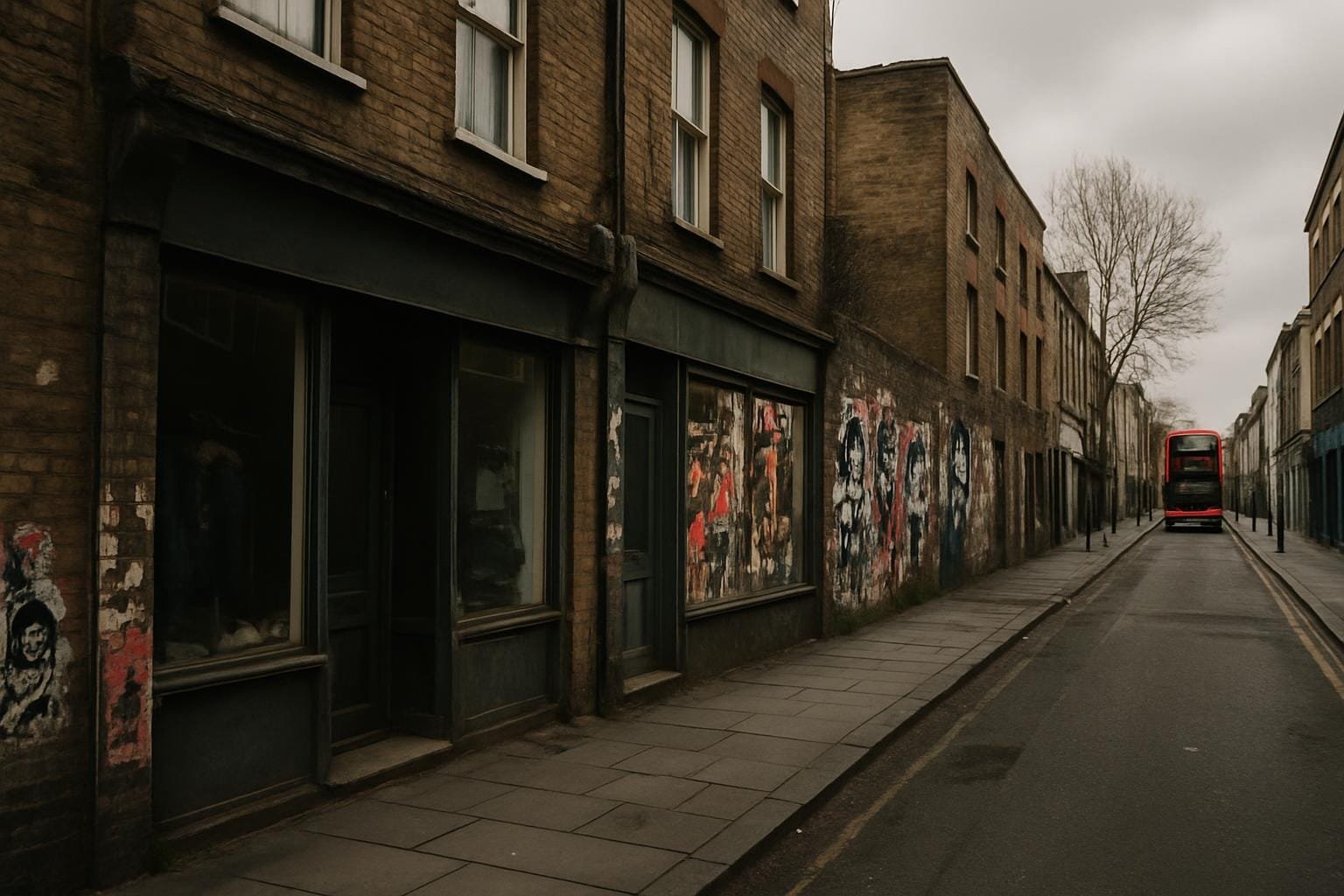
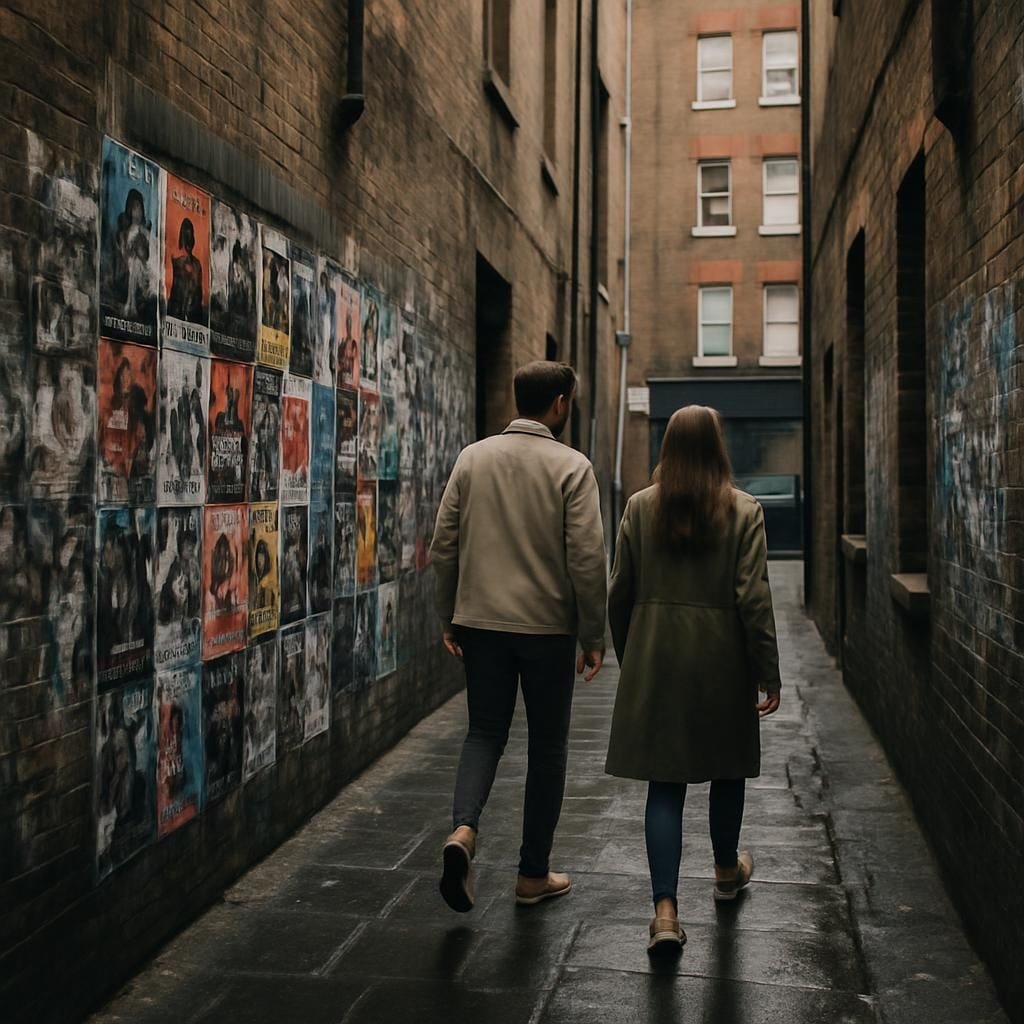
But Malcolm’s glossy London – or grubby-glossy, at least – wasn’t the full picture. The bit that interests me these days is the dull side streets and bus routes that led there. The Pistols’ London wasn’t all King’s Road peacocking; it was pub back rooms, converted cinemas, rehearsal spaces above shops. Those are the Sex Pistols London punk locations that actually explain the sound: too hot, bad acoustics, flat lager, a room that makes feedback howl in a certain way.
The first time I went down Denmark Street, I was half expecting it to feel like sacred ground. All I got was a headache from blokes playing metal riffs too loud in tiny guitar shops. Somewhere above those fronts, though, is where the Pistols rehearsed and recorded early demos with Dave Goodman around 1976 – rooms full of cigarette smoke, wires everywhere, gear held together with chewing gum and hope.
Denmark Street matters for a very mundane reason: distance. It’s a short walk from Soho, but it’s a certain walk – past porn shops, pubs that looked old even then, people hanging round because they had nothing better to do. That slog gets into your head. By the time you’re crammed into an upstairs room trying to bash through No Feelings, you’re already half wired just from getting there. Lydon’s bark on those early recordings sounds like someone who’s had a hateful commute through central London and now wants to start a fight with the wall.
My own Denmark Street moment came a lot later, mid-2000s, ducking into a rehearsal space above a shop with a friend’s band. The carpet was sticky, the bog barely worked, and the windows looked out over bins. When I finally heard those early Pistols demos properly years later (on some shoddy compilation I bought for a fiver in a second-hand shop in Leeds), the room in my head looked exactly like that. Half the Sex Pistols London punk locations you read about are glamourised in hindsight. In reality they’re tiny, airless rooms where the walls shake when a bus goes past.
1977 is always sold as Year Zero for punk in Britain, which is a nice slogan but rubbish history. What I will say is this: there is something oddly specific about the way the Pistols captured London in that one year on Never Mind the Bollocks. You can point to God Save the Queen getting to number two in June 1977 (or number one, depending on how angry you are about the chart rumours), but it’s the smaller details that really pin it down for me.
Listen to Bodies. Underneath the shock and the swearing, there’s a rhythm that sounds like feet running down concrete stairwells. That song has the pace of someone legging it for the Tube at closing time. It’s ugly on purpose. The London of 1977 was full of that ugliness – bin strikes, unemployment, National Front marches. You can absolutely say The Clash wrote the more nuanced city stories – and I’d agree; London’s Burning and Career Opportunities do more with everyday detail than anything the Pistols managed – but the Pistols caught the feeling of walking round a city that doesn’t like you.
Here’s the arguable bit: I think Never Mind the Bollocks is a better London album than it is a punk album. As a punk record, it’s actually cleaner and more controlled than its reputation suggests – Chris Thomas and Bill Price produced it at Wessex Studios with a pretty disciplined hand, especially on Pretty Vacant. But as a civic record, as a sort of horrible love letter to a city, it works beautifully. That relentless churn of EMI, the queasy lurch of New York, the stomp of Anarchy in the UK – they’re all different flavours of trying to survive in a place that keeps grinding you down.
If you’ve ever trudged from Finsbury Park to central London because the night bus gave up, you know that feeling already. That’s what I hear on the album now in my thirties, which isn’t what I heard at fourteen huddled at that bus stop. Back then it was just “loud and rude”. Now it sounds like overcrowded pavements and wet denim.
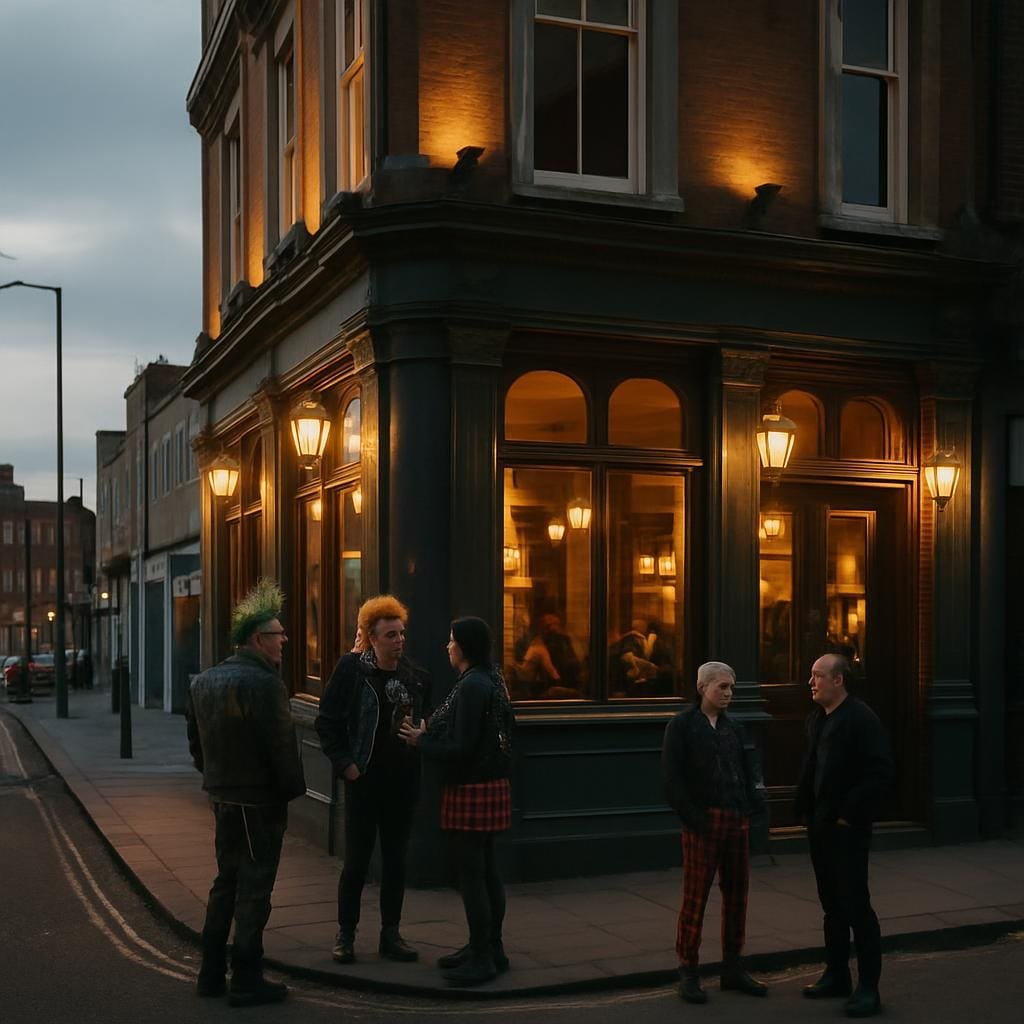
None of the famous Sex Pistols London punk locations were trying to be historical at the time. The 100 Club on Oxford Street – where they played that punk festival in September 1976 – was just another difficult room with a low ceiling and, from what older mates have told me, suspicious-smelling toilets. I never saw the Pistols there, obviously, but I did catch some garage bands in the late 2000s and it still felt slightly hostile in the best way, like the room was daring you to be good enough.
The Nashville Rooms in West Kensington, where they thrashed through sets in 1976, was basically a pub that tolerated noise. Same goes for places like the Marquee, the Screen on the Green in Islington (where they played with The Clash in August 1976), the Notre Dame Hall just off Leicester Square in early 1977. These were functioning venues trying to sell beer, not curate history. The fact that people now make lists of Sex Pistols London punk locations and go hunting for the buildings is slightly funny when you remember most punters at the time were just trying to see over someone’s head.
I’ve stood outside a few of those addresses over the years on the way to other things – usually food, if I’m honest. The old Screen on the Green is opposite a decent run of places flogging kebabs and late-night chips, which feels about right. Punk always went better with cheap food than with heritage plaques. Ask anyone who staggered out of a show at the Vortex in Soho with ringing ears and ended up in some all-night café trying to stop the room spinning.
This is where my two obsessions meet. When I started going to London more regularly – probably from about 2008 onwards, scraping together Megabus money and staying in grotty hostels near King’s Cross – I realised how much those old punk haunts are now surrounded by food scenes that have nothing and everything to do with 1977.
Take Soho. You wander down Wardour Street now thinking about where to get decent noodles, but in the late 70s you’d be catching whiffs of the Marquee Club and a dozen other gig rooms packed tight. I like imagining some kid in 1977 grabbing a late plate of something in Chinatown after a show, sticky tables and all, half-deaf and high on adrenaline. That mix of cheap late-night food and live music is how subcultures actually survive. Not the myth, not the safety pin earrings, but the plate of something warm you eat on your way back to the Tube.
Up in Camden, where the Pistols rehearsed now and then and where Sid Vicious hovered round before he replaced Glen Matlock in early 1977, you’ve now got vintage stalls and street food queues. Bit of a cliché to moan that Camden’s “not what it was”, but here’s my slightly grumpy opinion: if your idea of punk tourism is buying a pre-ripped jacket and some overpriced halloumi fries, you’re missing the point. The interesting bit is still the small, slightly shabby places feeding people who work odd hours – the bakeries opening at 5am, the hole-in-the-wall caffs where session players and sound engineers actually eat.
Whenever I pass through Camden on the way to a gig nowadays, I’m far more excited by finding a decent fry-up than by seeing another mural of Sid. The music mattered; the hunger kept it going.
My relationship with the Pistols has changed more than with almost any other band I liked as a teenager. In my late teens, they were this untouchable sacred cow of British punk – the poster, the T-shirt, the famous Bill Grundy TV chaos on Thames Television in December 1976, replayed endlessly on clip shows. By my mid-twenties, I’d swung the other way and decided they were hugely overrated compared to, say, Wire or The Damned. I remember getting into an argument in a pub in Leeds about how Pink Flag (released the same year) is a smarter, tighter record than Never Mind the Bollocks. I still stand by that, by the way.
But when I listen now, in my mid-thirties, with more gigs and more cheap rehearsal rooms under my belt, I hear the city more than the pose. I hear Steve Jones’ dense, overdubbed guitars on Problems as an attempt to bulldoze through boredom. I hear Paul Cook’s drumming on Holidays in the Sun as the sound of endless, identical days. These are the sounds of people boxed in by their environment and trying to punch their way out through volume.
The other arguable position I’ll throw in: Glen Matlock is the most underrated person in the whole Pistols story. He co-wrote most of the big songs, he actually cared about chords, and he gave them the slightly pop sensibility that makes Pretty Vacant lodge in your head on the walk back from the bus stop. Sid Vicious may be all over the T-shirts, but Matlock’s the reason you can still hum the tunes. That’s the problem with turning city music into heritage: the photogenic bits win.
Walk round central London today with 1977 Sex Pistols in your headphones and the city doesn’t line up literally. Of course it doesn’t. You’ve got Pret sandwiches where there used to be Wimpy, and half the scruffy pubs have become places selling small plates. But if you pay attention – and avoid the temptation to treat every address mentioned in Sex Pistols London punk locations lists like a shrine – you can still sense the grit.
It’s in the way sound echoes off narrow streets around Soho when a band’s loading in. It’s in the pinball of voices round Camden on a Sunday when five different venues are emptying at once. It’s in the slightly rushed conversation you catch between two teenagers on the Tube platform about starting a band even though they don’t really know how to tune a guitar yet.
Back at that bus stop in Wallsend, I didn’t know any of this. I didn’t know what Denmark Street was, or why the 100 Club mattered, or that there was once a flat in Hampstead (the infamous place on Maida Vale and another on Pindock Mews) where most of the Pistols seemed to pass through in 1977, leaving a trail of arguments. I just knew something in that tape felt like an escape route.
London in those songs is loud, hostile, sometimes stupid, frequently unpleasant – but never dull. And that, for all the myth-making and tourist maps and merch stands, is the thing worth hanging on to. The best music about cities doesn’t try to make them look good; it makes them feel alive, mess and all.
So if you ever find yourself near one of those vaunted Sex Pistols London punk locations, don’t bother recreating the old photos. Go find the nearest place that’ll feed you for under a tenner, listen to the background noise, and put Holidays in the Sun on. The city’s in there somewhere, still stomping down the pavement, still late for something.